
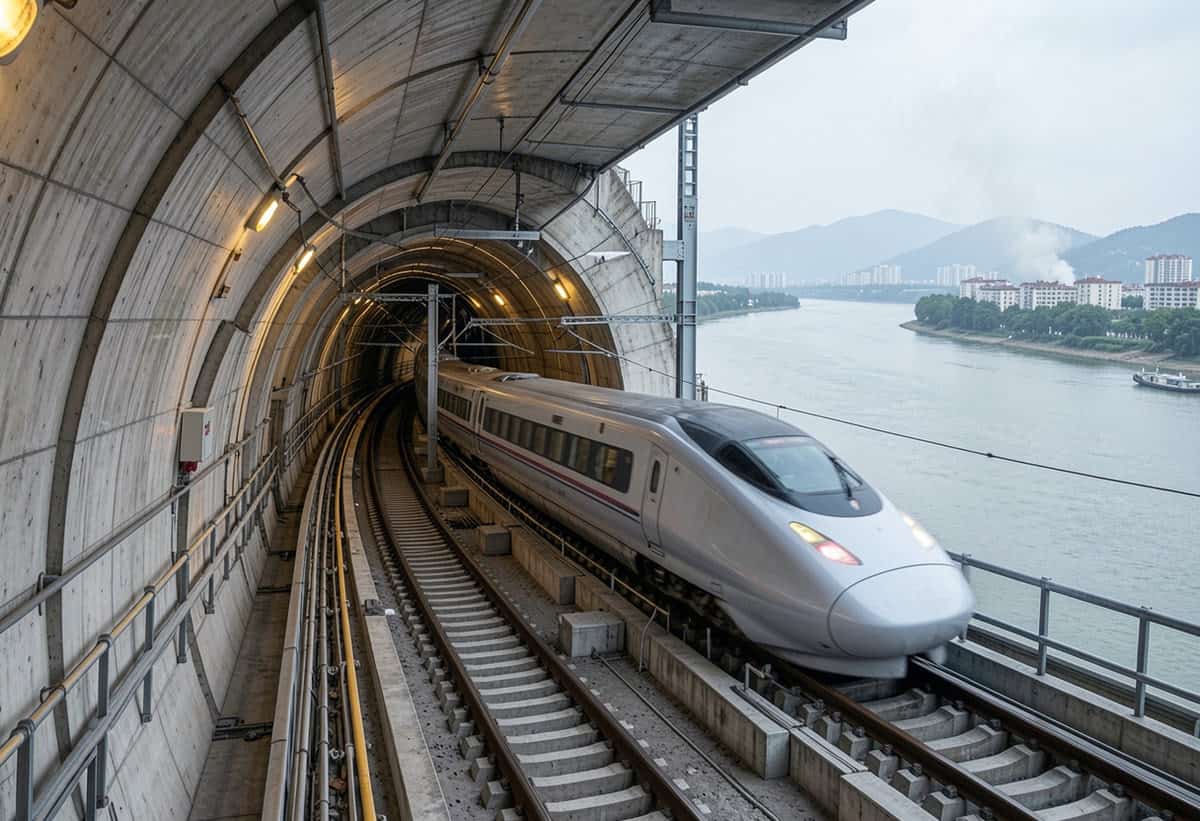
Image generated with Ai
China has completed its first high-speed railway tunnel beneath the Yangtze River, boosting inland and coastal connectivity by creating a critical link on the future Chongqing–Xiamen high-speed railway. The 11.9-kilometre engineering achievement overcomes complex geological and urban construction challenges while advancing one of the country’s key national rail corridors, bringing faster travel, stronger regional integration and improved transport connections between southwestern China and the southeastern coast a step closer.
The newly completed Caiyuanba Yangtze River Railway Tunnel extends 11.9 kilometres beneath one of the world’s busiest waterways. Located in Chongqing, the tunnel links two districts within the sprawling municipality and forms a vital section of the future Chongqing–Xiamen high-speed railway. Once the full route becomes operational, it will improve transportation between the major southwestern city of Chongqing and the coastal city of Xiamen in Fujian Province, reducing travel times and enhancing mobility for millions of passengers.
Advertisement
Constructing a high-speed railway tunnel beneath the Yangtze River presented a series of complex engineering challenges. The route passes underneath rugged mountains, densely populated residential neighbourhoods, urban infrastructure and sections of the riverbed, requiring precise planning and advanced construction methods. Engineers had to ensure the tunnel could be safely built while maintaining stability under varying geological conditions and protecting nearby communities and existing infrastructure.
To complete the project, construction teams relied on a specially designed tunnel boring machine created specifically for the demanding conditions beneath the Yangtze River. The customised equipment was engineered to withstand extremely high water pressure while excavating through alternating layers of hard and soft rock deep below the riverbed. Its advanced technology enabled crews to maintain continuous excavation while ensuring structural accuracy, operational safety and construction efficiency throughout the project.
Advertisement
Advertisement
The successful completion of the Caiyuanba Tunnel represents one of the most technically demanding achievements along the Chongqing–Xiamen high-speed railway. Although several sections of the railway are already operational, the completion of this critical crossing brings the full corridor another step closer to becoming a continuous high-speed route connecting western and southeastern China.
The Chongqing–Xiamen railway is one of the country’s 16 strategic high-speed rail corridors included in China’s long-term national transportation development plan. These corridors form the foundation of the country’s “eight vertical and eight horizontal” high-speed railway network, an ambitious programme designed to improve connectivity between major economic centres through eight north-south routes and eight east-west corridors.
Once fully completed, the nationwide network will connect major cities and regions across China, stretching from Gansu Province in the northwest to Hong Kong and Shenzhen along the southern coast, while also extending northeast to Harbin. The system is designed to strengthen national transportation links, support economic growth and improve travel efficiency between key metropolitan areas.
Construction of the broader high-speed rail framework has continued to progress steadily. By March this year, approximately 84 percent of the planned national high-speed railway grid had already been completed, demonstrating the rapid pace of infrastructure development across the country. New railway sections continue to enter service while work advances on remaining links needed to complete the national network.
China also plans to further expand its railway capacity during the coming years. Future development efforts will focus on increasing the overall capacity of the rail system, strengthening transportation links between major economic regions and improving commuter services across densely populated urban clusters. These investments are expected to support growing passenger demand while enhancing national logistics and regional integration.
The country’s high-speed rail network has already become the largest in the world. By the end of last year, operational high-speed railway lines exceeded 50,000 kilometres. National infrastructure plans call for expanding the network to approximately 60,000 kilometres within the next five years, extending high-speed rail access to additional cities while improving transportation efficiency across the country.
The rapid expansion of China’s railway system has also driven a new generation of technically advanced underwater tunnel projects. Engineers are increasingly constructing long railway tunnels beneath rivers, estuaries and coastal waterways to overcome geographical barriers while creating more direct transport corridors.
Among the major projects currently under construction is a railway crossing connecting Shanghai’s Chongming Island with Taicang in Jiangsu Province. The crossing is expected to become another important component of China’s expanding high-speed rail system and is scheduled for completion in the near future.
Meanwhile, construction continues in Guangdong Province on what is expected to become the world’s deepest underwater high-speed railway tunnel. Part of the Shenzhen–Jiangmen high-speed railway, the tunnel will reach depths of approximately 116 metres beneath the Pearl River Estuary, highlighting China’s continued investment in advanced railway engineering and large-scale infrastructure innovation.
With the completion of the Caiyuanba Yangtze River Railway Tunnel, China has reached another significant milestone in its nationwide rail modernisation programme. The achievement not only demonstrates advances in underground construction technology but also brings the Chongqing–Xiamen high-speed railway closer to full operation, reinforcing the country’s long-term strategy of building a faster, more efficient and better-connected national transportation network.
Advertisement
Advertisement
Advertisement













Saturday, September 5, 2026

Saturday, September 5, 2026

Saturday, September 5, 2026

Saturday, September 5, 2026

Saturday, September 5, 2026

Thursday, September 3, 2026

Saturday, September 5, 2026

Saturday, September 5, 2026



