
Australia’s Sydney Cruise Gateway Powers Vanuatu’s Port Vila Recovery as Fare-Inclusive Lelepa Sailings Prepare to Reshape Visitor Spending, but Will Local Operators, Farmers and Outer Islands Secure a Fairer Share?

Updated
Published
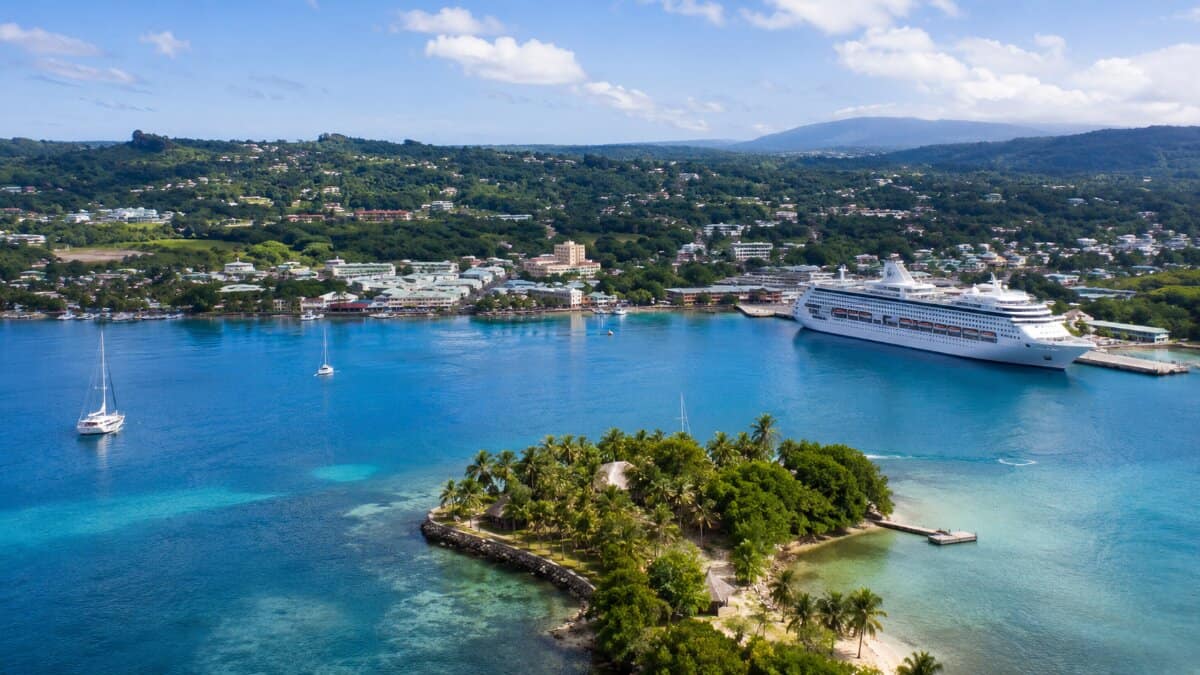
Vanuatu’s tourism recovery is being powered predominantly by cruise passengers, with close to 100,000 international visitors recorded during the first quarter of 2026 and approximately 78 per cent arriving by sea. Yet current public statistics do not show how much expenditure remains in Port Vila, Luganville, Mystery Island or farming communities. That omission is becoming more significant before Royal Beach Club Lelepa opens in October 2027 on Australia-origin itineraries with admission, transport, dining and core facilities included in cruise fares.
Vanuatu’s cruise recovery is growing faster than its local-spend evidence
Vanuatu recorded 45,679 international visitor arrivals in January 2026, with 79 per cent entering by sea. February brought another 18,761 visitors, of whom 13,697, or 73 per cent, were sea arrivals. March generated 35,529 visitors, including 28,402 cruise and other sea arrivals representing 80 per cent of the monthly total.
Advertisement
Advertisement
Combined, the three releases show 99,969 international arrivals during the first quarter. Applying the published monthly mode-of-arrival proportions indicates that approximately 78 per cent were sea visitors.
| 2026 period | Total international arrivals | Air share | Sea share | Commercial interpretation |
|---|---|---|---|---|
| January | 45,679 | 21% | 79% | Cruise traffic dominated the opening month |
| February | 18,761 | 27% | 73% | Sea visitors remained the majority despite a lower total |
| March | 35,529 | 20% | 80% | Four out of five arrivals came by sea |
| First quarter | 99,969 | About 22% | About 78% | Approximately 78,100 visitors were generated through sea traffic |
The first-quarter mode split is an editorial calculation using the published monthly totals and proportions. Rounded percentages can produce minor differences from subsequently revised statistical series.
Advertisement
Advertisement
This is a powerful volume recovery. It is not automatically an equally strong revenue recovery. Cruise passengers are generally counted as international visitors even though they do not purchase overnight accommodation, may eat onboard or at included facilities, and usually have only several hours to spend ashore.
The data-timeliness issue compounds the uncertainty. As of 29 July, the Vanuatu Bureau of Statistics indicated that its April, May and June 2026 international visitor arrival infographics were still due to be published. March therefore remained the latest detailed monthly release publicly located during this research.
Advertisement
Advertisement
The new issue is not visitor volume but economic retention
The decisive question for Vanuatu’s cruise economy is no longer simply how many passengers disembark. It is how much value remains after cruise-company commissions, externally controlled bookings, imported supplies, transport costs and expenditure at operator-managed facilities are accounted for.
Current public visitor releases report arrivals, travel purpose, mode of entry and source markets. They do not disclose five measurements that are central to assessing sustainable tourism:
| Missing measurement | Why it matters |
|---|---|
| Passenger expenditure by port | Reveals whether Port Vila continues capturing most visitor spending |
| Payments to Ni-Vanuatu-owned operators | Separates local enterprise income from expenditure retained by overseas intermediaries |
| Agricultural procurement | Measures whether farmers benefit from cruise-linked food and beverage demand |
| Community and customary-owner fees | Shows how much cruise activity finances local services and development |
| Retained value after imports and commissions | Provides a more realistic economic contribution than gross passenger expenditure |
This creates a statistical mismatch. Vanuatu can report a visible cruise recovery, but it cannot yet demonstrate through current published data whether the recovery is geographically broad, locally owned or strongly connected to domestic supply chains.
Historical evidence shows why Port Vila remains the critical benchmark
The most comprehensive publicly available cruise-expenditure assessment was undertaken by the World Bank Group, Australia’s Department of Foreign Affairs and Trade and Carnival Australia using 2013 activity.
That study calculated AUD 34.6 million in direct spending by cruise companies, passengers and crew. It also estimated AUD 18.6 million in secondary economic activity. However, the benefits were heavily concentrated in Port Vila.
| Port or destination | Passenger spending per visit in 2013 | Direct economic impact per passenger call | Historical distribution finding |
|---|---|---|---|
| Port Vila | AUD 96 | AUD 117 | Captured 85% of passenger expenditure and 80% of direct cruise expenditure |
| Luganville | AUD 45 | AUD 64 | Generated stronger local value than smaller anchorages but remained well behind Port Vila |
| Mystery Island | AUD 11 | AUD 21 | Lower commercial spending, although community landing fees created a direct local mechanism |
These figures are historical benchmarks rather than estimates of present-day spending. They have not been adjusted for inflation and must not be represented as 2026 results. Their continued relevance lies in the structural pattern they exposed. Port Vila possessed more excursions, shops, transport services and commercial capacity, enabling it to convert each ship call into substantially greater expenditure.
Advertisement
Advertisement
Tours represented 36 per cent of passenger spending in Port Vila and 45 per cent in Luganville. Ni-Vanuatu businesses also benefited from protected land-transport activity. Mystery Island followed a different model because landing fees were directed to a community committee and allocated towards community projects.
The historical assessment also identified a supply-chain limitation that remains crucial to the present investigation. Much cruise-company procurement was centrally managed and moved through international home ports. Vanuatu supplied selected products, including bottled water, coffee and fresh water, but the report considered it likely that much of the in-country benefit still returned to Port Vila, where major service businesses were concentrated.
Royal Beach Club Lelepa changes the cruise value chain
The opening of Royal Beach Club Lelepa in October 2027 will introduce Royal Caribbean’s first exclusive South Pacific cruise destination. Sailings are already being marketed from Sydney and Brisbane, initially involving Anthem of the Seas and Voyager of the Seas.
The model differs from a conventional open-port visit. Admission, tender transportation, two beaches, loungers, umbrellas, towels, games, a nature trail and two dining venues are included in the cruise fare. Unlimited island dining is also incorporated into the core product. Daybeds, equipment rentals and selected activities can generate additional transactions.
| Cruise-value component | Port Vila or Luganville call | Royal Beach Club Lelepa call |
|---|---|---|
| Destination access | Passenger enters a public urban economy | Admission and tender transfer included in fare |
| Food expenditure | Restaurants and vendors compete for discretionary spending | Core island dining included |
| Excursions | Independent and cruise-contracted operators can participate | Destination activity is more centrally organised |
| Retail opportunity | Shops, markets and mobile vendors across the port economy | Designated market and controlled retail environment |
| Traveller budgeting | Greater need for cash, cards and advance tour decisions | Higher upfront certainty and fewer essential purchases |
| Local-value visibility | Fragmented but potentially observable through business surveys | Requires operator-level procurement and benefit-sharing data |
The included model can improve traveller value. Families receive greater cost certainty. Passengers can access a complete beach day without purchasing a separate excursion. Tender transport, food, shade and basic activities are packaged into one product.
The same structure can make local economic effects harder to identify. When meals, access and facilities have already been purchased within the cruise fare, less spontaneous spending may occur among independent restaurants, taxi operators and excursion businesses. This is a reason for measurement, not evidence that Lelepa will necessarily reduce local benefits.
Advertisement
Advertisement
Royal Caribbean’s published itineraries also demonstrate that Lelepa can complement rather than replace established ports. One eight-night Brisbane itinerary combines Luganville, Port Vila and Lelepa, while Sydney itineraries can package Mystery Island and Lelepa within the same South Pacific voyage.
What does the new cruise model mean for travellers?
For passengers, the strongest proposition is predictability. A fare-inclusive Lelepa visit reduces uncertainty about beach access, meals, tender transport and essential facilities. It may be particularly attractive to families, first-time cruisers and travellers who prefer to control holiday expenses before departure.
However, travellers seeking direct engagement with locally owned enterprises will need to examine the whole itinerary rather than the Lelepa day alone. Port Vila offers urban markets, taxis, independent excursions and established tourism businesses. Luganville provides access to Santo-based attractions, cultural experiences, diving services and provincial operators. Mystery Island and Aneityum offer smaller community-scale transactions and local visitor services.
Travel advisers should therefore distinguish between two different customer promises: an included private-destination experience and a broader Vanuatu community-engagement itinerary. They can coexist, but they should not be marketed as economically or experientially identical.
Agricultural suppliers remain the least visible part of cruise recovery
Vanuatu’s sustainable-tourism framework has long identified agriculture, rural agritourism, import replacement and stronger domestic value chains as essential to spreading tourism benefits beyond major centres. Government tourism material describes a policy objective of distributing tourism returns more fairly among rural communities.
An official 2015 baseline study found that Port Vila’s hotel and restaurant sector spent approximately VUV 1.5 billion on fresh-produce procurement in 2014. That figure covered the wider hospitality economy and was not a measurement of cruise purchasing. It nevertheless demonstrated the scale of potential demand available when local production can meet volume, quality, pricing and consistency requirements.
Advertisement
Advertisement
No current official public dataset located for this investigation specifies how much produce, seafood, meat, fruit, beverages or processed food is purchased from Vanuatu suppliers for cruise ships, shore excursions or the planned Lelepa facilities.
This is the most important information gap for outer-island agriculture. A cruise destination can receive thousands of passengers while creating limited farm income when food is imported or shipped through international procurement systems. Conversely, guaranteed purchasing agreements could turn high-volume cruise calls into reliable demand for growers, fishers, processors and transport cooperatives.
Original B2B analysis: arrival growth no longer equals destination value
The emergence of Lelepa means Vanuatu’s tourism performance will increasingly need two parallel scorecards.
The first should measure traveller delivery: port-call completion, disembarkation rates, passenger satisfaction, excursion availability, safety, accessibility and value included in the fare.
The second should measure domestic retention: Ni-Vanuatu wages, local ownership, agricultural purchases, community fees, market-stall revenue, tax receipts and expenditure reaching provinces outside Port Vila.
Without both scorecards, the same cruise call could be interpreted in entirely different ways. It might represent an excellent passenger experience and strong itinerary demand while producing only modest open-market expenditure. Alternatively, a controlled facility could generate substantial local employment, procurement and community payments even when passengers make few visible cash purchases.
Advertisement
Advertisement
The central commercial issue is therefore not whether a beach-club model is inherently beneficial or damaging. It is whether Vanuatu establishes transparent indicators before operations begin. A 2026 expenditure baseline covering Port Vila, Luganville, Mystery Island, Champagne Beach and other active calls would allow government and industry to measure the effect of Lelepa rather than debate it retrospectively.
| Indicator needed before October 2027 | Recommended reporting unit |
|---|---|
| Local expenditure per disembarking passenger | VUV and AUD by destination |
| Ni-Vanuatu-owned excursion participation | Share of contracts and passenger bookings |
| Local food and beverage procurement | Value, volume and supplier island |
| Employment generated | Local jobs, hours, wages and training |
| Community benefit payments | Amount per ship call and funded project |
| Economic leakage | Imports, overseas commissions and external service costs |
| Traveller outcome | Satisfaction, complaints, accessibility and repeat intention |
Critical takeaways for travel agents and tour operators
- Separate arrivals from economic value: Do not describe strong cruise-passenger numbers as equivalent to high hotel revenue or broad community spending.
- Audit itinerary composition: Identify how many calls involve public ports, community anchorages and fare-inclusive controlled destinations.
- Verify local ownership: Ask ground handlers whether excursions, transport services, guides and retail experiences are Ni-Vanuatu owned or merely locally delivered.
- Protect against port disruption: Maintain alternatives for tender cancellations, weather changes, berth limitations and itinerary substitutions affecting Port Vila, Luganville, Mystery Island or Lelepa.
- Explain included and additional costs: Clarify which Lelepa facilities are packaged into the cruise fare and which upgrades, rentals, beverages or excursions require further payment.
- Build locally distributed packages: Combine the included Lelepa experience with independent Port Vila tours, Santo operators, Aneityum community activities and verified locally made products.
- Request procurement evidence: Corporate and incentive buyers should seek measurable information on local food sourcing, employment, community contributions and supplier development.
Long-term outlook for Vanuatu cruise tourism
Vanuatu’s cruise rebound is real, commercially significant and closely connected to the Australian source market. Yet the next stage will be judged less by passenger totals than by the design of the domestic value chain.
Royal Beach Club Lelepa could strengthen Sydney and Brisbane cruise demand, provide travellers with predictable destination experiences and encourage itineraries that retain Port Vila, Luganville and Mystery Island. Its wider contribution will depend on whether locally owned businesses, workers, artisans, customary owners and agricultural suppliers participate meaningfully in the revenue generated.
By publishing a new cruise-expenditure study before the October 2027 opening, Vanuatu could replace an outdated historical benchmark with destination-level evidence. That would allow the country to demonstrate not only that cruise tourism has recovered, but that its benefits are moving beyond the harbour, beyond the passenger count and further into the islands that support the visitor economy.Alert me when Vanuatu publishes April–June visitor data
Advertisement
