
Spain’s Travel Boom Accelerates Towards Historic Tourist Milestone as Rising Arrivals, Strong Spending and Global Uncertainty Reshape European Tourism

Updated
Published
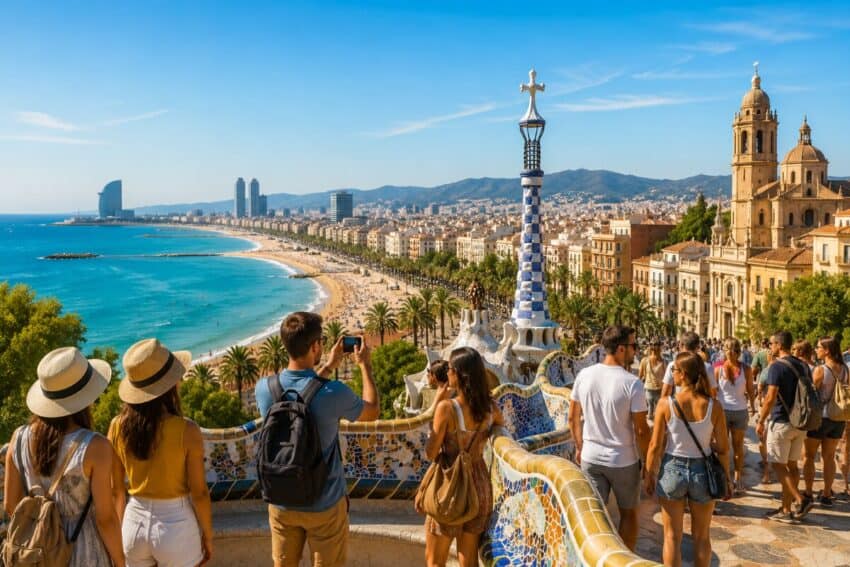
Image generated with Ai
Spain is moving closer to a historic 100 million international tourist milestone in 2026 because official data shows steady growth in arrivals, spending, air access and regional demand. Spain welcomed 96.8 million international tourists in 2025. In April 2026 alone, it received 9.1 million visitors. Across the first four months of 2026, arrivals rose by 3.4 per cent to 26.56 million. If this pace continues through the year, Spain could approach or pass 100 million visitors, even as global uncertainty, Middle East conflict risk, fuel pressure and changing air routes reshape travel choices.
Spain’s Tourism Surge Is No Longer Just A Summer Story
Spain’s tourism growth in 2026 is now a national economic story, not only a beach holiday story. The latest official figures show that visitor demand is rising before the full summer peak. This matters because Spain’s busiest months usually arrive later in the year. A strong April and a strong first four months give the country a powerful base before June, July, August and September.
The numbers also show that Spain is not depending on one single market. The United Kingdom, France and Germany remain vital. Yet Spain is also seeing movement from wider European, American and long-haul markets. This gives the country more protection when one source market slows.
The central question is simple. Can Spain reach 100 million international tourists in 2026? Official data does not yet confirm this. But the maths makes the possibility serious. A 3.4 per cent rise on the 2025 total of 96.8 million would place Spain just above 100 million. That makes the current trend one of the most important tourism signals in Europe.
Advertisement
Advertisement
Official Numbers Show Spain Is Already Running Ahead
Spain received 9.054 million international tourists in April 2026. That was 5.2 per cent higher than April 2025. During the first four months of 2026, the country welcomed 26.561 million international tourists, up 3.4 per cent year on year.
Advertisement
Advertisement
This growth followed an already historic year. In 2025, Spain received 96.8 million international tourists. That was a record and 3.2 per cent above 2024.
The important point is not only the volume. It is the timing. April is not the final measure of Spain’s annual tourism strength. It is a gateway month before the high season. A strong April often signals deep demand for coastal regions, city breaks, island holidays, cultural routes and event-led travel.
| Indicator | Official figure | Change | Why it matters |
|---|---|---|---|
| International tourists in 2025 | 96.8 million | 3.2 per cent up | Historic record base |
| International tourists in April 2026 | 9.054 million | 5.2 per cent up | Strong pre-summer demand |
| International tourists Jan-Apr 2026 | 26.561 million | 3.4 per cent up | Puts 100 million within reach |
| April 2026 air arrivals | 7.639 million | 6.8 per cent up | Air capacity remains key |
| April 2026 road arrivals | 1.247 million | 2.3 per cent down | Air travel is driving growth |
The 100 Million Question Needs Careful Framing
Spain has not officially recorded 100 million tourists in 2026. Any article must make that clear. The correct wording is that Spain could move towards 100 million international tourists if current growth is sustained.
This is important for editorial accuracy. A confirmed milestone and a projected milestone are different. The first is fact. The second is a reasoned forecast based on available data.
The projection is still powerful. Spain’s 2025 base was 96.8 million. The first four months of 2026 grew by 3.4 per cent. Applying that pace to the full 2025 figure gives a result close to 100.1 million. That does not guarantee the final year total. Summer weather, air capacity, hotel prices, fuel costs, geopolitical events and household budgets can still change the result.
Advertisement
Advertisement
| Scenario | Calculation basis | Possible annual direction |
| Flat year | Same as 2025 | Around 96.8 million |
| Current Jan-Apr pace | 3.4 per cent growth | Around 100 million |
| Strong summer lift | Higher than current pace | Above 100 million possible |
| External shock | Lower growth after April | Below 100 million possible |
Global Uncertainty Is Changing Where Travellers Feel Safe
Global uncertainty is now part of Spain’s tourism equation. Travel demand is still strong worldwide, but travellers are watching conflict, air disruption, rising fares and inflation. UN Tourism has reported that international tourism continued growing in early 2026 despite a more uncertain global environment.
For Spain, this creates a complex advantage. The country is seen as familiar, accessible and well connected. It has large airports, strong hotel capacity, major cruise ports, established rail networks and many year-round destinations. That gives Spain a strong position when travellers choose destinations that feel easier to plan.
Spain’s Ministry of Industry and Tourism has also monitored the potential impact of the Middle East conflict on tourism activity. The government has pointed to the need for coordination, early response and market tracking. This shows that Spain is not treating uncertainty as a distant issue. It is treating it as a live tourism risk.
The Spending Story Is Even Stronger Than The Arrival Story
Visitor numbers are rising, but spending is rising faster. This is crucial. Spain’s tourism model is no longer only about counting arrivals. It is also about value, destination balance and better economic return.
In April 2026, international tourists spent 11.686 billion euros in Spain. That was 7.4 per cent higher than the same month in 2025. In the first four months of 2026, total spending reached 36.703 billion euros, up 6.7 per cent.
Advertisement
Advertisement
Average spending per tourist reached 1,291 euros in April. Average daily spending rose to 189 euros. The average trip lasted 6.8 days.
| Spending indicator | April 2026 figure | Annual change |
| Total international tourist spending | 11.686 billion euros | 7.4 per cent up |
| Spending Jan-Apr 2026 | 36.703 billion euros | 6.7 per cent up |
| Average spend per tourist | 1,291 euros | 2.1 per cent up |
| Average daily spend | 189 euros | 1.4 per cent up |
| Average stay | 6.8 days | 0.7 per cent up |
This means Spain is gaining more value from tourism. It also supports the government’s long-term shift towards a tourism model based on quality, sustainability and territorial balance.
United Kingdom, France And Germany Still Drive Spain’s Core Demand
Spain’s biggest source markets remain deeply important. In April 2026, the United Kingdom was the top country of residence, with nearly 1.7 million tourists. France sent around 1.3 million visitors. Germany sent around 1.2 million visitors.
During the first four months of 2026, the United Kingdom remained the largest market with around 4.9 million tourists. France followed with more than 3.3 million. Germany was close behind with nearly 3.3 million.
This pattern matters because Spain’s growth is built on mature, repeat markets. British visitors support island, coastal and city destinations. French travellers strengthen road, rail and short-break flows. German travellers are vital for the Balearic Islands, Canary Islands and Mediterranean routes.
Advertisement
Advertisement
| Source market | April 2026 arrivals | Strategic meaning |
| United Kingdom | Nearly 1.7 million | Largest core market |
| France | Around 1.3 million | Strong neighbouring demand |
| Germany | Around 1.2 million | Key island and coastal market |
| United States | Growing long-haul role | Higher-value transatlantic demand |
| Rest of world | Expanding base | Supports market diversification |
Catalonia, Andalusia And The Balearic Islands Lead April Arrivals
Spain’s regional map shows how broad the tourism engine has become. Catalonia was the top destination in April 2026, with 20.8 per cent of international tourists. Andalusia followed with 16.5 per cent. The Balearic Islands received 15.2 per cent.
Catalonia benefits from Barcelona, Costa Brava, culture, gastronomy and strong air links. Andalusia gains from heritage cities, beaches, festivals and year-round climate. The Balearic Islands remain central to European leisure travel.
For the first four months, the Canary Islands led with 5.7 million tourists. Catalonia received 5.4 million. Andalusia received 4.2 million. This shows the value of Spain’s winter-sun and early-spring destinations.
| Region | April 2026 role | Jan-Apr 2026 position |
| Catalonia | Top April destination | 5.4 million tourists |
| Andalusia | Second in April | 4.2 million tourists |
| Balearic Islands | Third in April | Strong spring rebound |
| Canary Islands | Lower April share | Top Jan-Apr destination |
| Madrid Region | Strong city and air role | Major spending centre |
Air Connectivity Is Powering The Growth
Air travel is the main engine behind Spain’s 2026 tourism acceleration. In April 2026, 7.638 million international tourists entered by air, up 6.8 per cent year on year. That was far higher than road, rail or water arrivals.
Spain also received 10.1 million international air passengers in April 2026, up 3.7 per cent. Across the first four months, international air passengers reached 32.4 million, an increase of 5.1 per cent.
Advertisement
Advertisement
This matters because air access shapes Spain’s global reach. More air passengers mean stronger city breaks, island holidays, meetings travel, cruise connections and long-haul visitor flows. Madrid’s strong passenger growth also shows how Spain’s capital is gaining as a gateway for Europe, Latin America and wider global travel.
Accommodation Trends Show A Changing Visitor Pattern
Spain’s accommodation mix is also changing. In April 2026, market accommodation rose by 4.2 per cent. Hotel accommodation grew by 3.2 per cent. Rental housing grew much faster, up 12.1 per cent. Non-market accommodation rose by 9.1 per cent.
This reflects a wider shift in traveller behaviour. Some visitors still want hotels. Others want apartments, longer stays, family space or flexible neighbourhood-based trips. This creates opportunity, but it also increases pressure on housing, local services and resident life in high-demand areas.
That is why Spain’s tourism strategy now places stronger focus on residents, sustainability and destination management. The challenge is not only bringing more people in. It is managing where they go, when they arrive and how tourism affects local communities.
Spain Tourism 2030 Points To A New Model
Spain Tourism 2030 sets out a long-term direction for the sector. The strategy recognises tourism as a major part of the Spanish economy. It also places stronger attention on residents, destinations, workers, digitalisation, sustainability and environmental pressure.
Advertisement
Advertisement
This is important because a 100 million tourist year would be a landmark, but also a test. More visitors can bring more revenue, jobs and investment. They can also increase crowding, housing pressure, water use, transport stress and local tension.
Spain’s next tourism battle is therefore not only about growth. It is about control. The country must keep the benefits high and the pressure manageable. That means more off-season travel, more inland tourism, stronger data systems, smarter accommodation rules and better links between tourism income and resident benefit.
What The Numbers Really Mean For Spain In 2026
Spain is entering a decisive tourism year. The country has the demand, the access and the brand power to approach 100 million international tourists. April 2026 data shows strong momentum. Spending is rising faster than arrivals. Air demand is healthy. Major regions are performing well. Core European markets remain strong.
But the final result is not guaranteed. Global uncertainty can still affect fuel prices, flight schedules, airfares and consumer confidence. Spain’s advantage is that it is a mature, trusted and highly connected destination. In a nervous travel world, that matters.
The real story is not just that Spain may reach 100 million tourists. The bigger story is that Spain is trying to manage record demand while reshaping tourism around value, resilience and sustainability. If the country succeeds, 2026 could become more than a record year. It could become a turning point in how Europe’s tourism leader handles mass demand in an uncertain world.
Advertisement
