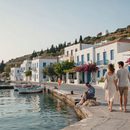
Image generated with Ai
Greece creates a better future for regional holidays outside of the high season by using its recent tourism cooperation with the UK to diversify travel options. It encourages visitors to move away from popular Greek resort destinations and to explore coastal cities, islands, mountain regions and local attractions. Also, it is capable of helping hotels, restaurants, ferries and guides to serve tourists throughout a longer period of time. Regional holidays could contribute some revenue to regions that would not be visited during the high season period. Nevertheless, the future of regional holidays in Greece depends on implementation, qualified personnel and transport.
The UK–Greece agreement gives tourism businesses a new reason to work together. Both governments have placed investment promotion, innovation, sustainability, entrepreneurship and training among the priorities. They also want to support special-interest travel. That includes culture, film, wine, food, rural tourism and mountain experiences.
Advertisement
This matters because Greece has long faced a clear seasonal challenge. Many visitors arrive in the hot summer months. Resorts become busy. Flights fill up. Local workers face intense pressure. Then demand drops sharply after the peak period.
A stronger travel calendar could help change this pattern. Visitors can enjoy Greece in April, May, September and October. These months can offer pleasant weather, lighter crowds and more room in hotels. They can also support businesses for longer.
Advertisement
Advertisement
The agreement creates a bilateral working group. This group is expected to review progress and suggest actions. Its future updates will matter greatly. They could show which regions receive support, which firms can join and what projects move from plans to reality.
The partnership should not be treated as a finished tourism revolution. It is the start of a process. The true test will come when the two sides publish clear outcomes. Travellers and businesses will want to know whether the pact leads to easier journeys, better products, stronger skills and more year-round jobs.
Greece welcomed 13.4911 million inbound travellers between January and June 2026. That was a rise of 15.4% from the same six months in 2025. Travel receipts reached €8.7963 billion, up 14.8%.
The UK remained one of Greece’s most important visitor markets. British travellers made 1.6795 million trips to Greece in the first half of 2026. This was an increase of 10.4%. Their spending reached €1.1792 billion, up 8.5%.
These figures show the scale of the opportunity. British visitors play a major role in Greek tourism. They support hotels, villas, restaurants, taxis, excursions, ferries and local shops. Their spending can also help smaller areas when travel products are designed well.
Yet the picture is not perfectly smooth. In June alone, Greece recorded 713,800 UK travellers. This was down 12% from June 2025. Receipts from UK residents fell 26.1% to €442.9 million for the month.
The June result does not prove why demand or spending changed. It does not show that travellers chose another country. It does not prove that prices caused the fall. It simply shows that a strong first half can still include weaker months.
That is why the new partnership should focus on resilience, not only high arrival numbers. Greece needs visitors who stay longer, spend locally and travel beyond the most crowded weeks. The UK market can help deliver that goal if airlines, travel agents, hotels and destinations work together.
Greece is not alone in trying to spread tourism more evenly. Across the European Union, tourist accommodation recorded 1.321 billion overnight stays in the first half of 2026. This was 1.7% higher than the same period a year earlier.
Foreign guest nights increased by 2.5%, while domestic guest nights rose by 0.9%. Ireland recorded a 14.6% rise in accommodation nights. Malta rose 9.9%. Slovakia grew by 5.9%. However, Cyprus fell by 7.7% and Romania dropped by 6.7%.
The figures show that tourism growth is uneven. Some places are gaining strongly. Others are losing ground. A country cannot rely on summer sun alone. It needs good access, clear value, quality accommodation and experiences that work in more than one season.
Greece faces a sharper seasonal pattern than the EU average. In 2025, July and August accounted for 41.6% of Greece’s annual tourist accommodation nights. Across the EU, the share was 31.1%.
Croatia had an even higher concentration at 54.5%. Bulgaria stood at 43.4%. Malta had a much lower share at 21.9%. This does not mean one destination is better than another. It shows how different tourism calendars can be.
For Greece, the challenge is clear. More visitors during the busiest months may lift annual totals. But it may not solve pressure on islands, roads, water supplies, workers or local communities. A better result would be more hotel nights in spring and autumn, more spending outside major resorts and more businesses open for longer.
The UK–Greece partnership can become useful if it helps make that change. It should encourage travellers to look beyond the traditional school-holiday rush and choose different regions at different times of the year.
Air links are vital, but the full journey matters more than a flight alone. A traveller needs to know how to get from an airport to a hotel, beach, village or island. If the transfer is confusing, long or costly, a smaller destination can remain out of reach.
Jet2 had 134 UK–Greece routes on sale in June 2026. Its summer programme covered 16 airport gateways and 28 Greek destinations. The company said capacity was 37% above its 2023 level.
The figures show the depth of the British market for Greece. They also show why UK regional airports matter. A holidaymaker from Birmingham, Manchester, Bristol or London may have different choices. Direct access can make a destination much easier to sell.
Chania and Kalamata offer a useful example. Jet2 announced an extended summer 2026 season in January 2025. Flights to Chania were scheduled from 3 April. Kalamata flights were scheduled from 5 April. Hotels were also offered from early April.
Chania links visitors with western Crete. It gives access to beaches, historic streets, food culture and mountain villages. Kalamata offers a different Greece. It connects travellers with the Peloponnese, olive country, coastal towns and ancient sites.
The key point is timing. Early April products can give travellers a chance to experience Greece before the high summer period. Hotels can gain bookings earlier. Local guides and restaurants can also benefit from a longer operating season.
New access must still match local capacity. A destination needs rooms, reliable transfers, staff, visitor information and services. More flights alone do not guarantee that local communities receive the economic gain.
The Olympus Riviera and Meganisi offer two very different examples of how tourism can move beyond the usual routes.
The Olympus Riviera sits in northern Greece. It combines the Aegean coast with views towards Mount Olympus. Its 2026 package programme uses Thessaloniki Airport and includes hotel transfers. The advertised travel window runs from 3 April to 31 October across participating UK bases.
This creates a wider holiday choice. Travellers can enjoy beaches but also explore northern Greece. They can visit mountain areas, local towns and cultural sites. This type of trip may appeal to families, walkers, food lovers and people who want more than a standard resort break.
Meganisi offers an island journey. It uses Preveza Airport, followed by ferry and shuttle transfers included in Jet2holidays packages. Its advertised 2026 window runs from 3 May to 20 October.
Meganisi does not have a direct airport. That is important. It shows why joined-up transport is so valuable. The flight gets a traveller close. The ferry and shuttle complete the trip. When these steps are easy to understand and book, a smaller island becomes more accessible.
This can help spread demand. Visitors may choose an island that they had not considered before. Local guesthouses, restaurants, boat operators and small shops can gain new customers. Yet this kind of growth must remain careful. Small islands have limited space and services. Tourism must support local life rather than overwhelm it.
The UK–Greece partnership can learn from both examples. The mainland coast needs strong road and hotel links. Islands need dependable ferry connections and clear travel information. Different places need different solutions.
Tourism promotion does not only happen in London. Regional Britain plays a key role in sending visitors to Greece.
The Greek National Tourism Organisation held a joint event with Jet2holidays in Bristol on 4 June 2026. Around 80 travel agents attended. The event formed part of the 2026 GNTO–Jet2holidays advertising programme.
The promotion highlighted Meganisi and the Olympus Riviera. It also pointed to 12 direct Greek destinations from Bristol. This gives travellers in south-west England more choice without needing to travel first to a London airport.
Travel agents remain important, especially for trips with several stages. They can explain which airport suits a traveller. They can help customers understand hotel transfers, ferry timings, family needs and package options. They can also guide people towards travel periods that better fit their budget and preferred style.
For Greece, regional sales work can support a more balanced tourism map. It can introduce travellers to destinations that do not have the same global fame as Santorini, Mykonos, Corfu or Rhodes. This does not replace the famous islands. It adds more choices.
The Bristol programme is proof of outreach. It is not proof that bookings have risen because of the event. The effect will need to be measured over time. Still, it shows how the partnership can work in practical places. A policy signed in London becomes more meaningful when an agent in Bristol can explain a new Greek holiday clearly to a family or couple.
Hospitality is another important part of the UK–Greece tourism story. International hotel brands can bring sales networks, loyalty programmes, operating systems and staff training. They can help a destination reach travellers who may not know a local property.
However, hotel branding and hotel ownership are not the same thing. This difference is crucial.
IHG announced two Gelasakis Group-owned hotels in Crete in April 2025. The Chania Hotel Crete, Vignette Collection, has 39 rooms. Kimpton La Mer Crete has 76 rooms. IHG said the properties would add luxury and lifestyle choices to the island.
IHG’s half-year results in August 2026 confirmed that Kimpton opened its first Greek hotel during the first half of the year. This showed delivery at brand level.
But the information does not prove that British money financed the buildings. The properties are owned by the Greek Gelasakis Group. IHG provides a global hotel brand and its commercial systems. These are different roles.
A hotel project may involve several parties. One company owns the land. Another pays for development. Another runs the hotel. Another provides a brand. Each role can support tourism, but they should not be confused.
The UK–Greece pact mentions investment promotion. That is a promising area. Yet any claim about investment should name the investor, project, amount and stage. Until then, it is better to describe the agreement as a platform for future opportunity rather than proof of new capital already committed.
Greece is famous for its islands, sea and summer light. Yet its mountains offer another major tourism opportunity. Mountain villages, walking routes, nature areas and winter sports can help build a fuller year-round travel offer.
In April 2026, Greece presented a mountain-tourism promotion programme. It aims to support travel across the whole year. The programme includes ski-centre infrastructure upgrades and a digital platform for promotion. The ministry said the Recovery and Resilience Facility-backed project was due for completion during 2026.
At first, the campaign targets the domestic market. International promotion is expected later. This is an important distinction. It should not be presented as an active UK marketing campaign today. It is also separate from the July UK–Greece tourism agreement.
Still, the two ideas can support each other in time. If mountain areas gain better facilities, clear visitor information, transport options and trained staff, they may become easier to include in future international travel plans.
A British visitor may want to combine Athens with a mountain village. Another may choose a hiking holiday in spring. A family may prefer a cooler summer escape. Food, local traditions and nature can give these regions a strong identity.
The destination must prepare well. It needs safe paths, accommodation, transport, local guides and reliable services. A beautiful mountain is not enough. A complete visitor experience matters.
This is where tourism cooperation can become practical. The UK can bring market knowledge and travel distribution. Greece can develop local products and infrastructure. Together, they can help visitors see a different side of the country.
The two nations are set to unlock a strong tourism deal that will go beyond summer tourism and provide escape opportunities within regions. This is because the deal provides the two parties an opportunity to make use of their high tourist numbers in making sustainable benefits for their hotels and regional businesses. Also, this means that they will be in a position to explore other places apart from the known places during the holiday season in Greece.
This is because they will be participating in spring breaks in Chania, relaxing at the shores of Olympus Riviera, sailing in Meganisi and holidaying in the mountains, all without having to visit the overcrowded beaches. The tourism deal puts in place the issues of skills, innovations, sustainability and improved accessibility as the main focus of future collaboration.
Nevertheless, the time has come for actions to be taken. The two nations need visible activities, reporting and community support to prove that their partnership is working for them.
Advertisement
Advertisement
Advertisement













Monday, September 7, 2026
Monday, September 7, 2026
Monday, September 7, 2026

Monday, September 7, 2026

Monday, September 7, 2026

Monday, September 7, 2026