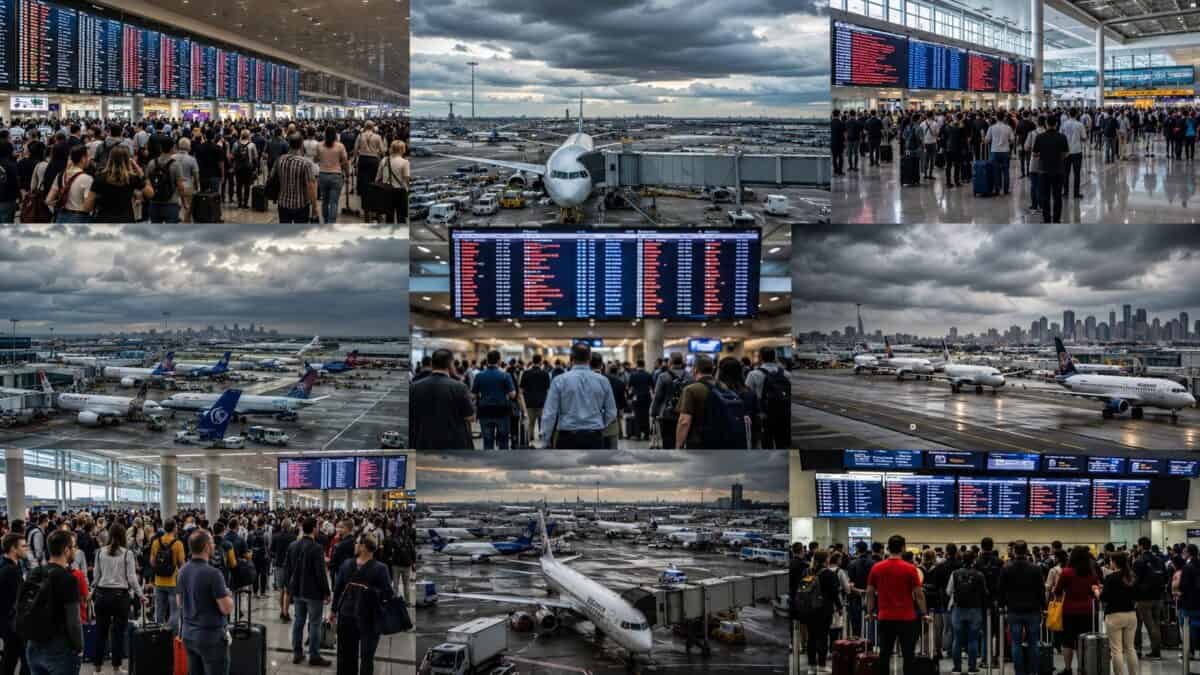
Image generated with Ai
Today, July 5, 2026, air travel across the United States is experiencing another day of widespread disruption, with 182 flight cancellations and 693 flight delays recorded within, into, or out of the country. The largest operational impacts are being seen at John F. Kennedy International Airport, Chicago O’Hare International Airport, Newark Liberty International Airport, Los Angeles International Airport, Miami International Airport, Boston Logan International Airport, and Dallas/Fort Worth International Airport, where disruptions are affecting thousands of passengers travelling on both domestic and international routes.
The concentration of cancellations at major airline hubs has intensified the impact of today’s disruption. These seven airports alone account for 143 of the nation’s 182 cancelled flights—nearly 79% of all cancellations—demonstrating how operational problems at key connecting airports quickly spread across airline networks. JetBlue, United Airlines, American Airlines, Delta Air Lines, SkyWest, Republic Airways and several international carriers are among the airlines reporting the highest number of affected services.
Multiple operational factors are contributing to today’s widespread cancellations and delays rather than a single nationwide event.
John F. Kennedy International Airport (JFK) experienced the highest number of disruptions among the airports analysed, reporting 51 flight cancellations and 57 delays today. The figures reflect operational challenges affecting both domestic services and numerous international departures across Europe, the Middle East and Asia.
Advertisement
| Airline | Cancelled | Delayed |
|---|---|---|
| JetBlue | 18 | 14 |
| Endeavor Air (DAL) | 9 | 4 |
| Delta Air Lines | 6 | 12 |
| Republic | 4 | 0 |
| Alaska Airlines | 4 | 2 |
| American Airlines | 3 | 9 |
| British Airways | 3 | 0 |
| Virgin Atlantic | 2 | 0 |
| Royal Jordanian | 1 | 0 |
| Cathay Pacific | 0 | 1 |
| El Al | 0 | 5 |
| Iberia | 0 | 1 |
| ITA Airways | 0 | 1 |
| Norse Atlantic Airways | 0 | 1 |
| Neos | 0 | 1 |
| Qatar Airways | 0 | 1 |
| Singapore Airlines | 0 | 1 |
| Saudia | 0 | 1 |
| Swiss | 0 | 2 |
| AeroMéxico | 0 | 1 |
JetBlue recorded the largest operational impact at JFK with 18 cancellations and 14 delays, accounting for more than one-third of all cancellations at the airport. Endeavor Air followed with 9 cancellations, while Delta Air Lines experienced 6 cancellations and 12 delays, indicating that although Delta maintained more scheduled operations than JetBlue, many flights still operated behind schedule.
International carriers experienced comparatively fewer cancellations but were not immune to disruption. British Airways, Virgin Atlantic, and Royal Jordanian all recorded cancelled services, while airlines including El Al, Qatar Airways, Singapore Airlines, Swiss, Cathay Pacific, and Saudia primarily reported delays, suggesting that international operations were affected more by schedule adjustments than widespread cancellations.
Chicago O’Hare International Airport (ORD) reported 45 flight cancellations and 88 delays, making it the second-most disrupted airport in the United States today. As one of the country’s largest airline hubs, operational challenges at O’Hare have the potential to affect flights across the Midwest as well as connections to Europe, Canada, Asia and other major US cities. The high number of delays also indicates that many services continued to operate, albeit behind schedule.
| Airline | Cancelled | Delayed |
|---|---|---|
| SkyWest | 18 | 36 |
| United | 13 | 10 |
| American Airlines | 6 | 16 |
| British Airways | 3 | 1 |
| GoJet (UAL) | 1 | 0 |
| Frontier | 1 | 1 |
| Qatar Airways | 1 | 0 |
| Envoy Air (AAL) | 1 | 8 |
| Jazz (ACA) | 1 | 0 |
| Delta Air Lines | 0 | 3 |
| Lufthansa | 0 | 1 |
| Endeavor Air (DAL) | 0 | 2 |
| Aer Lingus | 0 | 1 |
| Japan Airlines | 0 | 1 |
| JetBlue | 0 | 1 |
| Republic | 0 | 4 |
| Emirates | 0 | 1 |
| Air Canada | 0 | 1 |
| Austrian Airlines | 0 | 1 |
SkyWest experienced the greatest operational impact at Chicago O’Hare with 18 cancellations and 36 delays, representing the highest number of delayed flights among all airlines at the airport. United Airlines, O’Hare’s largest hub carrier, recorded 13 cancellations and 10 delays, while American Airlines followed with 6 cancellations and 16 delays, highlighting disruptions among the airport’s three principal domestic operators.
Advertisement
Advertisement
International carriers saw comparatively limited cancellations. British Airways cancelled three flights, while Qatar Airways, Jazz (Air Canada Express), Frontier, GoJet, and Envoy Air each reported isolated cancellations. Several overseas airlines—including Lufthansa, Emirates, Japan Airlines, Aer Lingus, Air Canada, and Austrian Airlines—recorded delays rather than cancellations, indicating that international operations largely continued despite operational constraints.
Los Angeles International Airport (LAX) recorded 11 flight cancellations and 46 delays today, reflecting moderate but significant disruption across both domestic and international operations. As one of the busiest gateways on the US West Coast, delays at LAX can affect trans-Pacific services as well as flights connecting the United States with Canada, Mexico, Europe and Oceania. While cancellations remained relatively limited, the number of delayed flights suggests airlines were largely able to maintain operations despite scheduling challenges.
| Airline | Cancelled | Delayed |
|---|---|---|
| American Airlines | 6 | 6 |
| JetBlue | 2 | 3 |
| Delta Air Lines | 2 | 5 |
| KLM Royal Dutch Airlines | 1 | 0 |
| Air New Zealand | 0 | 1 |
| Alaska Airlines | 0 | 2 |
| British Airways | 0 | 1 |
| China Eastern Airlines | 0 | 1 |
| China Cargo | 0 | 2 |
| XiamenAir | 0 | 1 |
| Lufthansa | 0 | 1 |
| Finnair | 0 | 1 |
| Fiji Airways | 0 | 1 |
| Iberia | 0 | 1 |
| Japan Airlines | 0 | 2 |
| Nippon Cargo | 0 | 1 |
| Qantas | 0 | 1 |
| SkyWest | 0 | 5 |
| Southwest | 0 | 6 |
| Swiss | 0 | 1 |
| Air Tahiti Nui | 0 | 1 |
| Volaris | 0 | 1 |
| Air Canada | 0 | 2 |
American Airlines accounted for more than half of all cancellations at LAX with 6 cancelled flights, while also reporting 6 delays. JetBlue and Delta Air Lines followed with 2 cancellations each, with Delta additionally recording 5 delayed flights, indicating that it maintained most of its schedule despite operational disruptions.
Most international airlines avoided cancellations but experienced isolated delays. Carriers including British Airways, Lufthansa, Japan Airlines, Qantas, Air New Zealand, Air Canada, China Eastern Airlines, Finnair, and Air Tahiti Nui largely kept flights operating, although behind schedule. Among domestic carriers, Southwest Airlines reported 6 delays, while SkyWest registered 5 delays, reflecting continued pressure on regional and domestic operations at one of America’s busiest airports.
Newark Liberty International Airport (EWR) reported 19 flight cancellations and 30 delays today, making it another major hotspot for operational disruption in the New York metropolitan area. As a key hub for domestic travel and transatlantic services, disruptions at Newark have affected passengers travelling across the United States, Canada and Europe, while also placing additional pressure on airline schedules throughout the Northeast corridor.
| Airline | Cancelled | Delayed |
|---|---|---|
| United | 8 | 18 |
| Republic | 4 | 0 |
| American Airlines | 3 | 0 |
| JetBlue | 2 | 6 |
| Jazz (ACA) | 1 | 0 |
| Air Canada | 1 | 0 |
| Dreamjet | 0 | 1 |
| Endeavor Air (DAL) | 0 | 1 |
| Iberia | 0 | 1 |
| Porter Airlines | 0 | 2 |
| Singapore Airlines | 0 | 1 |
United Airlines experienced the greatest operational impact at Newark, reporting 8 cancellations and 18 delays. This means United accounted for over 42% of all cancellations at the airport while also recording the highest number of delayed flights, reflecting the challenges faced by the airport’s largest hub carrier. Republic Airways followed with 4 cancellations, while American Airlines cancelled 3 flights.
Most international carriers operating from Newark avoided cancellations. Porter Airlines, Singapore Airlines, Iberia, Dreamjet, and Endeavor Air reported only isolated delays, suggesting that while operations were disrupted, airlines generally managed to keep international and regional schedules running with limited cancellations.
Miami International Airport (MIA) experienced comparatively lighter disruption than several other major US hubs, recording 6 flight cancellations and 16 delays today. Despite the lower figures, operational issues at Miami remain significant because the airport serves as one of the country’s primary gateways to Latin America and the Caribbean. Even a small number of cancellations can affect onward international connections and regional travel plans.
| Airline | Cancelled | Delayed |
|---|---|---|
| Envoy Air (AAL) | 4 | 0 |
| American Airlines | 2 | 9 |
| Amerijet International | 0 | 1 |
| Frontier | 0 | 2 |
| Avianca Costa Rica | 0 | 1 |
| Southwest | 0 | 2 |
| Swiss | 0 | 1 |
Envoy Air (AAL) accounted for the majority of Miami’s cancellations, with 4 of the airport’s 6 cancelled flights, while American Airlines cancelled 2 flights and reported 9 delays, representing more than half of all delayed operations at the airport. This reflects the operational pressure on the American Airlines network, for which Miami serves as a major hub.
Other airlines experienced only minor schedule disruptions. Frontier and Southwest Airlines each recorded 2 delayed flights, while Amerijet International, Avianca Costa Rica, and Swiss reported isolated delays without cancellations. Overall, today’s disruption at Miami was driven more by delays than widespread flight cancellations, allowing most scheduled services to continue operating.
Boston Logan International Airport (BOS) reported 8 flight cancellations and 34 delays today, with disruptions affecting both domestic and international services. Although the number of cancellations remained relatively modest compared with larger hubs such as JFK and Chicago O’Hare, the volume of delayed flights indicates that airlines faced continued operational challenges while attempting to keep most scheduled services running.
| Airline | Cancelled | Delayed |
|---|---|---|
| Air Canada | 2 | 0 |
| JetBlue | 2 | 16 |
| American Airlines | 2 | 1 |
| Air France | 1 | 0 |
| Virgin Atlantic | 1 | 0 |
| Delta Air Lines | 0 | 4 |
| Envoy Air (AAL) | 0 | 2 |
| Etihad Airways | 0 | 1 |
| Iberia | 0 | 1 |
| Cape Air | 0 | 1 |
| Republic | 0 | 2 |
| Southwest | 0 | 6 |
JetBlue recorded the highest number of delayed flights at Boston Logan with 16 delays, while also cancelling 2 flights, making it the airport’s most significantly affected carrier overall. American Airlines and Air Canada each cancelled 2 flights, while Southwest Airlines reported 6 delays and Delta Air Lines recorded 4 delays, indicating that airlines largely preserved their schedules despite operational pressures.
International carriers experienced limited disruption. Air France and Virgin Atlantic each cancelled one flight, while Etihad Airways and Iberia reported isolated delays. Overall, the data suggests that delays, rather than widespread cancellations, were the dominant challenge at Boston Logan today.
Dallas/Fort Worth International Airport (DFW) experienced the lightest disruption among the airports analysed, recording 3 cancellations and 16 delays. Despite the relatively low cancellation count, DFW remains one of the busiest aviation hubs in the United States, meaning even minor operational issues can affect connecting passengers across extensive domestic and international networks.
| Airline | Cancelled | Delayed |
|---|---|---|
| JetBlue | 2 | 0 |
| Delta Air Lines | 1 | 1 |
| Air France | 0 | 1 |
| China Airlines | 0 | 1 |
| Japan Airlines | 0 | 1 |
| PSA Airlines (AAL) | 0 | 1 |
| Qantas | 0 | 1 |
| American Airlines | 0 | 10 |
JetBlue accounted for 2 of the airport’s 3 cancellations, while Delta Air Lines recorded 1 cancellation alongside 1 delayed flight. The most notable operational impact, however, was on American Airlines, which reported 10 delayed flights without any cancellations, reflecting efforts to maintain flight schedules despite operational constraints at its largest hub.
The remaining international carriers—including Air France, China Airlines, Japan Airlines, and Qantas—each reported only a single delayed service and no cancellations. Overall, DFW demonstrated comparatively strong operational resilience, with the majority of disruptions taking the form of delays rather than cancelled flights.
The scale of today’s 182 cancellations and 693 delays is the result of several operational factors occurring simultaneously rather than a single nationwide incident. Because the most heavily affected airports—JFK, Chicago O’Hare, Newark, Los Angeles, Boston, Miami and Dallas/Fort Worth—serve as major airline hubs, even localized disruptions can ripple across the national aviation network.
Some of the primary contributing factors include:
Today’s widespread disruptions are affecting passengers well beyond the airports where cancellations originated, particularly those travelling through major connecting hubs.
Passengers whose flights have been cancelled should first determine whether the disruption resulted in a cancellation or a delay, as airline policies often differ. In many cases, airlines will offer rebooking on the next available service without additional charges. If a flight is cancelled and a passenger decides not to travel, they may also be eligible for a refund depending on the ticket conditions and applicable regulations.
Travellers should contact their airline as soon as possible through official mobile apps, customer service channels or airport service desks. Keeping boarding passes, booking confirmations and receipts for additional expenses can be useful if reimbursement or compensation becomes available. International travellers should also review the consumer protection rules that apply to their specific itinerary, particularly when travelling on flights covered by overseas passenger-rights regulations.
A total of 182 flights have been cancelled within, into, or out of the United States today, alongside 693 delayed flights.
John F. Kennedy International Airport (JFK) reported the highest number among the airports analysed, with 51 cancellations and 57 delays.
The largest disruptions were reported by JetBlue, SkyWest, United Airlines, American Airlines, Delta Air Lines, Republic Airways and Endeavor Air, although several international airlines also experienced isolated cancellations and delays.
Airlines often choose to delay flights rather than cancel them when aircraft, crew or weather conditions are expected to improve later in the day. This helps carriers maintain as much of their scheduled network as possible.
Passengers whose flights are cancelled should first contact their airline. Depending on the circumstances, ticket conditions and applicable regulations, travellers may be eligible for rebooking or a refund if they decide not to travel.
Passengers travelling through major US hubs should continue checking official airline notifications and airport updates before leaving for the airport, as operational conditions may change throughout the day.
Travellers planning to use major American airports over the coming days should monitor flight status frequently and remain flexible with their travel plans. Checking airline mobile apps before leaving home, arriving at the airport with additional time, and keeping notifications enabled can help passengers respond quickly to schedule changes. Those with connecting itineraries should also consider longer connection times where possible, as disruptions at major hub airports can quickly cascade throughout domestic and international networks. While airlines continue working to restore normal operations, staying informed remains the most effective way to minimise travel inconvenience.
Days like today demonstrate just how interconnected the modern aviation system has become. While 182 cancellations may not represent the majority of US flights, the concentration of disruptions at airports such as JFK and Chicago O’Hare illustrates how quickly operational challenges can spread across the country. Behind every cancelled or delayed flight is a traveller whose holiday, business meeting or family reunion has been unexpectedly disrupted. As airlines and airports continue investing in operational resilience, passengers can only hope that improved planning, technology and communication will help reduce the frequency and impact of such widespread disruptions during future peak travel periods.
Advertisement
Tags: American airport disruptions, Chicago O'Hare Delays, JFK cancellations, los angeles international airport, Newark Liberty Airport
Advertisement
Advertisement













Friday, September 4, 2026

Friday, September 4, 2026

Friday, September 4, 2026

Thursday, September 3, 2026

Wednesday, September 2, 2026

Friday, September 4, 2026
Friday, September 4, 2026