
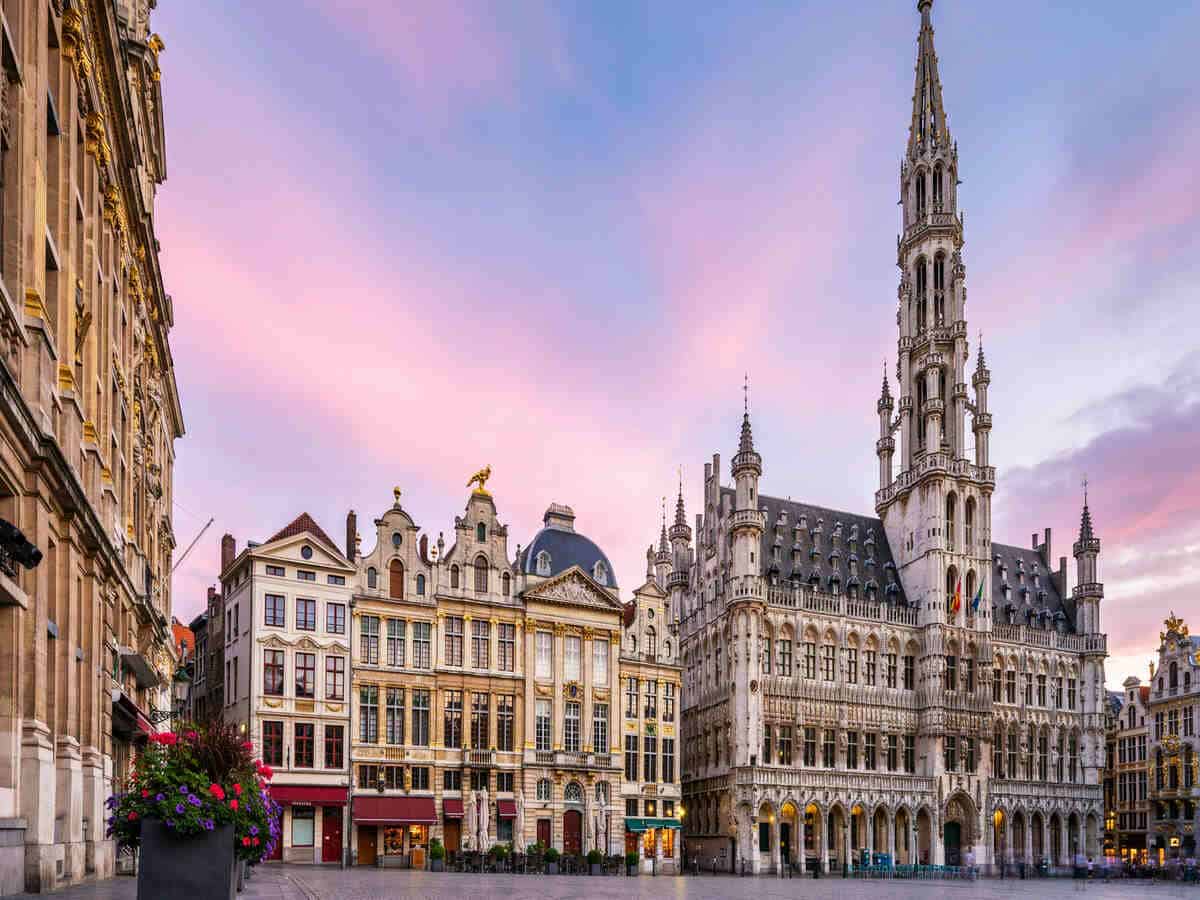
Image generated with Ai
India And Belgium Enhance Tourism Through Quick Visa Process, Direct Flights And Better Travel Connections In 2026. India and Belgium are moving forward into an advanced stage of cooperation between them in 2026 through new agreements on mobility, connectivity, economic cooperation, education and people to people interactions. This comes after discussions between the two countries in which the leaders of both sides have promised to support each other’s candidacy for the non-permanent membership of the UN Security Council.
While the diplomatic agreement has attracted attention for its geopolitical importance, the wider India-Belgium partnership carries an equally significant travel and tourism dimension. Faster visa processing, a push for direct air connectivity, greater business exchanges, educational mobility and closer India-European Union ties could collectively make travel between India and Belgium easier and more attractive.
Advertisement
India and Belgium have strengthened a relationship that already spans diplomacy, business, education, technology and cultural connections.
Belgian Prime Minister Bart De Wever visited India from 2 to 4 September 2026, marking his first official visit to the country since taking office in February 2025. He travelled with Belgium’s Minister of Defence and Foreign Trade, Theo Francken, alongside a high-level delegation of officials and business leaders.
Advertisement
Advertisement
During the visit, Prime Minister Narendra Modi and De Wever held bilateral discussions covering trade, investment, connectivity, technology, defence, security, clean energy and people-to-people relations.
The expanding partnership matters to tourism because stronger political and commercial relationships can create greater movement of travellers between the two countries.
One of the most important developments for travellers is the push towards direct air connectivity.
India and Belgium have encouraged airline operators to explore direct flights between the two countries. No airline, destination pair, frequency or launch date has yet been confirmed, meaning travellers should not interpret the announcement as confirmation that nonstop services are immediately beginning.
However, the political backing for exploring direct connectivity is significant.
Direct flights could reduce dependence on connecting journeys through other European or Middle Eastern hubs. They could also make Belgium more accessible to Indian leisure travellers, business visitors, students and people visiting friends and relatives.
For Belgium, stronger aviation connectivity with India could improve its position as an entry point into Western Europe.
Visa processing is another major component of the expanding relationship.
India and Belgium have recognised that increasing movement between the two countries requires efficient visa services and smoother processing arrangements. Visa-processing capacity at diplomatic missions is expected to increase significantly, while Belgium is strengthening its visa-delivery capabilities in India.
This could become particularly important as more Indians travel internationally for holidays, education, business and family visits.
Belgium is part of the Schengen Area, making the visa process an important element of travel planning for Indian visitors. Improvements in processing capacity could therefore make it easier for travellers to organise Belgium itineraries with greater certainty.
Faster and more efficient visa services could also help tour operators, travel agencies and business travel companies plan European journeys more effectively.
Belgium offers Indian tourists a combination of European history, architecture, gastronomy, culture and heritage.
Brussels remains its principal international gateway, while Bruges, Ghent and Antwerp provide additional city-break and cultural tourism possibilities.
Better air connectivity and visa processing could make these destinations easier to package for Indian visitors.
Belgium’s geographical location also provides an advantage. Travellers can combine Belgium with wider European itineraries, allowing the country to form part of multi-destination holidays.
This means improved India-Belgium connectivity could have consequences beyond bilateral tourism alone. Belgium could increasingly function as one component of wider European travel itineraries for Indian visitors.
The wider India-European Union relationship is also becoming increasingly important.
India and Belgium have welcomed the EU-India Comprehensive Framework of Cooperation on Mobility and the launch of a pilot European Union Legal Gateway Office in India.
The initiative is intended to facilitate legal mobility opportunities for skilled workers, professionals and students.
Although professional and educational mobility should not be confused with leisure tourism, increasing numbers of Indians living, studying or working in Europe can create additional travel demand.
Students may receive visits from family members. Professionals can combine work trips with leisure stays. Communities living abroad can also generate visiting-friends-and-relatives tourism.
The result could be a broader travel ecosystem connecting India, Belgium and Europe.
Business tourism is positioned to benefit substantially from the strengthened partnership.
India and Belgium have set an ambition of doubling bilateral trade within five years. Cooperation is expanding across pharmaceuticals, biotechnology, semiconductors, critical minerals, renewable energy, defence, logistics, ports, technology and advanced industries.
An India-Belgium Investment Fast-Track Mechanism has also been launched to facilitate investments and address potential business bottlenecks.
Such developments can generate travel.
Corporate delegations, investors, executives, researchers and government representatives frequently need to travel as bilateral economic relationships deepen.
Conferences, exhibitions, trade meetings and investment events could consequently generate additional demand for airlines, hotels and meeting venues.
Brussels and Antwerp could benefit from increased Indian corporate arrivals, while Indian commercial centres including Delhi, Mumbai and Bengaluru could receive additional Belgian business travellers.
The India-European Union Free Trade Agreement represents another important element of the wider relationship.
India and Belgium welcomed the conclusion of negotiations for the agreement in January 2026 and have emphasised timely implementation.
Increasing trade between India and Europe can indirectly stimulate travel because stronger commercial relationships require regular interaction between companies, governments and industry organisations.
Belgium occupies an important position within this framework. Brussels sits at the centre of European Union policymaking, while Antwerp is a major European commercial and logistics centre.
The historic diamond connection linking Antwerp with Mumbai and Surat also provides an established foundation for business travel between the two countries.
Greater commercial cooperation could therefore strengthen premium aviation demand and the meetings, incentives, conferences and exhibitions sector.
Education represents another important part of the partnership.
Prime Minister Modi has invited leading Belgian universities and academic institutions to establish campuses in India.
The two countries are also looking at deeper cooperation involving vocational education, apprenticeships, skills development, research and recognition of qualifications.
These initiatives could gradually increase movement by students, academics, researchers and education professionals.
Educational mobility has a wider tourism impact because international students frequently attract visits from parents, relatives and friends. Academic conferences and research partnerships also generate international journeys.
Consequently, stronger university cooperation could create a sustainable source of two-way travel rather than a short-term tourism spike.
India and Belgium also share an important historical connection that can support heritage tourism.
More than 9,000 Indian soldiers died in Belgium’s Flanders Fields during the First World War. Their sacrifice remains a powerful connection between the two countries.
Cooperation between the Flanders Fields Museum in Ypres and India’s Centre for Armed Forces Historical Research is helping preserve this shared history.
This relationship creates opportunities for remembrance and battlefield tourism involving Indian travellers interested in military history, family heritage and the role played by Indian soldiers during the First World War.
Ypres and the surrounding Flanders Fields could consequently form an important niche tourism proposition for the Indian market.
The year 2027 will mark 80 years of diplomatic relations between India and Belgium.
Belgium was among the early European countries to establish diplomatic relations with independent India in 1947, and the approaching anniversary gives both countries another opportunity to strengthen cultural exchanges.
Events surrounding the anniversary could potentially encourage exhibitions, academic programmes, cultural initiatives and official visits, providing another platform for people-to-people connections.
The foundations for these exchanges are being strengthened during 2026.
The relationship extends far beyond tourism.
India and Belgium have agreed to support each other’s candidature for non-permanent membership of the United Nations Security Council.
Belgium will support India’s candidature for the 2028-29 term, while India will support Belgium’s candidature for the 2037-38 term.
Belgium has additionally reaffirmed its support for India’s candidature for permanent membership of a reformed and expanded UN Security Council.
Both countries have called for Security Council reform to make the institution more representative of the contemporary international system.
While this diplomatic commitment does not directly affect travellers, it demonstrates the wider political confidence underpinning the rapidly expanding bilateral relationship.
The 2026 developments do not amount to a standalone bilateral tourism agreement, and no new direct flight has yet been formally announced. Nevertheless, the combination of measures now taking shape could create a much stronger environment for tourism.
Faster visa processing could remove practical barriers. Potential direct flights could reduce journey times and improve convenience. Student and professional mobility could generate new travel flows, while expanding trade could stimulate corporate and MICE tourism.
Belgium, meanwhile, has an opportunity to position Brussels, Bruges, Ghent, Antwerp and Flanders more strongly among Indian travellers.
India could similarly benefit from increasing numbers of Belgian visitors attracted by its heritage, culture, cities and expanding business opportunities.
Tourism Improvements in 2026 by India and Belgium Thanks to Quickened Visa Procedures, Scheduled Flights, Increased Mobility, and Better Tourism Links.
The importance of the new alliance goes far beyond that of diplomacy. By India siding with Belgium in 2026, it will be possible to get more flights, increased mobility, better trade ties, and movement of more people which would lay the foundations of a much stronger tourism link between the two countries.
Advertisement
Advertisement
Advertisement













Thursday, September 3, 2026

Thursday, September 3, 2026

Thursday, September 3, 2026
Thursday, September 3, 2026

Thursday, September 3, 2026

Wednesday, September 2, 2026

Thursday, September 3, 2026

Thursday, September 3, 2026


