
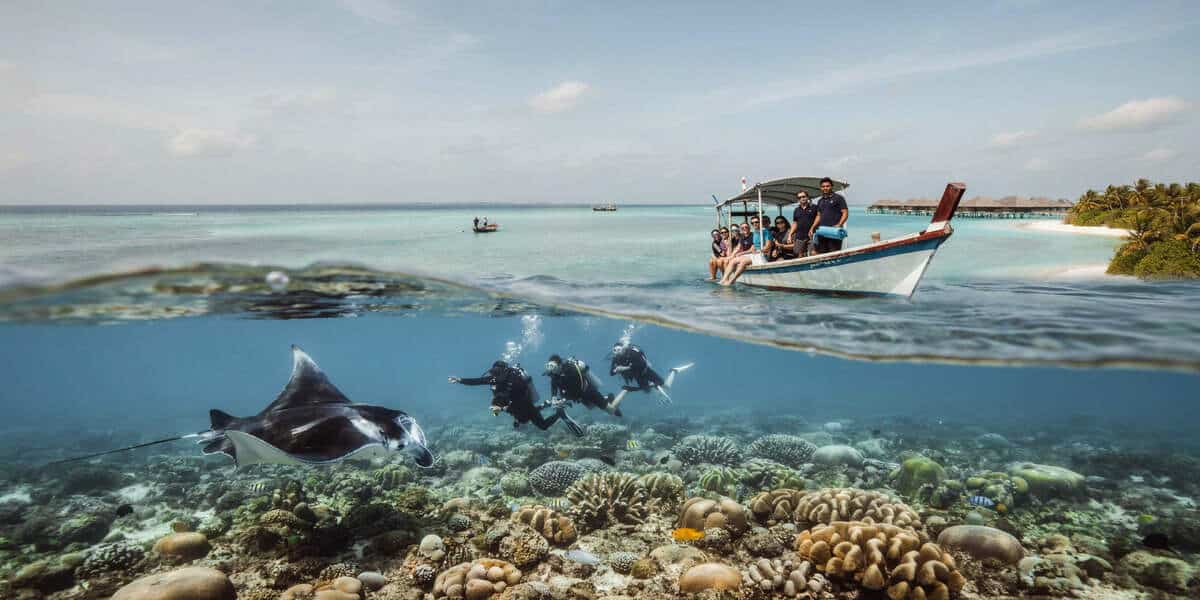
Image generated with Ai
The Tourism of Maldives is picking up pace since manta sightings attract more tourists to the dive boats, local business establishments, and Kandooma itself during the month of September. Holiday Inn Resort Kandooma Maldives is making “Manta Month” a powerful marine tourism event that encompasses wildlife, conservation, and economic activity, and also benefits many other tourism businesses in South Male Atoll.
The Maldives is turning manta-ray conservation into a powerful tourism experience, with Holiday Inn Resort Kandooma Maldives using its third annual Manta Month this September to attract travellers through diving, snorkelling, wildlife encounters and marine education. As of 3 September 2026, the month-long programme is placing South Malé Atoll’s underwater world firmly in the spotlight. The impact reaches beyond one resort. Maldives government research shows that manta-led marine tourism around the nearby Guraidhoo Kanduolhi Marine Protected Area supports dive operators, guesthouses, resorts, boats, guides, restaurants and other local businesses.
Holiday Inn Resort Kandooma Maldives celebrates Manta Month every September. The programme gives visitors a chance to discover manta rays while learning why these animals need protection.
Guests can join guided scuba-diving and snorkelling trips when conditions and sightings allow. Marine education, family activities and conservation programmes add another layer to the holiday.
Advertisement
IHG officially promotes Manta Month as an annual Kandooma experience. It says the programme aims to combine manta conservation with memorable guest encounters in Maldivian waters.
This matters for tourism because it gives travellers a specific reason to visit during September. Instead of selling only beaches, villas and blue lagoons, Kandooma can offer a seasonal wildlife experience.
The idea has already developed from a small event into an established tourism programme.
Visit Maldives reported that Kandooma first held a week-long manta celebration. Strong guest feedback encouraged the resort to extend the concept into a full month from September 2024. It returned in September 2025 following the success of the earlier programme. The 2026 edition is its third annual Manta Month.
That evolution is important.
A month-long event creates more opportunities to market stays around wildlife, diving and conservation. Families can take part in educational activities. Divers can seek manta encounters. Other guests can join clean-ups and learn about the ocean.
It therefore broadens the tourism appeal beyond traditional luxury relaxation.
The strongest evidence of the tourism impact comes from the Maldives Government.
The Ministry of Climate Change, Environment and Energy describes Guraidhoo Kanduolhi Marine Protected Area as a cornerstone of marine tourism in South Malé Atoll. The protected area lies close to Kandooma and contains important manta habitat and diving sites. It was first protected in September 1995 and today covers around 352 hectares.
Government research says the area is linked to 78 registered guesthouses across Guraidhoo, Gulhi and Maafushi, while 11 resorts operate near the protected area.
This shows why protecting manta habitat also has an economic purpose. Healthy marine ecosystems support the experiences that visitors travel to the Maldives to enjoy.
Manta tourism also creates immediate visitor spending.
According to the government conservation plan, during the April-to-November manta season, operators from Maafushi can run three to four boats a day, with around 20 to 30 tourists on each vessel.
The same government assessment recorded 12 or more safari vessels during peak periods. These liveaboards commonly operate seven-to-ten-day itineraries around South Malé Atoll, with Guraidhoo Kanduolhi forming an important stop.
Excursion and diving fees in the government assessment ranged from roughly US$45 to US$55 per person. Equipment hire, guiding and other services create further income.
Crucially, the report says the predictable presence of attractive marine species, particularly manta rays, allows operators to charge premium prices for specialised encounters.
That makes a living manta ray an economic tourism asset.
The tourism effect does not stop at Kandooma’s shoreline.
The government says access to Guraidhoo Kanduolhi has helped support businesses on Maafushi, Guraidhoo and Gulhi.
Visitors need accommodation. They eat in restaurants, use speedboats, book dive trips, visit souvenir shops and water-sports centres.
Marine tourism also creates work for dive masters, boat captains, hospitality employees and tour guides. The government’s conservation plan says local dive centres also provide training and certification, creating employment pathways for young people.
This creates a multiplier effect. One traveller coming to see manta rays can spend money across several parts of the tourism economy.
The timing of Kandooma’s programme is also significant.
Visit Maldives says European travel behaviour is changing in 2026. Europe remains the Maldives’ biggest regional market, but more travellers are looking outside the traditional summer peak.
Its first-quarter tourism intelligence report said one in five travellers was choosing September and autumn instead of the traditional August peak, describing the shift as a move towards a “smart shoulder season”.
Manta Month fits directly into that trend.
A visitor considering a September Maldives holiday now has an added reason to travel: a seasonal marine experience combined with conservation and education.
Visit Maldives has also been actively promoting manta encounters elsewhere in the country in 2026, including around Hanifaru Bay, showing how marine wildlife is becoming an important part of destination marketing.
The economic argument becomes even stronger in research highlighted in Kandooma’s 2026 announcement.
The resort cites peer-reviewed research published in PLOS ONE in June 2026, estimating that manta-ray tourism generated US$227.3 million in the Maldives in 2021, equivalent to around 2.6% of national GDP. The research estimated wider direct economic benefits to businesses, communities and government at more than US$311 million annually.
It also estimated the lifetime tourism contribution of the Maldives’ reef manta population at US$8.6 billion, with a single reef manta potentially carrying a lifetime tourism value of around US$2.6 million.
The figures strengthen a simple message: conservation and tourism economics can reinforce each other.
Kandooma is also using tourism to support conservation.
During Manta Month, guests learn about manta behaviour and marine threats. Children can join themed programmes. Guests and employees can participate in reef and island clean-ups.
The resort also sells manta pendants, with US$5 from each sale donated to the Manta Trust. Visit Maldives has confirmed the donation initiative as part of Kandooma’s wider sustainability programme.
Government authorities, meanwhile, are trying to ensure that growing tourism does not destroy the attraction itself. The Guraidhoo Kanduolhi conservation framework includes visitor-management measures designed to balance tourism with habitat protection.
Maldives tourism is gaining fresh travel power because manta encounters are bringing visitors onto dive boats, into local businesses and towards Kandooma during September. Holiday Inn Resort Kandooma Maldives is using its annual Manta Month to turn the seasonal arrival of manta rays into a stronger tourism experience. Guests can join guided dives, learn about marine life and support conservation, while their spending also reaches boat operators, guides, guesthouses, restaurants and other businesses across South Malé Atoll. The result is a tourism model where wildlife protection, local income and seasonal travel demand can grow together.
Maldives Tourism is demonstrating that value can be generated through nature if the efforts of both conservation and tourism complement each other. The Kandooma Manta Month is giving tourists one more incentive to visit the islands in September, while other services such as diving tours, transportation, local business and marine related activities will reap the advantages of this additional attention. On the other hand, the emphasis on sustainable interaction contributes to the preservation of wildlife which attracts tourists to the island nation. If this trend is sustained, manta tourism will be more than just a vacation adventure.
Advertisement
Tags: Holiday Inn Resort Kandooma, Maldives Manta Tourism, Maldives tourism, Manta Month Maldives, Travel News
Advertisement
Advertisement













Thursday, September 3, 2026
Thursday, September 3, 2026
Thursday, September 3, 2026

Thursday, September 3, 2026

Thursday, September 3, 2026

Wednesday, September 2, 2026
Thursday, September 3, 2026

Thursday, September 3, 2026


