
Australia and New Zealand Push Trans-Tasman Travel Towards a More Contactless Border

Published
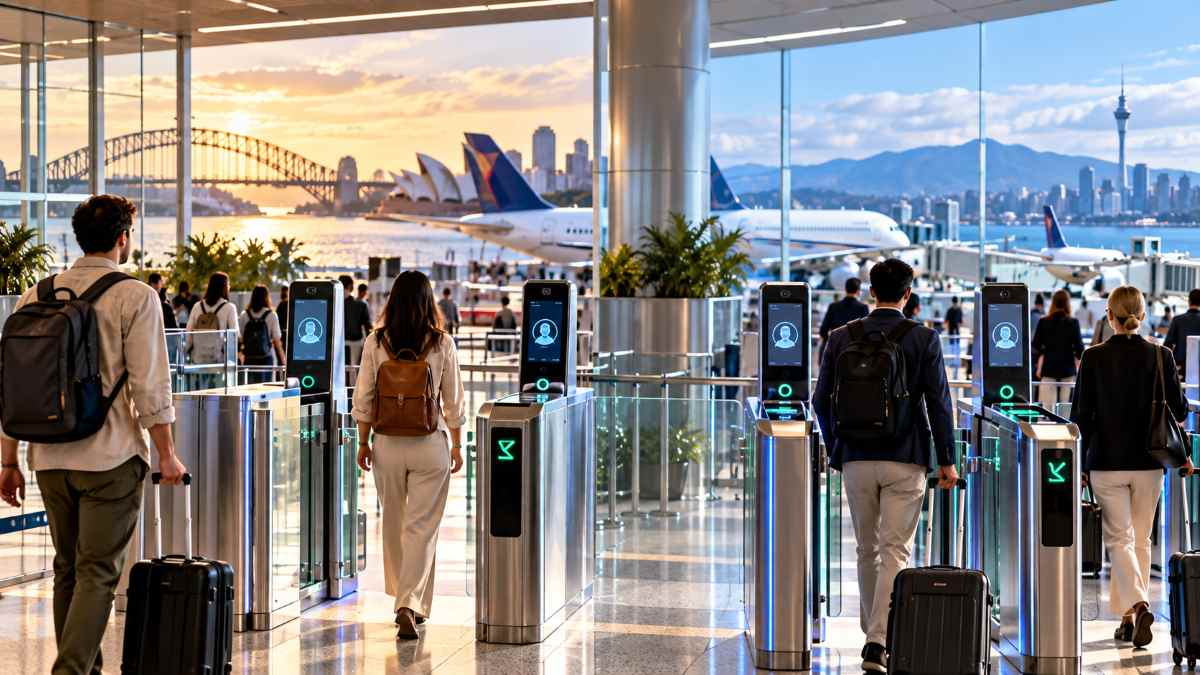
Image generated with Ai
Australia and New Zealand have stepped further towards a digital age in terms of their travel corridor, as the two nations embrace automatic border processing, biometric authentication, and digital declaration of travellers. Sydney, Melbourne, and Auckland are emerging as vital playgrounds of a program meant to minimise bureaucracy and make travel through international airports easy. The way forward is clearly defined, though not yet fully contactless from entry point to boarding point. Currently, there are programs that integrate automatic passport gates, biometric verification, and digital declaration in various segments of the airport process. In Australia, SmartGates are run in some major international airports like Sydney and Melbourne. This process integrates one’s passport and facial features to automate passport control check procedures for eligible travellers.
Expansion of SmartGate facilities has been witnessed in Sydney. In May 2025, eight more SmartGate kiosks have been introduced in the international terminal, leading to an increase in processing capacity of up to 640 people per hour. It has been noticed that there was a 10% decrease in waiting time in the first quarter of 2025 relative to the previous quarter at Sydney Airport. Melbourne is one of the airports in Australia that have come under the digital border initiative of Australia. In May 2026, eligible passengers on some Qantas services from Auckland and Queenstown airports have become a part of the Australia Travel Declaration pilot project. Passengers can fill out the declaration through the Qantas app within 72 hours of departure and get a digital pass that consists of a QR code.
Advertisement
Advertisement
Auckland Builds the New Zealand Side
New Zealand operates biometric eGates at Auckland, Wellington, Christchurch and Queenstown airports. Eligible travellers aged 10 or over with approved ePassports can use the automated system, which compares the facial image captured at the gate with the photograph stored in the passport.
Advertisement
Advertisement
The New Zealand Traveller Declaration is integrated into the arrival process. Travellers must complete the declaration before reaching passport control, and the information is checked when the passport is scanned at the eGate.
Auckland is now preparing for another stage of border modernisation. In September 2026, Auckland Airport announced that New Zealand Customs is beginning an eGate replacement programme alongside changes to the international terminal. The airport is also preparing to change the order of security and passport-control processes as part of its future integrated terminal.
Advertisement
Advertisement
The Trans-Tasman Corridor Becomes a Digital Test Bed
Australia and New Zealand are cooperating through the Trans-Tasman Seamless Travel Group, which is exploring biometrics, digital credentials, pre-clearance and digital declarations to reduce friction between the two countries.
The Australia Travel Declaration is one of the clearest results so far. Its pilot began with passengers travelling from New Zealand to Australia through Brisbane before expanding to selected Sydney services and later Melbourne.
This approach means some passenger information can be supplied before arrival rather than collected entirely at the airport. It also allows border and biosecurity agencies to assess information earlier in the journey.
What Travellers Can Expect
For eligible passengers, the experience is becoming increasingly digital, but important checks remain in place.
Advertisement
Advertisement
Travellers still need valid passports and must meet immigration requirements. Australia continues to use SmartGates for automated passport control, while New Zealand requires the New Zealand Traveller Declaration for arrivals.
Biometrics do not mean every traveller can bypass officers. Passengers may still be directed to manual processing if automated verification fails, additional checks are required or they do not meet eligibility requirements.
The technology is therefore best understood as a layered border system rather than a single biometric corridor extending from the kerb to the aircraft door.
Why the Change Matters for Tourism
Trans-Tasman is one of the major international travel routes in the South Pacific. More efficient border management could affect the experience of these countries even before the passengers set foot in the airports. For regular travelers, elimination of repetitive paper forms and increased use of automated passport check can help ease airport journeys. The benefit to the tourism industry would be the development of the travel system that revolves around the exchange of digital data, not manual processing of paper documents. This next step will be especially crucial as Australia gears up for an influx of international tourists ahead of the Brisbane 2032 Olympics and Paralympics.
The claim made that there has been a 28% reduction in boarding friction due to trans-Tasman technology is unfounded based on the official government documentation consulted in the preparation of this essay. On the contrary, the facts presented indicate that the increase in the capacity of SmartGate, digital declarations and biometrics is an indicator that the country is gradually progressing towards smoother travel. It appears that Australia and New Zealand are creating a new border experience where identity declarations and risk assessments can be conducted via digital platforms and human officers will be present in case additional help is needed for some passengers. Travelling to and from Sydney, Melbourne and Auckland is becoming paperless and seamless.
Advertisement
