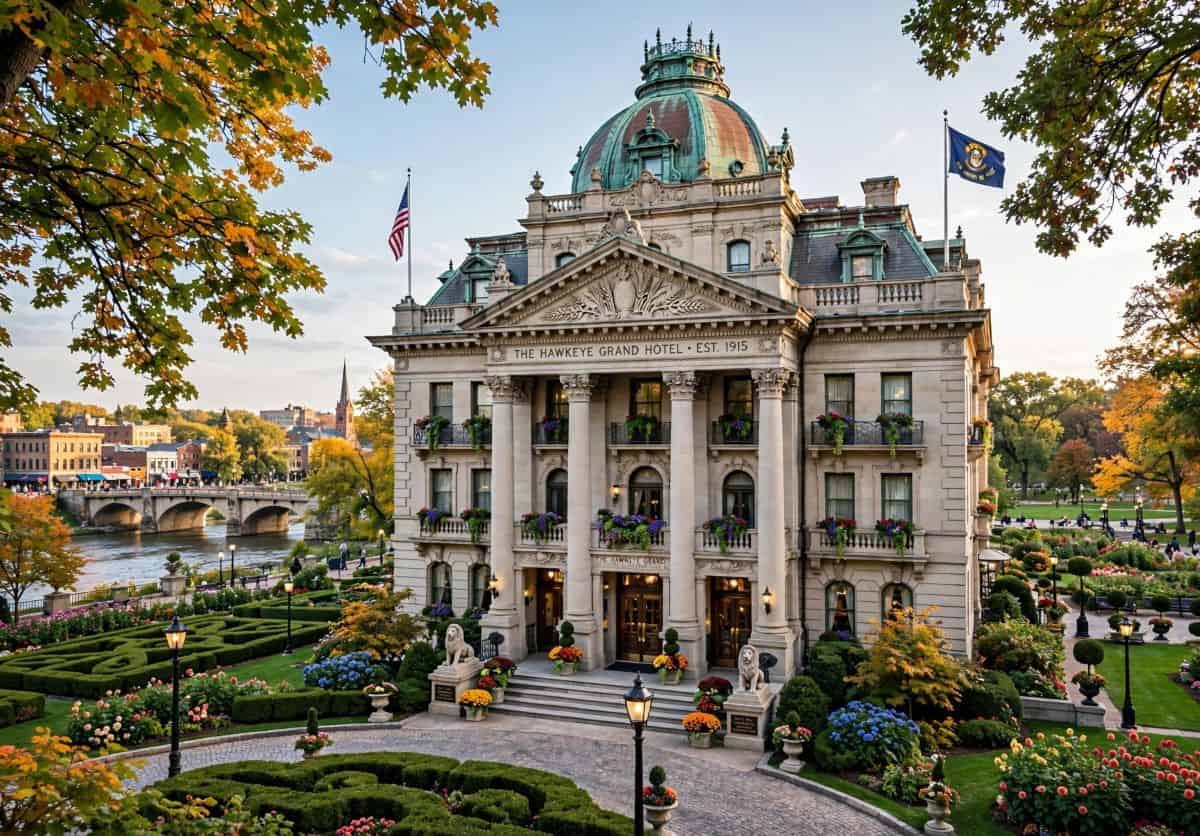
Image generated with Ai
There are many reasons why I think Midwest falls trips to Iowa are enjoyable. Perhaps the most notable is the natural beauty. Midwestern nature presents itself in picturesque autumn palette. Iowa cornfields could even lure some into a corn supply vs. corn demand game. Even the Iowa cornfields motivate some to tailgate. The demand problems the state of Iowa faces are from thousands of people who visit Kinnick for the “Crisp Saturday winds” as well as those who visit the Mississippi and the fall foliage. Even the most corporate of travelers will extend their stays in the suites in downtown and put a strain on Iowa’s housing. Iowa creates even more strain on housing due to the fluctuating corporate taxes, seasonal shifts, and the fall demands. All of these parts play their part, but the most challenging and the most rewarding is knowing when to opt out of the game and vacation at the nearest exit on the interstate. Iowa even has other ways to enjoy the fall, but without the rush of Indiana.
Why Are College Football Games Driving Dramatic Lodging Price Spikes Across Iowa City and Ames?
University athletic schedules serve as the single largest economic catalyst for acute lodging rate surges across central and eastern Iowa during autumn. When tens of thousands of sports fans descend upon collegiate hubs, dynamic hotel algorithms dramatically elevate room rates overnight while enforcing strict minimum stays.
Major home fixtures at Kinnick Stadium in Iowa City and Jack Trice Stadium in Ames completely saturate available lodging capacity. High-stakes encounters such as the University of Iowa hosting Ohio State on 3 October 2026 represent peak dynamic pricing periods statewide. Similarly, Iowa State University hosting Utah on 26 September or Kansas State on 28 November drives extreme room shortages across Story County, leaving budget-conscious travelers seeking alternative regional accommodations.
Advertisement
Advertisement
How Do Regional Commercial Activity and Seasonal Tourism Shift Hotel Rates in Des Moines and Northeast Iowa?
Beyond university athletics, distinct regional economic engines dictate accommodation costs across central urban centers and scenic rural landscapes. In Des Moines, midweek corporate travel and major trade conventions hosted at the Iowa Events Center absorb downtown room inventory, maintaining high rack rates from Tuesday through Thursday throughout September and October.
Conversely, leisure tourism dominates the pricing landscape across Northeast Iowa along the scenic Mississippi River corridors. Scenic destinations in the Driftless Region, including Dubuque and Decorah, experience peak annual rates during mid-to-late October when autumn foliage travelers flock to local blufflands and fill regional boutique inns.
What Is the True Impact of State and Municipal Tax Laws on Total Iowa Hotel Bill Invoices?
Advertisement
Advertisement
Calculating baseline nightly room rates reveals only part of the total accommodation cost, as statutory tax levies alter final invoices. Under Code of Iowa Chapter 423A, room rentals of 90 consecutive days or fewer incur a mandatory 5.0% State Hotel and Motel Sales Tax. Additionally, individual municipalities retain authority to enact a Local Option Hotel and Motel Tax of up to 7.0%. Major urban centers including Des Moines, Cedar Rapids, Iowa City, and Ames levy the maximum allowable rate, resulting in a combined lodging tax burden of 12.0%.
For corporate travelers and displaced residents executing extended projects, state law provides crucial financial relief. Stays exceeding 90 consecutive days by the same individual or corporate entity qualify for a complete statutory tax exemption, with initial taxes paid eligible for full administrative reimbursement through the Iowa Department of Revenue.
When Are the Most Lucrative Seasonal Discount Windows Available for Travelers in Autumn 2026?
Lodging market dynamics follow a downward trajectory as the autumn calendar progresses into early winter. September presents elevated rate volatility due to university move-ins and corporate travel resumptions, making Sunday-through-Tuesday stays the most viable window for securing discounted room rates. October represents peak overall pricing across leisure and collegiate travel sectors, forcing travelers toward secondary markets like Ankeny or Cedar Rapids.
By mid-November, leisure demand contracts following the conclusion of regional harvest seasons, giving rise to promotional offers at independent properties. December opens the largest statewide discounting window as universities enter winter break and corporate travel pauses, making late November through December ideal for direct rate negotiations with hotel sales teams.
How Do Official Government Frameworks and State Tourism Programs Shape Iowa’s Hospitality Industry?
Official regulatory frameworks and administrative benchmark systems continuously anchor the economics of the hospitality sector across Iowa. Standard travel per diem allowances established by the U.S. General Services Administration (GSA) set baseline expenditure limits for official state and federal personnel, acting as price caps on non-event weekdays in government centers such as Polk County.
Simultaneously, state authorities utilize centralized data analytics to track occupancy percentages, Average Daily Rates, and Revenue Per Available Room. Municipalities leverage these metrics to craft sustainable tourism strategies that maintain business stability through off-peak winter months.
What Strategic Purchasing Tactics Can Save Travelers Up to 60 Percent on Iowa Accommodations?
To bypass hyper-inflated room pricing during peak autumn demand, travel buyers should employ structured outer-radius booking strategies. Securing lodging 25 to 35 miles away from primary event hubs such as staying in Newton or the Quad Cities during major game weekends reduces nightly costs by 50% to 60%.
Additionally, engaging hotel sales departments directly between late November and late December allows buyers to capitalize on the early winter rate dip. Finally, auditing complete hotel expenses inclusive of local option taxes ensures accurate budgeting and prevents unexpected financial overruns.
Total Economic Impact & Macro Tourism Revenue Metrics Across Iowa’s 99 Counties
The travel sector serves as a primary driver for Iowa’s broader macroeconomic performance. Across the state’s 99 counties, visitor activity generates an estimated $6.9 billion in direct expenditure annually. This financial intake spreads across multiple commercial categories, with local transit and fuel capturing $1.8 billion, food and beverage operations securing $1.5 billion, and hotel and short-term accommodations generating $1.3 billion. When factoring in indirect supply chain activity and induced household spending, the broader statewide economic output expands to $10.4 billion.
This sustained capital flow generates approximately $1.1 billion in state and municipal tax revenues, funding key civic infrastructure and municipal services. On the employment front, the hospitality ecosystem directly and indirectly supports 68,607 jobs. This accounts for nearly 5% of Iowa’s total non-farm labor force. Key urban centers act as primary economic nodes, led by Polk County with Des Moines, Linn County anchored by Cedar Rapids, and Scott County within Davenport.
Short-Term Rental Dynamics Versus Traditional Lodging Performance Across Key Campus Markets
The rapid expansion of short-term residential rentals through platforms like Airbnb and VRBO has reshaped the hospitality market during peak autumn demand windows. Traditional hotels and short-term rentals show distinct performance variations during major university sports weekends. During high-demand Big Ten and Big 12 home football dates, short-term rental occupancy spikes to 92%–96% across collegiate markets. This performance matches or exceeds traditional hotel inventory levels, creating parallel dynamic price adjustments across both sectors.
Average Daily Rate spreads widen during these major event windows. Traditional hotels enforce strict minimum-night stay requirements, whereas residential rentals often adjust pricing dynamically per room. In core urban hubs like Iowa City in Johnson County and Ames in Story County, peak sports weekends drive elevated yields. In regional centers such as the Des Moines Metro area and Dubuque, corporate convention schedules maintain stable Revenue Per Available Room metrics across both hotel and residential options.
The Agricultural Tourism Engine Driving Fall Harvest and Rural Lodging Demand
Outside major urban centers, agritourism activities drive rural lodging demand through the autumn harvest season. Agritourism, farm stays, and fall harvest festivals contribute over $1.1 billion annually in direct visitor spending on rural recreation and regional entertainment. This rural tourism sector redistributes traveler spending away from primary interstate highways directly into smaller agrarian communities.
Between late September and late October, regional lodging properties experience a 25% to 40% boost in weekend occupancy. Historic bed-and-breakfasts, countryside inns, and boutique farm stays report high booking levels driven by family leisure travel and harvest gatherings. Popular cultural destinations include Pella in Marion County, Kalona in Washington County, the Amana Colonies in Iowa County, and Winterset in Madison County.
Northwest Iowa Lakes Corridor and Resort Market Dynamics
Iowa’s premier northern water resort area undergoes a major economic transition as summer leisure gives way to autumn off-peak conditions. During peak summer months from June through August, the region generates over $1.6 million per day in direct visitor expenditures. Across the four-county resort district, tourism activity contributes over $312 million annually to the local economy. Starting in mid-September, daily traveler spending declines by 60% to 70% as warm-weather lake recreation concludes.
This seasonal drop creates lower off-season pricing for fall travelers. Average Daily Rates at regional resorts drop by up to 50% between August and November. This rate drop offers cost savings for corporate retreats, regional meetings, and late-season leisure stays. Key destinations across this market include Lake Okoboji and Spirit Lake in Dickinson County, Storm Lake in Buena Vista County, and Spencer in Clay County.
Corporate Procurement Strategies and Federal Per Diem Benchmark Rates
Midweek room pricing across Iowa’s county seats is shaped by official government travel allowances. Standard lodging benchmark rates established by the U.S. General Services Administration typically set maximum reimbursement caps between $107 and $128 per night, depending on county designations. These official rates act as baseline anchors, limiting excessive price increases for midweek commercial stays in government centers.
Corporate procurement officers utilize these GSA benchmarks during contract negotiations to secure rates below published public rack pricing. Negotiating annual corporate volume agreements against these baseline caps yields 20% to 35% savings during non-event midweek periods. Primary administrative nodes relying on these structured procurement models include Des Moines in Polk County, Cedar Rapids in Linn County, Davenport in Scott County, and Council Bluffs in Pottawattamie County.
Interstate Hospitality Logistics Along Key Highway Corridors
Iowa’s major interstate highways—specifically I-80, I-35, and I-380—serve as travel routes that direct guest traffic to roadside accommodations. Overall travel spending on transit, vehicle maintenance, fuel, and roadside services totals $1.8 billion annually. Properties along these key corridors maintain stable midweek occupancy rates between 68% and 75%, supported by commercial freight traffic and regional business travel.
These highway corridors also absorb overflow demand during high-demand event weekends in primary college towns. Booking roadside hotels 25 to 35 miles outside saturated host cities yields nightly savings of 40% to 60%. Key highway hubs capturing this overflow demand include Newton in Jasper County, Grinnell in Poweshiek County, Ankeny in Polk County, Coralville in Johnson County, and Williamsburg along the Interstate 80 corridor.
Infrastructure Investments Fueling Regional Hospitality Growth
State-backed capital investments and infrastructure grants continue to expand regional lodging capacity across Iowa. Large development projects include an $80 million expansion at the Field of Dreams site in Dyersville and a $70 million revitalization project at Schmitt Island in Dubuque. These multi-use projects are designed to draw visitors year-round and reduce seasonal occupancy fluctuations.
Funding allocations distributed through the Iowa Economic Development Authority and Elevate Iowa Tourism grants support local tourism projects. These state funds encourage private investment in regional lodging, supporting a projected 1.5% to 2.2% annual growth in hotel supply statewide. Key development hubs driving this expansion include Dyersville in Dubuque County, the Port of Dubuque, the Des Moines Events Center Corridor, and Sioux City in Woodbury County.
The Final Verdict
When Iowa’s landscape begins to fade and Iowa’s winter state begins with the bluffs slowly emptying of people, the quiet nature of the Iowa River begins to take over. With sleeps of empty hotels and stadiums, traveling begins to slow down as well. The Hawkeye State’s real return and the busy season of the travel year come with the calm, beautiful winter nights rather than the busy, packed season. The Fall/Winter travel season in Iowa is more bustling with travelers, but to avoid the noise and rest in peace before the fans begin to roar, travel plans must be made even more strategically. Travelers tend to lose sight of the not so busy, beautiful nature just minutes exits down the highway. It’s not getting a winning travel deal, it’s more of a win to build opportunities that will bring joy to the lives of others.
Frequently Asked Questions
What is the highest combined lodging tax rate in Iowa? The highest combined lodging tax rate in Iowa is 12.0%, consisting of the mandatory 5.0% State Hotel and Motel Sales Tax plus the maximum allowable 7.0% Local Option Hotel and Motel Tax levied by cities like Des Moines, Ames, Iowa City, and Cedar Rapids.
How does the 90-day extended stay rule work for hotel taxes in Iowa? Under Code of Iowa Chapter 423A, any continuous stay exceeding 90 consecutive days by the same person or corporation is exempt from state and local lodging taxes, with taxes paid during the first 90 days eligible for a full refund or credit.
Which autumn dates see the highest hotel rate spikes in Iowa? The highest rate spikes occur during major home football Saturdays at the University of Iowa in Iowa City and Iowa State University in Ames.
Where can travelers find affordable hotel rates during major Iowa sports weekends? Travelers can save 50% to 60% by booking hotels located 25 to 35 miles outside host cities along major interstate corridors, such as staying in Newton, Ankeny, Cedar Rapids, or the Quad Cities.
Advertisement
Tags: hospitality sector, Iowa, Travel News, United States
Advertisement
Advertisement













Saturday, September 5, 2026

Friday, September 4, 2026
Saturday, September 5, 2026

Friday, September 4, 2026

Thursday, September 3, 2026

Wednesday, September 2, 2026

Friday, September 4, 2026