
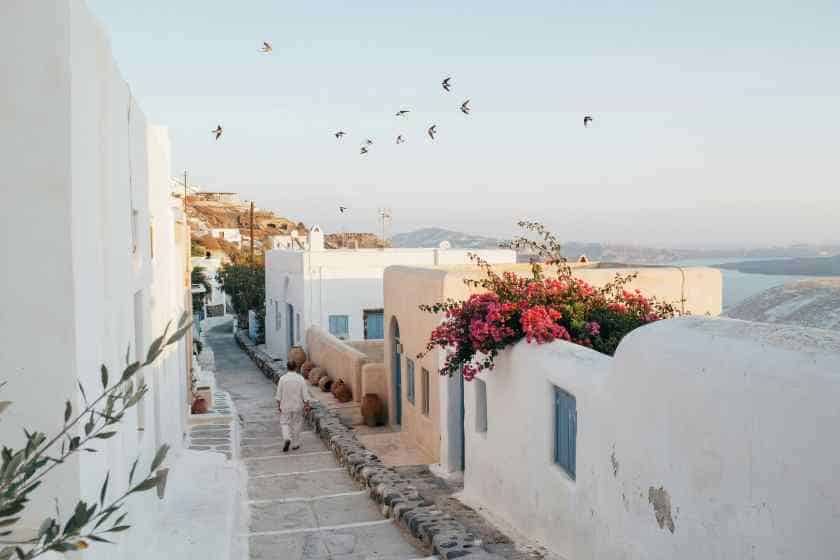
Image generated with Ai
Ancient Thira, Santorini and Fira continue attracting cultural travellers eager to explore one of Greece’s most remarkable archaeological sites, where centuries of Minoan, Dorian and Classical Greek history unfold high above the sparkling waters of the Aegean Sea. Perched dramatically on a cliff overlooking Santorini’s famous caldera, Ancient Thira offers visitors an opportunity to walk through the remains of a once-thriving settlement while enjoying some of the most spectacular historical landscapes in the Mediterranean.
While Santorini is often celebrated for its luxury tourism, volcanic scenery and world-famous sunsets, Ancient Thira provides a very different perspective on the island’s identity. Here, history takes centre stage as visitors discover temples, houses, marketplaces, theatres and tombs that reveal how generations of inhabitants lived, worshipped and traded on one of the Aegean’s most strategically important islands.
For travellers seeking experiences beyond beaches and resorts, Ancient Thira remains one of Santorini’s most rewarding cultural attractions.
Ancient Thira occupies one of the most dramatic archaeological settings in Greece.
Advertisement
Situated atop Mesa Vouno mountain between the coastal resorts of Kamari and Perissa, the settlement commands sweeping views across the island, the surrounding sea and Santorini’s volcanic landscape.
Its elevated position provided natural defensive advantages while allowing residents to monitor maritime routes that connected the island with other parts of the ancient Mediterranean world.
The site’s origins can be traced back to the Minoan period, although it later became an important Dorian settlement and continued developing through Hellenistic, Roman and Byzantine eras.
This long history makes Ancient Thira one of the most significant archaeological locations in the Cyclades.
Advertisement
Advertisement
Today, visitors can explore layers of history spanning more than a thousand years, all preserved within a remarkably scenic setting.
One of the most engaging aspects of a visit to Ancient Thira is the opportunity to walk along the original streets of the settlement.
Unlike many archaeological sites where only isolated ruins remain, Ancient Thira offers a layout that allows travellers to visualise how the city once functioned.
Visitors can move between residential areas, public spaces and religious structures while tracing pathways used by residents centuries ago.
The arrangement of buildings provides insight into urban planning and daily life in the ancient world.
As travellers explore the site, they encounter remnants of homes, gathering spaces and civic buildings that once formed the heart of the community.
The experience creates a direct connection between modern visitors and the people who lived on Santorini thousands of years ago.
Ancient Thira’s ruins reveal the social, cultural and religious foundations of the settlement.
Among the most important structures are the remains of temples that highlight the role of religion in everyday life.
These sacred spaces served as centres of worship and community activity, reflecting the spiritual traditions of successive civilisations that occupied the site.
The settlement also contains the remains of a theatre, where performances and public gatherings would have played an important role in social life.
Nearby, the agora—or marketplace—served as the commercial and civic centre of the city.
In ancient Greek settlements, the agora functioned as more than a place of trade. It was a centre for communication, politics and social interaction.
Exploring these areas allows visitors to understand how Ancient Thira operated as a thriving urban community.
Another important feature of Ancient Thira is its cemetery.
Archaeological excavations have uncovered numerous tombs that provide valuable information about burial practices, social status and cultural traditions.
Some of the tombs are particularly elaborate, reflecting the significance of certain individuals within the community.
The cemetery offers insight into how ancient inhabitants viewed death, remembrance and the afterlife.
For historians and archaeologists, these discoveries continue contributing to a broader understanding of life in the ancient Aegean world.
For visitors, the cemetery adds another layer to the site’s historical narrative.
Many of the most important discoveries from Ancient Thira are preserved in the Archaeological Museum of Thera in Fira, Santorini’s capital.
The museum houses a rich collection of artefacts recovered from excavations across the island.
These include pottery, jewellery, sculptures and everyday objects that help illustrate the cultural and economic life of Ancient Thira.
For travellers, visiting both the archaeological site and the museum provides a more complete understanding of Santorini’s historical significance.
The artefacts reveal connections between the island and wider Mediterranean trade networks while showcasing the artistic achievements of ancient societies.
Among the museum’s most celebrated exhibits are the kouroi discovered at Ancient Thira.
These larger-than-life statues of young men date to the 7th century BC and are considered some of the most important examples of early Greek sculpture.
The statues demonstrate the artistic transition towards the idealised human forms that would later define Classical Greek art.
Their scale, craftsmanship and historical significance continue attracting visitors interested in ancient sculpture and cultural heritage.
The kouroi remain among Santorini’s most recognised archaeological treasures.
As travellers increasingly seek meaningful and educational experiences, Ancient Thira has become an important destination within Greece’s cultural tourism sector.
The site offers a combination of archaeology, history, architecture and natural beauty that few destinations can match.
Visitors can explore ancient ruins while enjoying panoramic views of the Aegean Sea, creating an experience that combines heritage discovery with scenic exploration.
This blend of history and landscape continues strengthening Santorini’s appeal beyond traditional leisure tourism.
Minoan Period
Early settlement activity develops on the site.
Dorian Era
Ancient Thira becomes an important regional settlement.
7th Century BC
Creation of the famous kouroi statues later discovered through archaeological excavations.
Modern Excavations
Archaeologists uncover houses, temples, tombs, sculptures and civic structures.
Present Day
Ancient Thira remains one of Santorini’s most important historical attractions and a leading destination for cultural tourism.
Ancient Thira, Santorini and Fira offer travellers an extraordinary opportunity to experience the island’s rich historical heritage beyond its famous coastal scenery. From its cliffside streets and ancient temples to its marketplace, cemetery and celebrated kouroi statues, the site reveals centuries of Minoan, Dorian and Greek civilisation overlooking one of the Mediterranean’s most spectacular landscapes. As cultural tourism continues growing across Greece, Ancient Thira stands as a destination where archaeology, history and breathtaking natural beauty combine to create one of Santorini’s most unforgettable visitor experiences.
Advertisement
Tags: ancient Greece travel, Ancient Thera, Ancient Thera Greece, Ancient Thira, Ancient Thira Santorini
Advertisement
Advertisement













Friday, September 4, 2026

Friday, September 4, 2026

Friday, September 4, 2026

Thursday, September 3, 2026

Wednesday, September 2, 2026

Friday, September 4, 2026

Friday, September 4, 2026