

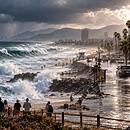
Image generated with Ai
Southern California’s holiday coast is starting to look like a dangerous travel destination thanks to Hurricane Marie. Even though the storm is still far offshore, the NWS has issued a warning for life-threatening Surf and rip currents for most coastal areas.
Sets of local waves up to 12-ft have been reported. The storm is expected to throw large surf and beach erosion through the end of the week and is possibly longer. Further, Newport Beach lifeguards made 177 rescues last Saturday, and Long Beach has issued a 3-day swimming advisory due to increased risk of runoff from contaminated rainfall.
Although Hurricane Marie is expected to die out and not make landfall, the effects are expected to cause dangerous surf through Tuesday. Distantly located systems and tropical storms are often a disruption for coastal holidays, and this is a great example of the disruption caused for travellers without Marie making landfall.
Hurricane Marie has remained hundreds of miles from California. Nevertheless, its large ocean swell has travelled towards the coast and intensified beach hazards.
Advertisement
The National Weather Service’s Los Angeles/Oxnard office issued a High Surf Advisory and Coastal Flood Advisory. Both advisories remain in force through Tuesday evening for affected coastal areas.
For Los Angeles County beaches, forecasters expected surf between five and eight feet. Local sets could reach 12 feet, particularly along south-facing beaches.
The agency also classified the rip-current risk as high. That classification means life-threatening rip currents are likely.
The threat extends beyond Los Angeles. Ventura County beaches face similar surf conditions and a high rip-current risk. Farther north, parts of Santa Barbara and San Luis Obispo counties remain under a Beach Hazards Statement.
This matters for tourism because travellers often assess hurricane risk by tracking the storm’s centre. Marie shows why that approach can be misleading.
A tropical cyclone does not need to make landfall to affect a coastal destination. Powerful winds over open water can generate long-period swells that travel considerable distances.
The National Weather Service specifically warns that distant hurricanes can produce dangerous rip currents far from the storm itself.
The immediate concern is not simply large waves. Instead, several hazards are arriving together.
Large surf can create powerful currents, while rising water levels can push waves farther inland. Heavy rainfall adds another layer of concern through stormwater runoff.
The National Weather Service has warned of coastal flooding alongside the high surf. South-facing beaches remain particularly exposed because of the direction of the incoming swell.
The following table outlines the principal risks currently affecting travellers.Coastal Risk Current Situation Traveller Impact Surf Five to eight feet, with local sets up to 12 feet Swimming and shoreline activities become hazardous Rip currents High risk across several Southern California beaches Strong swimmers can be swept offshore Coastal flooding Advisory active through Tuesday evening Low-lying roads, paths and parking areas may flood Rainfall Tropical moisture affecting Southern California Outdoor plans may face delays Runoff Increased after significant rainfall Water-contact activities may become unsafe Beach erosion Elevated surf can accelerate erosion Access points and exposed areas may become unstable
The combination is especially important for international visitors unfamiliar with Pacific beach conditions.
A beach can appear calm from the promenade while dangerous currents develop beneath the surface. Conversely, a wave that looks manageable from a distance can surge much farther inland than expected.
The National Weather Service advises visitors to check local beach forecasts before entering the water. It also recommends swimming near lifeguards and following posted warnings.
Newport Beach provides the clearest indication of how quickly conditions can overwhelm ordinary holiday infrastructure.
Lifeguards in the city conducted 177 rescues on Saturday, according to Newport Beach Fire Department lifeguard battalion chief Adam Yacenda.
Yacenda described any day exceeding 100 rescues as busy. He also warned that only experts should consider entering the water under the current conditions.
The figures are significant for tourism operators because they demonstrate the difference between beach accessibility and beach usability.
A destination may remain officially open while swimming becomes inappropriate. Restaurants, hotels and attractions can continue operating even when the primary reason for a coastal visit becomes unavailable.
That distinction matters during peak holiday periods. Labour Day traditionally brings heavy recreational activity along Southern California’s coastline.
The National Weather Service had already identified a high likelihood of large waves and strong rip currents for holiday beachgoers. It also highlighted the possibility of coastal flooding on south-facing shores.
For destination managers, the episode underlines the value of communicating conditions quickly. Visitors need clear information about what remains open, what remains accessible and what activities should be avoided.
Surf is only one reason travellers should reconsider swimming.
Long Beach issued an advisory against swimming at city beaches and bays for at least three days. Significant rainfall can increase runoff from storm drains and rivers.
That runoff can carry pollutants into coastal waters. Long Beach has repeatedly used a three-day precautionary period after significant rainfall because of potential water-quality concerns.
This creates an important distinction for travellers.
A beach closure or swimming advisory does not necessarily mean the entire destination is closed. Hotels, restaurants, museums and inland attractions may continue operating normally.
However, travellers should avoid interpreting a functioning beachfront promenade as an invitation to enter the water.
For families, this distinction becomes even more important. Children may be attracted to shallow surf without recognising that strong currents can develop close to shore.
Visitors should therefore follow local health notices as closely as marine warnings.
Seal Beach has taken a different precaution.
The coastal city closed two beachfront parking lots until Wednesday morning. Officials cited anticipated elevated surf and coastal flooding as reasons for the measure.
The Seal Beach Municipal Pier remained open, according to the reported local advisory.
The move illustrates how coastal authorities can manage risk without closing an entire tourism district.
For travellers arriving by hire car, however, parking restrictions can materially change the practicality of a beach visit. Visitors should check local access information before travelling to individual beaches.
The broader lesson is straightforward. Coastal access can change faster than hotel or attraction operating schedules.
Travellers should therefore avoid relying solely on itineraries created several days earlier.
Marie has already weakened from hurricane strength and was forecast to become a tropical storm. Importantly, the storm is not expected to make landfall in California.
That does not mean coastal conditions will immediately normalise.
The National Weather Service forecast significant southerly swell and hazardous surf through at least Tuesday. The latest forecast also pointed to continuing rain across Los Angeles County, with some effects extending into Ventura and Santa Barbara counties.
The timeline is therefore more relevant to travellers than the storm category itself.Period Expected Coastal Situation Travel Consideration Sunday High surf, strong rip currents and rainfall Avoid recreational swimming Monday Five-to-eight-foot surf, local sets up to 12 feet Use extreme caution around exposed beaches Tuesday High surf and coastal flooding advisories continue Check local conditions before coastal excursions After Tuesday Conditions expected to gradually improve Recheck official forecasts before resuming water activities
These timings can change as marine conditions evolve. Travellers should therefore treat the table as a planning guide rather than a guarantee.
The official National Weather Service remains the most useful source for local beach hazards and forecast updates.
The National Hurricane Center provides the latest tropical cyclone advisories and track information.
Rip currents remain one of the most misunderstood beach hazards.
They are narrow channels of water moving away from shore. Strong currents can carry swimmers beyond the breaking surf surprisingly quickly.
Importantly, rip currents do not necessarily look dramatic. A calmer-looking section between breaking waves can sometimes indicate a current channel.
The National Weather Service advises swimmers not to fight a rip current directly. Instead, people should remain calm and move parallel to the shoreline until they escape the current.
If escape proves difficult, floating or treading water can conserve energy. Swimmers should then signal for help.
Travellers should never attempt an unplanned rescue by entering dangerous surf. Instead, they should alert a lifeguard or emergency services.
The National Weather Service says rip currents claim more than 100 lives annually in the United States.
This makes California beach safety a practical issue rather than simply a weather-story detail.
Visitors can still enjoy Southern California without entering hazardous water.
The safest approach is to separate coastal sightseeing from water-based recreation. Travellers can continue using restaurants, shops and many inland attractions while postponing swimming and surfing.
Beach walks also require greater caution during elevated surf. Visitors should remain well back from the waterline and avoid rocks, jetties and exposed coastal structures.
The National Weather Service specifically advises visitors not to turn their backs on the ocean. It also warns people to stay away from jetties during dangerous conditions.
Travel planners should also consider transport conditions.
Coastal flooding can affect low-lying roads, bike paths and parking areas. Rain can also slow traffic and disrupt outdoor events.
Therefore, a flexible itinerary offers a clear advantage.Traveller Type Recommended Adjustment Families Replace swimming with indoor or supervised alternatives Surfers Follow local lifeguard and surf advisories International visitors Check official forecasts before each coastal excursion Road-trippers Monitor coastal flooding and parking restrictions Cruise or marine passengers Check operator-specific weather updates Photographers Keep away from rocks, jetties and exposed edges
The key principle is simple: do not confuse spectacular surf with safe recreational conditions.
The storm also offers a useful case study for destination marketing organisations.
Weather disruptions are not limited to flight cancellations. They can affect the experience that destinations promote most heavily.
Southern California sells a powerful combination of beaches, surfing, coastal drives and outdoor recreation. When those products become temporarily unsafe, tourism businesses need alternative messaging.
Hotels can promote inland attractions and dining experiences. Destination organisations can provide real-time safety links. Tour operators can offer flexible rescheduling where appropriate.
This approach protects both visitor confidence and local businesses.
It also reflects a wider change in travel planning. Modern travellers increasingly expect destinations to provide clear information during weather disruptions.
For the industry, transparency is more useful than simply maintaining a destination’s normal promotional narrative.
California is not unique in facing distant-storm impacts.
The same principle applies to coastal destinations elsewhere. Tropical systems can generate swells that reach areas far beyond the storm’s projected track.
The National Weather Service has documented this phenomenon across multiple US coastlines. Its guidance stresses that distant tropical systems can produce dangerous surf even when local skies remain relatively benign.
That has wider implications for international travel.
A traveller may see a hurricane projected to remain offshore and assume their beach holiday is unaffected. Yet the storm’s most consequential tourism impact may arrive through waves rather than wind.
This is why professional travel advisers increasingly need to monitor marine forecasts alongside conventional weather apps.
For coastal destinations, California beach safety is therefore part of a broader resilience challenge.
The industry must prepare for disruptions that are geographically distant but operationally immediate.
Travellers heading towards Southern California beaches should make several checks before leaving their hotel.
First, they should review the latest National Weather Service beach forecast. Conditions can change during the day, particularly around high tides and changing swell.
Second, they should confirm whether their intended beach has active lifeguard coverage.
Third, they should check local health advisories after significant rainfall. Water-quality restrictions can continue after rainfall appears to have ended.
Finally, travellers should reconsider plans involving rocks, piers, jetties or exposed shoreline areas.
The current conditions make spontaneous swimming a poor choice.
A strong swimmer is not automatically protected against powerful surf or rip currents. Even experienced ocean users can encounter rapidly changing conditions.
The safest decision can therefore be the simplest one: stay out of the water when officials advise against entering it.
Although Hurricane Marie will not reach California, it will change some travel experiences along Southern California.
Travelers along the coast need to think about more than just where a hurricane will make landfall. Other factors, like swell and wave direction, size, and currents, as well as the risk of rip currents, storm surge, and rain and coastal flooding, will determine the safety and playability of a particular beach.
For travelers, the top priority is to not enter the water when there is an active warning. Furthermore, travelers should follow the instructions of lifeguards and stay away from rocks and jetties.
Travel child businesses should be reminded of the importance of flexible travel plans and keeping visitors informed, an important lesson from this event.
Marie will likely move away and weaken. Even so, the energy created will take longer to calm down and disperse than the storm itself.
The main lesson from this event is relevant to people who plan on taking a coastal vacation. Even with a storm far away, you still have to make an informed decision on which beach is safe before assuming a perfect beach day.
Advertisement
Advertisement
Advertisement













Monday, September 7, 2026
Monday, September 7, 2026

Monday, September 7, 2026

Monday, September 7, 2026

Monday, September 7, 2026

Monday, September 7, 2026

Monday, September 7, 2026