
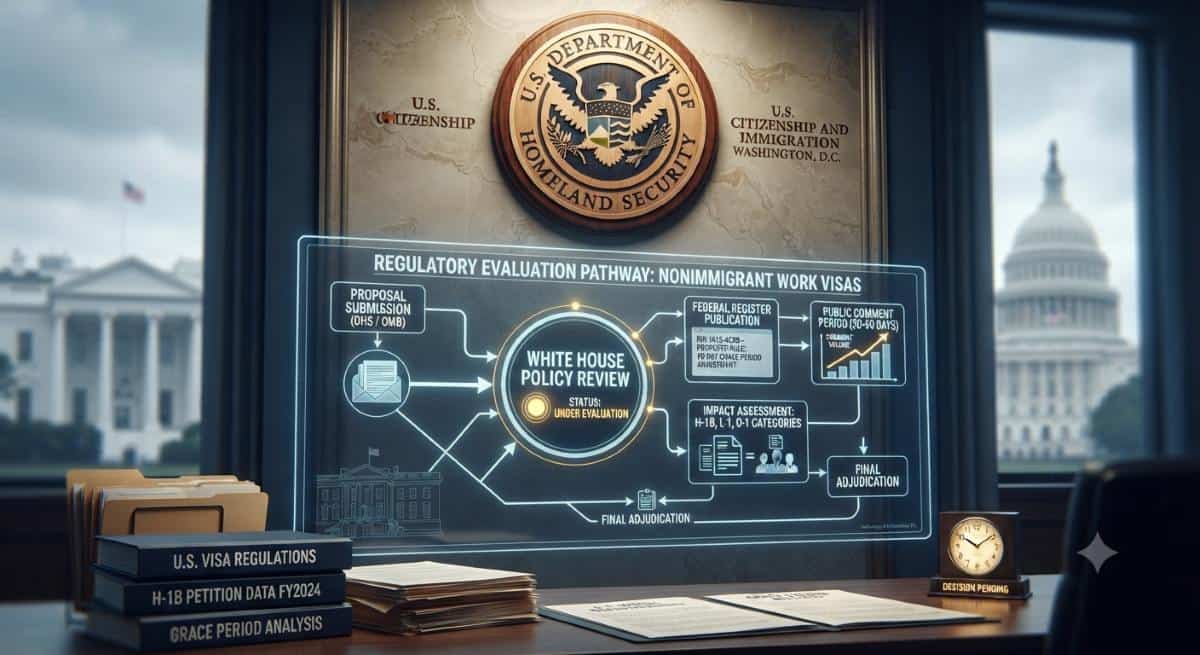
Image generated with Ai
The evaluation of immigration policies within the United States has recently introduced significant anxiety among foreign professionals. A new regulatory proposal has been reviewed by the White House, specifically targeting the elimination of the established 60-day grace period. This grace period was originally introduced in the year 2017 to protect nonimmigrant visa holders and their dependents when employment was unexpectedly terminated. The Department of Homeland Security submitted this measure to the Office of Management and Budget for official evaluation. If the regulation is officially finalized, it will remove the window of time that historically allowed high-skilled employees to search for alternative employment or organize their departure from the country. Indian nationals constitute a major portion of these visa recipients, accounting for 71 percent of all successful applications in the fiscal year 2024 within a broader community of approximately 5.2 million Indian-Americans residing in the United States.
The potential removal of this safeguard creates severe logistical and emotional challenges for global professionals and their families. Affected nonimmigrant categories include E-1, E-2, E-3, H-1B, H-1B1, L-1, O-1, and TN visa holders. When a sudden termination occurs, individuals are currently granted two months to secure a new sponsor, change their status, or wrap up their affairs. Without this duration, affected workers would face immediate out-of-status violations. Families would be forced into sudden displacement, leaving no time to handle property leases, settle bank accounts, or transition children out of educational institutions. Former advisors to the administration have noted that stripping away this protection is fundamentally unworkable and places an unfair burden on law-abiding individuals who have contributed years of dedicated labor and tax revenue to the economy.
Immigration experts and corporate stakeholders have closely monitored these regulatory shifts, noting that the Department of Homeland Security holds the legal authority to adjust or restrict grace periods, though such sweeping actions have historically been rare. Industry analysts observe that the existing 60-day buffer was designed not only to assist workers but also to help U.S. employers effectively manage transitions for both current staff and newly recruited global talent. Critics of the new proposal argue that shortening or entirely erasing this timeline damages the competitiveness of the American labor market in attracting top-tier global minds. Advocacy groups emphasize that high-skilled technology sectors rely heavily on stable immigration policies to maintain innovation, and sudden regulatory volatility could drive talent toward other international markets.
The regulatory process requires specific administrative milestones before any policy takes full effect. Following the recent review by the White House, the next step involves the formal publication of the proposed rule in the Federal Register. Once published, a mandatory public comment period typically lasting between 30 and 60 days will be initiated, allowing stakeholders, organizations, and affected individuals to voice their perspectives. Precise details regarding enforcement dates and exact exemptions remain undisclosed until this official publication occurs. Nonimmigrant workers and their employers are advised to closely monitor updates from immigration attorneys and federal registries to prepare for any transitional requirements or upcoming deadlines.
Advertisement
Advertisement
When contrasted with historical immigration frameworks, the current move represents a sharp tightening of federal oversight regarding temporary foreign workers. Prior to 2017, workers who lost their jobs faced immediate loss of legal status with virtually no formalized window to rectify their situation, which often resulted in chaotic and rushed departures. The introduction of the 60-day grace period in 2017 brought a structured, humane approach to employment transitions. The newly evaluated proposal seeks to reverse this precedent, shifting the regulatory landscape back toward a restrictive stance. While past discussions often centered on extending or protecting visa flexibilities for high-skilled workers, current policy movements indicate an intensification of scrutiny toward nonimmigrant employment categories.
Advertisement
Advertisement
Advertisement













Friday, September 4, 2026

Friday, September 4, 2026

Friday, September 4, 2026

Thursday, September 3, 2026

Wednesday, September 2, 2026

Friday, September 4, 2026

Friday, September 4, 2026