
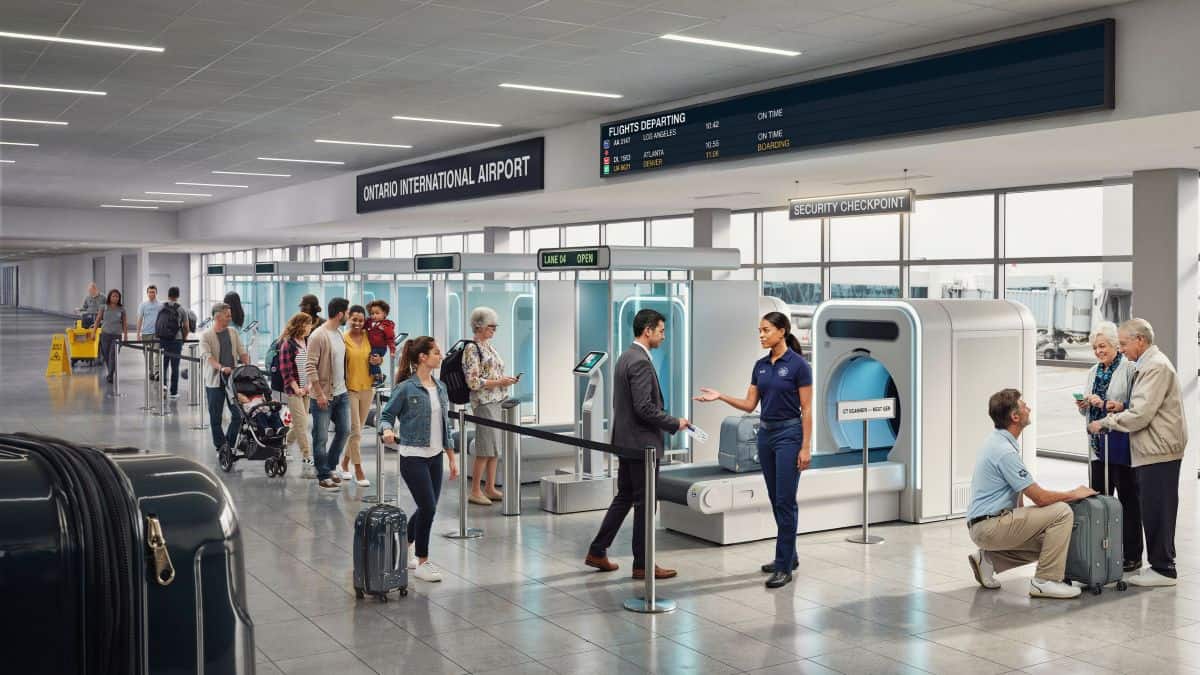
Image generated with Ai
Ontario International Airport in California has opened a major passenger screening upgrade designed to handle growing traveller demand, improve airport movement and create a smoother journey from check-in to boarding. The project comes as airports across North America compete to build faster, safer and more comfortable security experiences for millions of passengers.
The Terminal 2 security expansion at Ontario International Airport (ONT) adds new screening capacity, improves passenger circulation and introduces upgraded identity verification and digital guidance systems. At the same time, major Canadian gateways including Vancouver International Airport, Toronto Pearson, Calgary International Airport and Edmonton International Airport are moving towards advanced CT X-ray screening and redesigned security checkpoints.
Advertisement
The changes reflect a wider transformation in global aviation. Airports are no longer focusing only on adding gates and runways. They are redesigning the passenger journey, with security becoming one of the most important areas for innovation.
Ontario International Airport’s latest investment is directly connected to its impressive growth story. The Southern California airport returned to local ownership in November 2016 and has expanded significantly since then. Passenger numbers increased from around 4.25 million travellers in 2016 to more than 7.1 million passengers in 2025.
Advertisement
Advertisement
This rapid growth created pressure on existing airport facilities. Security checkpoints became one of the most important areas requiring improvement because even a modern terminal can experience delays when passenger screening capacity does not match demand.
The airport’s new Terminal 2 checkpoint expansion includes two additional security screening lanes, redesigned passenger movement areas and a relocated secure exit corridor. A similar improvement programme for Terminal 4 includes an additional screening lane and a modernised exit route.
The project represents an $11 million investment, supported by a $7 million federal grant through the US Federal Aviation Administration’s airport improvement funding programme. The upgrade is designed to increase passenger processing efficiency while maintaining strong security standards.
For travellers visiting Southern California, the benefits are practical. During busy holiday periods and peak departure hours, additional screening capacity can reduce queues, improve movement through terminals and create a less stressful airport experience.
Ontario International Airport describes the project as next-generation passenger screening because it combines new infrastructure with advanced airport technologies. The upgraded checkpoint includes improved document verification equipment, enhanced monitoring systems, upgraded CCTV technology and digital passenger information displays.
However, the airport’s publicly announced improvements focus mainly on checkpoint design and passenger movement rather than confirmed CT carry-on baggage screening.
This difference is important because airport security innovation is developing in several directions. Modern airports are improving not only the machines used for screening bags but also the entire passenger journey around those machines.
The US Transportation Security Administration has continued expanding technologies such as Credential Authentication Technology, automated screening lanes and computed tomography (CT) scanning. These systems aim to improve security accuracy while reducing unnecessary delays for passengers.
CT screening allows security officers to examine detailed three-dimensional images of carry-on bags. The technology has become one of the most important developments in airport security because it can reduce the need for passengers to remove certain items during screening.
Ontario International Airport’s upgrade strengthens its operational foundation. Future technology additions could further align ONT with airports leading the global shift towards fully automated and digitally connected security experiences.
While Ontario International Airport is expanding its security checkpoint capacity, several major US airports are taking similar steps to redesign passenger screening for a new era of aviation growth. Across the United States, airports are investing in larger checkpoints, additional screening lanes, smarter passenger-flow designs, automated screening systems and advanced security technology to handle rising traveller numbers.
The transformation is happening at airports of all sizes. Some airports are expanding existing security areas inside current terminals, while others are creating completely new centralised screening facilities as part of major terminal redevelopment programmes.
Unlike Ontario International Airport’s current focus on adding capacity, improving circulation and strengthening identity verification, several major US airports are combining physical expansion with technologies such as Computed Tomography (CT) screening, Automated Screening Lanes (ASLs) and advanced passenger processing systems. These developments show that airport security is becoming a key part of the overall travel experience rather than simply a mandatory checkpoint.
Denver International Airport has become one of the strongest examples of large-scale security modernisation in the United States. Through its Great Hall programme, DEN created new passenger screening infrastructure designed around higher capacity, improved movement and better technology integration.
The airport opened its new West Security Checkpoint in 2024 and later opened the East Security Checkpoint in 2025. Both facilities feature 17 security lanes and were designed to distribute passenger demand more efficiently across the terminal.
Denver’s approach represents a major shift from traditional airport layouts. Instead of simply adding more equipment into existing spaces, the airport redesigned the passenger journey by creating larger screening areas with improved access points, clearer movement patterns and modern technology systems.
Houston’s George Bush Intercontinental Airport is following a similar direction through major terminal redevelopment. The airport’s Terminal E modernisation programme includes a significantly expanded security operation with 17 TSA screening lanes and next-generation security technology.
The project is part of Houston’s wider effort to transform the international passenger experience. The airport is combining expanded security capacity with upgraded ticketing areas, baggage systems and passenger facilities to create a more efficient international gateway.
Tampa International Airport provides one of the closest comparisons to Ontario International Airport because it is upgrading existing passenger facilities rather than building an entirely new terminal. In 2025, Tampa completed major security checkpoint expansions at Airside A and Airside E.
The projects increased checkpoint space, improved passenger queuing areas and expanded screening capacity from six to seven lanes at each location. Tampa has also introduced CT screening technology as part of its security upgrade strategy, with the airport planning broader deployment of advanced screening equipment across its facilities.
Pittsburgh International Airport represents another major model for future airport security. Its transformed terminal, opened in 2025, created a single large security checkpoint with 12 screening lanes, state-of-the-art screening equipment, updated passenger information displays and a redesigned post-security area.
The Pittsburgh approach demonstrates how airports are moving towards centralised security models where passengers experience a more organised and efficient journey through screening.
Louisville Muhammad Ali International Airport is another strong comparison with Ontario International Airport because its project focuses on expanding an existing checkpoint rather than replacing the entire terminal.
The airport began construction on a major security checkpoint expansion project designed to add up to 10 screening lanes, improve passenger movement and increase screening capacity by more than 60%. The project also includes a new breach-control exit lane and additional passenger processing space.
The Louisville project shows a growing trend across the United States. Airports that experienced passenger growth before having large terminal redevelopment plans are choosing targeted security improvements to remove bottlenecks quickly.
Dallas Fort Worth International Airport is also continuing security improvements as part of wider terminal expansion. Recent Terminal C checkpoint upgrades have been completed, while the airport’s future Terminal F development will include new security screening facilities as part of a larger $4 billion expansion programme.
Boston Logan International Airport has also focused on improving passenger movement through security and terminal redesign. The airport’s modernisation projects include larger security areas, improved wayfinding and redesigned passenger spaces aimed at creating a smoother travel experience.
These examples show that the US airport industry is following a common strategy. Airports are no longer treating security checkpoints as isolated operational areas. Instead, they are integrating security into complete passenger-experience redesigns.
Ontario International Airport’s security expansion fits clearly into this wider American trend. The California airport is responding to strong passenger growth by increasing screening capacity, improving exit routes and creating a smoother passenger flow through Terminal 2 and Terminal 4.
However, the scale and technology focus vary between airports. ONT’s publicly announced project highlights two additional Terminal 2 screening lanes, one additional Terminal 4 lane, new secure exit corridors, improved document verification, upgraded monitoring systems and digital passenger guidance.
Other US airports are taking the next step by combining these improvements with large-scale CT screening deployments and automated screening infrastructure.
The Transportation Security Administration has identified Computed Tomography, Automated Screening Lanes and Credential Authentication Technology as key elements of future airport security. CT systems create detailed three-dimensional images of carry-on bags, allowing security officers to analyse contents more effectively, while automated lanes are designed to improve passenger processing speed.
Tampa, Denver, Houston and Pittsburgh demonstrate how airports are combining these technologies with larger physical redesigns. Their projects show that future security improvements will depend on both advanced machines and smarter terminal layouts.
Ontario International Airport therefore represents an important part of this national movement. Its upgrade is a practical response to rapid passenger growth and operational pressure. The airport has strengthened its security foundation, while other major US airports show where the next stage of development is heading.
The security transformation taking place at Ontario International Airport and other major US airports signals a major change in how travellers will experience airports in the coming years.
Passengers can expect security checkpoints to become faster, more organised and less disruptive. Additional lanes will reduce congestion during busy travel periods, while smarter layouts will make movement through terminals easier.
Advanced screening technologies will also reduce some of the traditional frustrations associated with airport security. CT scanners, automated lanes and digital identity verification systems are designed to improve both security accuracy and passenger convenience.
For Southern California travellers, Ontario International Airport’s investment strengthens its position as a growing alternative to larger regional hubs. As passenger demand continues increasing, airports that improve their security infrastructure will have a competitive advantage.
The wider US airport upgrade movement shows that the future of aviation will not only depend on more flights and bigger terminals. It will also depend on creating a smoother journey from the moment travellers enter the airport until they reach the aircraft. Ontario International Airport has joined this national transformation. From California to Colorado, Texas, Florida and Pennsylvania, airports across America are rebuilding security systems to prepare for the next generation of global travel.
Advertisement
Advertisement
Advertisement













Sunday, September 6, 2026

Sunday, September 6, 2026

Sunday, September 6, 2026
Sunday, September 6, 2026

Saturday, September 5, 2026

Saturday, September 5, 2026

Saturday, September 5, 2026

Saturday, September 5, 2026



