
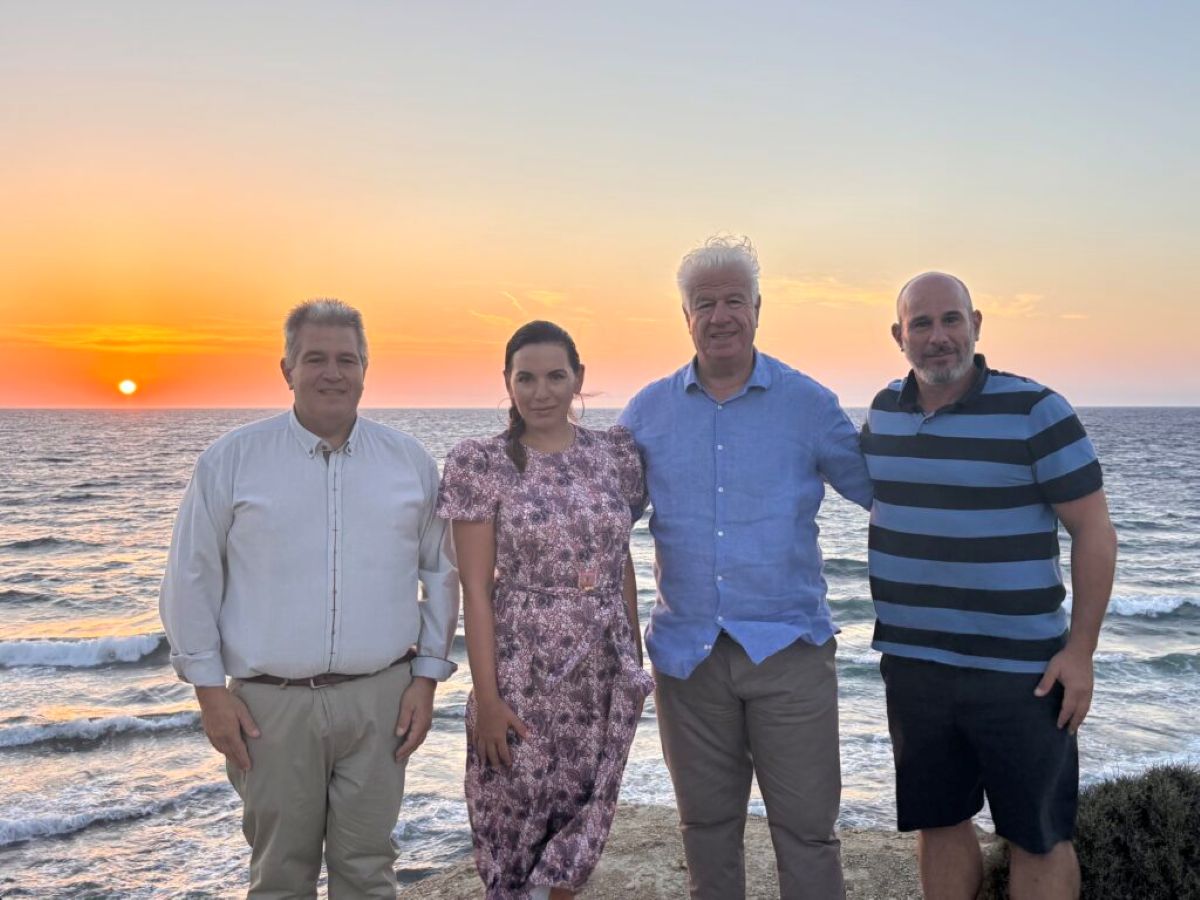
The Greek government is working towards making sure that the tourism future of the Diapontia Islands will improve through increased focus on improved transport connectivity, port facilities and carefully managed tourism development. This came after the visit by Tourism Minister Olga Kefalogianni and the Ionian Islands Regional Governor Yiannis Trepeklis on 24 August 2026.
The talks were geared towards finding solutions for the challenges facing the three islands which include land infrastructure, port facilities, linkages to Corfu, funding options and tourism planning. Greek officials are looking for a solution to create a platform for improving lives of the locals without reducing the size of the islands or their uniqueness.
The Diapontia Islands, lying off north-western Corfu, represent a markedly different tourism proposition from Greece’s larger and more heavily visited island destinations. Their comparatively small communities, natural landscapes and limited infrastructure mean that simply increasing visitor numbers would not necessarily constitute successful development. The government’s approach is therefore centred on making the islands economically viable while retaining the attributes that make them distinctive. During the official visit, discussions were held with residents, local authorities and business representatives to identify priorities and examine realistic pathways towards sustainable tourism growth.
This approach is important because tourism on small islands operates under different constraints. Transport capacity is limited. Infrastructure can be more expensive to maintain. Seasonal demand may place pressure on services. A development strategy must consequently connect tourism with the needs of permanent communities rather than treating the islands solely as holiday products. For Greece, the policy question is increasingly about quality, resilience and local benefit, not simply volume.
Advertisement
Advertisement
Connectivity sits at the centre of the development strategy. Unlike destinations with major airports and extensive road networks, Othonoi, Mathraki and Ereikousa depend heavily on maritime links, making ports and reliable connections fundamental to both tourism and everyday island life. The Ministry of Tourism confirmed that discussions covered land and port infrastructure, alongside ways to improve links between the islands and Corfu. Better connectivity could make it easier for travellers already staying on Corfu to add one or more of the smaller islands to their itinerary.
The official Municipality of Central Corfu tourism portal describes Othonoi as around 12 nautical miles from northern Corfu, while Mathraki is linked to Corfu through small-boat connections using its island harbours. This illustrates why transport reliability is not merely an infrastructure matter. It is a tourism-development issue. More dependable maritime access can support longer stays, island-hopping, accommodation demand and small-business activity. At the same time, capacity needs to remain proportionate to the islands’ physical limits.
One of the strongest opportunities identified by the Greek government is the proximity of the islands to Corfu, an established international tourism destination. Rather than attempting to build global recognition for the Diapontia Islands completely independently, policymakers see an opportunity to use Corfu’s existing visibility as a gateway. The Ministry has specifically identified the combination of Corfu’s international recognition and stronger Diapontia-Corfu connectivity as an advantage that could increase exposure for the three smaller islands.
Crucially, the objective is described as gentle and balanced tourism development that respects their environment, scale and identity. A separate ministerial meeting held in Corfu on 21 August 2026 also placed Ereikousa, Othonoi and Mathraki within a wider strategy aimed at promoting smaller Ionian islands and extending tourism activity beyond the conventional high season. That could allow the Diapontia Islands to benefit from Corfu’s visitor flows without attempting to replicate Corfu’s tourism model.
Advertisement
Advertisement
A central element of the strategy is the Destination Management and Promotion Organisation, or DMMO, for the Ionian Islands Region. The organisation is expected to play a broader role than conventional tourism marketing. According to the Ministry, it can help develop individual plans that consider the character, requirements and growth potential of each island rather than applying a uniform regional tourism model. The government has outlined several functions for the DMMO, including collecting and analysing data, coordinating public bodies and businesses, managing pressures on island destinations and developing a long-term sustainable tourism strategy.
This is particularly significant for small islands. Marketing can attract visitors quickly. Infrastructure and community capacity often expand much more slowly. A destination-management structure can therefore help authorities understand how much tourism an island can realistically support and identify when additional investment is needed. For Othonoi, Mathraki and Ereikousa, this could mean moving from fragmented promotion towards a more carefully managed tourism proposition.
Greek authorities are also examining funding opportunities to support special-interest tourism, rather than relying exclusively on conventional beach tourism. The aim is to create a distinctive, high-quality visitor product built around the particular characteristics of each island. That strategy has clear potential.
Othonoi, the largest of the three main Diapontia Islands, combines coastline, small settlements and maritime scenery. The official Corfu tourism portal identifies it as Greece’s north-westernmost area and notes a coastline extending for around 30 kilometres. Mathraki, meanwhile, is the smallest of the group and is characterised by small bays, beaches and compact island settlements. Its maritime environment and quieter scale can appeal to travellers seeking nature-oriented trips away from heavily developed resorts Ereikousa similarly offers a low-density island environment within reach of Corfu. Together, the islands could support carefully managed forms of walking tourism, nature tourism, marine experiences, sailing, cultural discovery and slow travel if infrastructure and local capacity develop alongside demand.
The most notable feature of the initiative is what Greece is not proposing. The objective is not uncontrolled resort construction or rapid mass-market expansion. The Ministry has repeatedly connected development with the preservation of the islands’ physical scale, natural environment and local identity. The government’s recently signed Special Spatial Planning Framework for Tourism, prepared by the Ministries of Tourism and Environment and Energy, establishes broader guidelines for tourism development while giving particular consideration to safeguarding the character of small islands.
That distinction matters because the very characteristics that could attract travellers to the Diapontia Islands — relative tranquillity, open landscapes, small communities and an absence of large-scale urbanisation — could be weakened by poorly controlled development. The challenge is therefore to increase tourism’s economic contribution without destroying the tourism product itself. This creates an opportunity for Greece to position the islands around lower-impact, experience-led tourism, where value per visitor can matter more than sheer visitor volume.
The policy also has an important social and economic dimension. Greek authorities have identified support for smaller islands as a national priority because these communities need sufficient economic activity, infrastructure and opportunity to remain viable places for permanent residents. Tourism can contribute by supporting accommodation businesses, restaurants, transport operators, local retail, marine services and other small enterprises. However, tourism alone cannot guarantee island sustainability. Infrastructure, transport and public services remain essential.
The government’s focus on both funding and infrastructure improvement therefore indicates a broader development agenda rather than a promotional campaign alone. If visitor demand becomes more predictable, local businesses may gain greater confidence to invest. Stronger transport links could also improve conditions for residents as well as tourists. The potential economic impact is therefore two-sided: tourism can help support island livelihoods, while better facilities for local communities can make the destination itself more resilient.
The approach for Othonoi, Mathraki and Ereikousa Island represents a larger trend regarding the way that Greece can develop its tourism industry. Rather than focusing all demand for tourism on known destinations, there is the potential for Greece to direct visitors to some of its smaller islands and less well-known attractions, if done in moderation and with enough infrastructure. The Diapontia Islands already have the environment and distinctiveness necessary to offer a differentiated tourism product.
What is lacking are adequate connections, infrastructure, planning, funding and promotion. Utilizing Corfu as a stepping stone while having the Ionian Islands DMMO facilitate coordination and promotion could allow for these islands to enter the broader Greek tourist market in a sustainable fashion. Ultimately, for tourists, that means gaining access to a quieter side of the Ionian Islands. For residents, it also means having a tourism framework which is sustainable and capable of delivering economic activity without undermining the unique environment which attracts people in the first place.
Image Source: Ministry of Tourism, Greece
Advertisement
Tags: Corfu travel connections, Greece Diapontia Islands tourism, Greek tourism infrastructure, island destination management, sustainable island tourism
Advertisement
Advertisement












Sunday, September 6, 2026

Sunday, September 6, 2026

Sunday, September 6, 2026

Sunday, September 6, 2026
Saturday, September 5, 2026
Saturday, September 5, 2026
Saturday, September 5, 2026
Saturday, September 5, 2026



