
Brittany Ferries Reshapes Its Network as Poole–Cherbourg Closes and Barfleur Moves to Rosslare

Published
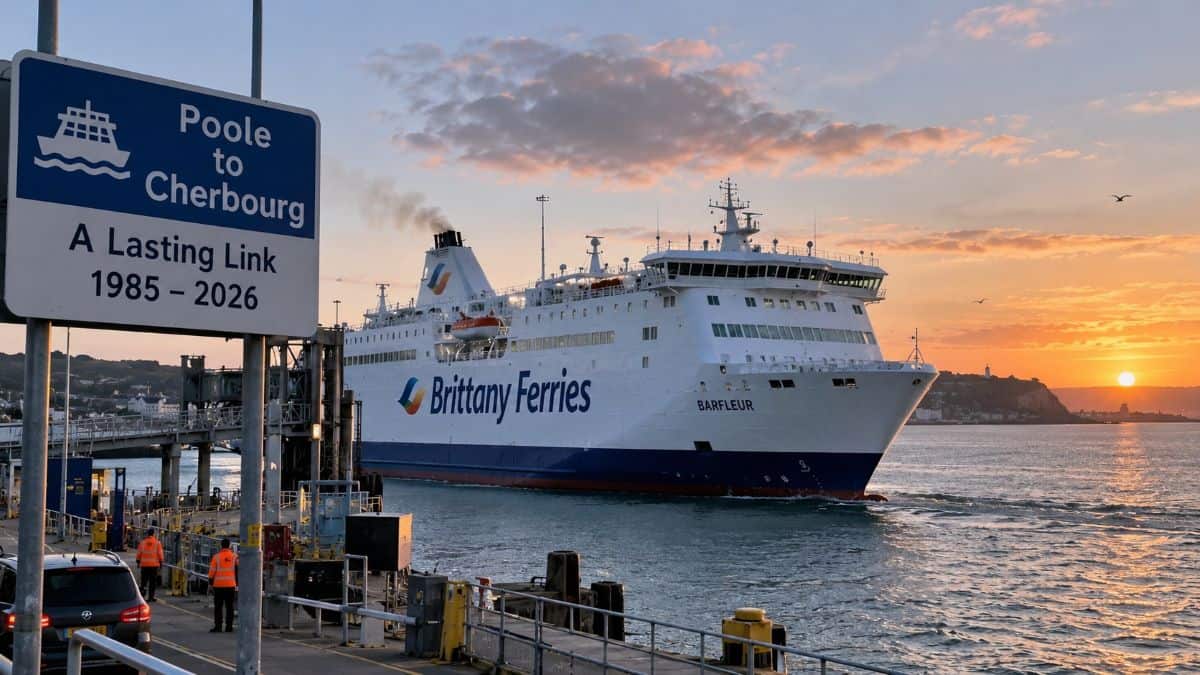
Brittany Ferries Reshapes Its Network as Poole–Cherbourg Closes and Barfleur Moves to Rosslare because the company is redirecting vessel capacity towards a more strategically important Ireland–France freight corridor. The long-running Poole–Cherbourg service had been scheduled to end on 31 October 2026, but the closure was brought forward after the withdrawal of Cotentin and a gearbox failure affecting Commodore Clipper. As Barfleur Moves to Rosslare, Brittany Ferries is prioritising a route that now carries nearly a quarter of its freight traffic. For travellers, the change means the direct Dorset–Normandy connection disappears, while alternatives from Portsmouth and other Channel ports remain available.
Why Did Brittany Ferries Close Poole–Cherbourg Earlier Than Planned?
The early ending was primarily an operational decision rather than a sudden closure of Poole Harbour.
Brittany Ferries had already confirmed that its Poole–Cherbourg passenger and freight operation would cease at the end of October 2026. Poole Harbour Commissioners had identified 31 October 2026 as the expected final sailing date. That timetable changed when pressure developed elsewhere in the company’s fleet.
Cotentin, which had been operating between Rosslare and Cherbourg, was scheduled for sale and withdrawal. At the same time, a gearbox failure on Commodore Clipper removed a vessel that could otherwise have helped cover capacity.
Advertisement
Advertisement
Brittany Ferries therefore transferred Barfleur away from Poole earlier than expected. Its first reassigned Rosslare–Cherbourg operation was scheduled from 12 October 2026, cutting approximately three weeks from the final Poole operating period.
For affected passengers, the significance lies in having to rearrange not only the ferry ticket but potentially the entire road-travel itinerary.
Advertisement
Advertisement
How Important Was the Route After More Than Four Decades?
The modern Brittany Ferries relationship with Poole–Cherbourg dates to 1985, according to Poole Harbour Commissioners.
That means the operator maintained the connection for more than four decades, serving residents, visitors, freight customers and businesses travelling between southern England and Normandy. The wider port-to-port connection has even older roots dating to earlier ferry operations in the 1970s.
The UK Department for Transport continued to classify Poole–Cherbourg among the country’s international short-sea passenger routes. It was still included in the official group of international routes carrying more than 1,000 passengers during 2024.
That distinction is important. The route was not merely a nostalgic remnant of an older ferry era. It remained part of Britain’s monitored international passenger network in recent statistical periods.
Its closure therefore changes the Channel travel map for motorists in Dorset and parts of south-west England.
Why Was Barfleur So Closely Linked With Poole?
Barfleur effectively became synonymous with the route.
Advertisement
Advertisement
The vessel entered service between Poole and Cherbourg in April 1992, having been ordered specifically for the increasingly popular crossing. Demand was strong enough during construction for the ship’s original design to be lengthened by nine metres.
Barfleur in Numbers
| Specification | Official figure |
|---|---|
| Built | 1992 |
| Length | 158 metres |
| Beam | 24 metres |
| Gross tonnage | 20,133 GT |
| Speed | 19.5 knots |
| Passenger capacity | 1,212 |
| Car capacity | 547 |
| Lorry capacity | 75 |
| Cabins | 59 |
| Beds | 233 |
The vessel’s capacity explains why it became important for motorists, families, coach groups and freight. It could carry more than 1,200 passengers alongside hundreds of cars and dozens of lorries.
The early closure therefore ends not just a ferry service, but a roughly 34-year association between Barfleur and Poole–Cherbourg.
Why Did Travellers Value the Direct Poole–Cherbourg Crossing?
One of the route’s strongest advantages was journey time.
Brittany Ferries marketed it as its shortest conventional crossing to France, with a typical journey taking around 4 hours and 45 minutes.
That was particularly valuable for travellers living in Dorset, Devon and other parts of southern and western England. Driving to Poole could be more convenient than travelling east towards busier Channel ports.
Advertisement
Advertisement
Cherbourg also worked well as an arrival point for motorists heading deeper into Normandy, Brittany, the Loire or towards Paris.
For caravan owners and families carrying substantial luggage, a direct conventional ferry could also offer greater practical flexibility than flying.
The loss therefore affects more than crossing time. Former customers must now consider extra road mileage, alternative ports, different check-in arrangements and potentially different French arrival points when rebuilding a similar itinerary.
Why Was Rosslare–Cherbourg Given Priority?
The strategic answer is freight.
Brittany Ferries says the Rosslare–Cherbourg corridor now accounts for nearly 25% of the company’s entire freight traffic. That makes the Ireland–France route commercially and operationally significant.
The corridor has also gained strategic importance since Brexit because it allows freight to move directly between Ireland and continental Europe without travelling through Great Britain.
Advertisement
Advertisement
When fleet problems emerged, Brittany Ferries therefore had a strong commercial reason to place Barfleur on Rosslare–Cherbourg rather than leave it at Poole for the final few weeks.
| Route factor | Poole–Cherbourg | Rosslare–Cherbourg |
|---|---|---|
| Main role | Passenger, vehicle and freight | Major passenger/freight corridor |
| 2026 position | Closing | Strategically prioritised |
| Barfleur deployment | Ended early | Began from 12 October |
| Freight significance | Lower priority | Nearly 25% of company freight traffic |
This comparison helps explain why the closure was accelerated rather than simply allowed to reach its original end date.
What Happens to Travellers With Existing October Bookings?
Brittany Ferries says customers whose Poole bookings were affected are being offered either alternative travel from Portsmouth or a full refund.
For many travellers, changing ports is not a minor inconvenience.
A rerouted journey can affect:
- driving distance and fuel costs;
- motorway planning;
- ferry check-in times;
- hotel reservations;
- onward travel through France;
- toll expenses;
- pet travel arrangements;
- caravan or motorhome logistics.
Portsmouth–Cherbourg becomes the most obvious substitute for travellers still wanting a direct Brittany Ferries connection into Normandy.
Advertisement
Advertisement
However, passengers should compare the entire journey rather than just sailing duration because extra driving in Britain may significantly alter overall travel time.
Does Poole Still Have a Direct Connection With France?
Poole is not losing every international ferry service.
Brittany Ferries says fast-craft operations will continue from Poole through Guernsey and onward to St Malo, with 2027 bookings already available for that service.
The specific loss is therefore the direct conventional Poole–Cherbourg route.
Other UK–France corridors remain available, including:
| UK departure route | French destination |
|---|---|
| Dover | Calais |
| Dover | Dunkirk |
| Newhaven | Dieppe |
| Plymouth | Roscoff |
| Portsmouth | Caen |
| Portsmouth | Cherbourg |
| Portsmouth | Le Havre |
| Portsmouth | St Malo |
These routes remain part of the UK’s official international short-sea passenger network.
Advertisement
Advertisement
For Dorset-based travellers, however, none recreates the exact convenience of driving directly to Poole and arriving in Cherbourg.
Why Does the Closure Matter for Dorset Tourism and Business?
Poole Harbour Commissioners has described the route as important to tourism, trade and cultural exchange between southern England and northern France.
The port authority specifically highlighted the impact on local residents, businesses, visitors, freight operators and the wider regional economy.
Ferry routes generate spending beyond the port gates. International motorists can use local hotels, restaurants, petrol stations, supermarkets and parking facilities before sailing. Freight movements also create demand for logistics and port-related services.
The closure therefore removes a long-standing flow of cross-Channel traffic from Poole even though other maritime activity continues.
For Normandy, the change also removes one direct arrival channel for British motorists.
Advertisement
Advertisement
Comment From Anup Keshan, Founder and Editor-in-Chief of Travel And Tour World
“Poole–Cherbourg represented far more than a ferry timetable; it was a long-standing tourism and transport connection linking southern England directly with Normandy. Its early closure will require some travellers to reconsider driving routes, departure ports and onward holiday plans, particularly those accustomed to using Poole for vehicle-based trips into France. At the same time, Brittany Ferries’ decision illustrates how ferry networks increasingly balance tourism demand with strategically important freight corridors. The continued availability of Portsmouth services and Poole’s fast-craft connection through Guernsey to St Malo gives travellers alternatives, but the end of this direct route still marks a significant change in UK–France travel.”
Conclusion: Why Has the UK–France Ferry Route Closed Earlier Than Expected?
The UK to France ferry route has closed early after more than 40 years because fleet pressures forced Brittany Ferries to prioritise its increasingly important Ireland–France operation.
The original Poole–Cherbourg final sailing had been set for 31 October 2026, but the withdrawal of Cotentin and a gearbox failure affecting Commodore Clipper changed the operational picture. Barfleur was consequently reassigned to Rosslare–Cherbourg from 12 October, a corridor carrying nearly 25% of Brittany Ferries’ freight traffic.
For passengers, Portsmouth offers the closest direct alternative to Cherbourg, while Poole retains fast-craft links through Guernsey to St Malo.
For Dorset, however, the change closes a significant chapter: a conventional direct ferry connection that linked Poole with Normandy for more than four decades has now disappeared from the Channel network.
Advertisement
