
Leigh-on-Sea Emerges as London Coastal Escape for Commuters Seeking Space, Heritage and Direct Rail Links

Updated
Published
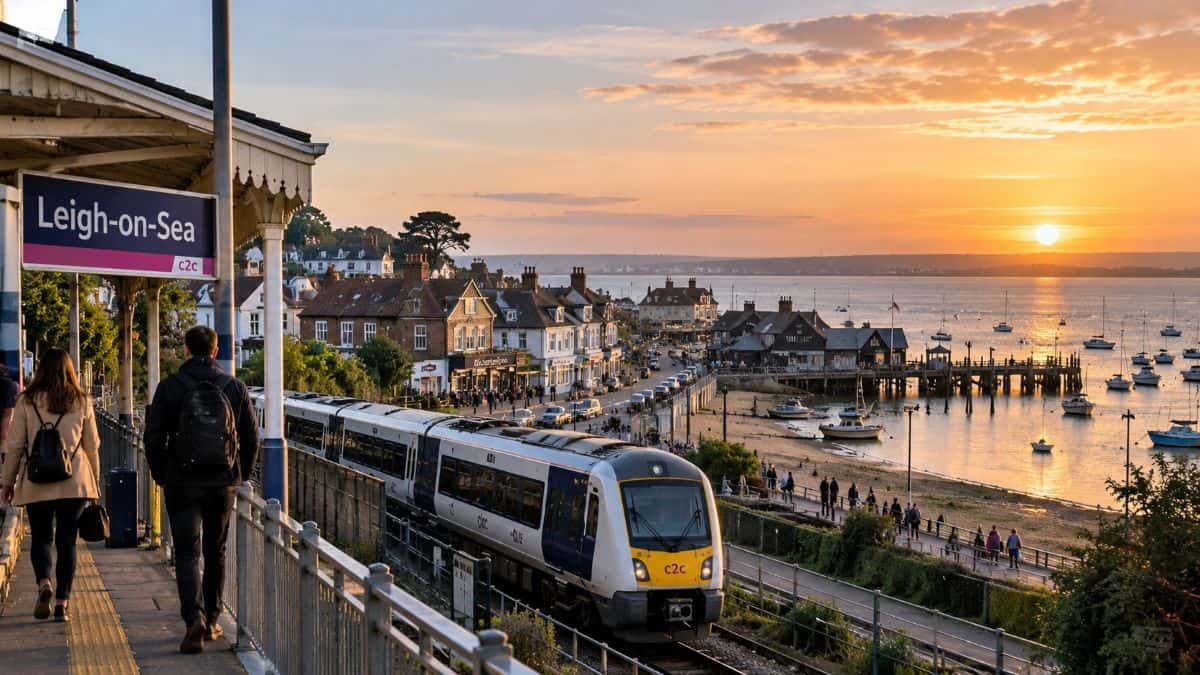
Londoners are increasingly looking beyond the capital for homes that preserve access to work while offering a different everyday environment, and Leigh-on-Sea fits that equation unusually well. Direct c2c services connect the Essex coastal town with London Fenchurch Street, while Old Leigh, the Thames Estuary and a protected maritime heritage give the area an identity far removed from a standard commuter suburb. Housing across the wider Southend-on-Sea authority also remains materially cheaper than many London markets, with an average property price of £328,000 in July 2026. The attraction, therefore, is not abandoning London entirely. It is gaining coastal character while keeping the capital within practical reach.
Why does Leigh-on-Sea work so well for London commuters?
Rail connectivity is the most practical reason Leigh-on-Sea works as a commuter destination.
Advertisement
Advertisement
c2c runs direct weekday services from Leigh-on-Sea to London Fenchurch Street. Its May 2026 timetable includes morning departures such as 07:08 and 07:37, demonstrating that the town functions as a genuine commuter base rather than merely a weekend coastal destination.
This allows residents to combine employment and entertainment in London with a home environment beside the Thames Estuary.
Advertisement
Advertisement
Southend-on-Sea City Council’s planning material reinforces that accessibility. Leigh benefits from Leigh-on-Sea station, nearby Chalkwell station, shops and services, established bus links and access to London Southend Airport.
That means the lifestyle proposition is relatively simple: residents can live outside central London without severing ties with it.
Advertisement
Advertisement
For households with hybrid-working arrangements, that balance can become particularly attractive because fewer weekly journeys make coastal living easier to manage.
How different are housing costs from the wider London market?
Official ONS figures for the wider Southend-on-Sea authority show an average house price of £328,000 in July 2026, up 1.6% from £323,000 a year earlier.
Advertisement
Advertisement
The breakdown is equally useful:
| Property type | Southend-on-Sea average |
|---|---|
| Detached | £644,000 |
| Semi-detached | £430,000 |
| Terraced | £335,000 |
| Flat or maisonette | £199,000 |
| First-time buyer average | £271,000 |
| Home-mover average | £419,000 |
These are Southend-wide figures rather than Leigh-specific prices, so they should not be interpreted as the exact cost of buying in Leigh-on-Sea.
That qualification matters because Leigh is one of the more desirable parts of the city and individual homes can sell substantially above the wider local-authority average.
Even so, the statistics explain why buyers priced out of parts of London may look east along the c2c corridor for alternatives.
Advertisement
Advertisement
What does renting in the area actually cost?
Renters face a similar equation.
ONS data puts the average private rent across Southend-on-Sea at £1,306 per month in August 2026, a rise of 4.9% year on year from £1,245.
Average monthly rents were:
| Size | Average monthly rent |
|---|---|
| 1 bedroom | £878 |
| 2 bedrooms | £1,116 |
| 3 bedrooms | £1,360 |
| 4+ bedrooms | £1,864 |
By property type, flats averaged £1,035, terraced properties £1,322, semi-detached homes £1,420 and detached homes £1,665.
Again, Leigh itself can command higher prices than the city-wide average.
Still, the official numbers provide an important benchmark for households weighing the cost of remaining in London against living farther east while retaining direct rail access.
Advertisement
Advertisement
How large is Leigh-on-Sea and who lives there?
The Leigh ward had 9,898 residents at the 2021 Census, according to Southend-on-Sea City Council.
The demographic profile is particularly relevant to its commuter reputation.
Around 57.6% of residents were aged 25–64, while 17.6% were under 16, 14.8% were aged 65–84 and 2.6% were aged 85 or above.
The figures point towards a substantial working-age population, although the census data does not establish how many specifically commute to London.
The wider Southend-on-Sea population reached approximately 180,700 in 2021, up around 4% from 173,700 a decade earlier.
Leigh should therefore not be imagined as an isolated seaside village. It is part of a substantial urban coastal area while retaining a much smaller-scale historic centre and waterfront identity.
Advertisement
Advertisement
Why does Leigh feel different from an ordinary commuter suburb?
History plays a major role.
The council records Leigh in the Domesday Book of 1086 under the name “Legra”. The settlement later developed around fishing, shipbuilding and maritime trade.
Its conservation area retains traditional terraces, historic marine architecture, estuary views and links with the working fishing port.
The railway arrived in 1856, triggering residential expansion beyond the original waterside settlement.
That sequence matters because Leigh was not created solely as a commuter town. Its coastal and commercial history existed centuries before the railway connected it more closely with London.
For modern residents, this produces something many commuter locations struggle to manufacture: a strong sense of place.
Advertisement
Advertisement
The combination of historic streets, independent shops, waterfront walks and London connectivity helps explain why Leigh can feel like a lifestyle move rather than simply a housing compromise.
Why is Old Leigh central to the town’s attraction?
Old Leigh is the clearest expression of the town’s maritime character.
Southend-on-Sea City Council describes it as a working marine village between Leigh Creek and the railway. Its conservation area was formally designated in 1977.
Historically, the area supported fishing fleets, boatbuilding, coastal commerce, merchant vessels and naval activity.
Planning policy continues to protect its working-port character, waterfront relationship, historic buildings and traditional cockle sheds.
For visitors and residents, this makes Old Leigh more than a decorative heritage quarter.
Advertisement
Advertisement
It remains connected to the estuary economy while also functioning as a leisure and tourism destination.
That distinction strengthens Leigh’s appeal to people leaving London because the town provides a recognisable local identity rather than simply rows of commuter housing surrounding a station.
Are there disadvantages to Leigh-on-Sea’s growing popularity?
Yes. Popularity creates pressure.
Southend’s local planning documents identify traffic and parking as established problems, particularly around Old Leigh. The council has previously warned that congestion and parking pressure can damage the character of the conservation area and reduce visitor enjoyment.
Current planning policy therefore aims to improve walking and cycling, strengthen public transport and reduce the impact of traffic.
The council also wants Leigh Old Town to retain its role as a working port, leisure destination and tourism area while protecting the estuary environment and heritage assets.
Advertisement
Advertisement
This is an important reality check for prospective movers.
Leigh is not a traffic-free village detached from urban pressures. It is a successful residential, visitor and commuter location operating within a constrained coastal environment.
That success is precisely what makes managing future development difficult.
Why does the wider Southend data matter to London movers?
The wider numbers help explain the economic pull.
Southend’s average home price was £328,000, with first-time buyers paying £271,000 on average and flats averaging £199,000 in July 2026.
Southend also had around 180,700 residents in 2021 and was the third-most densely populated local authority in the East of England, behind Luton and Watford.
Advertisement
Advertisement
That means moving to Leigh does not represent a move into rural isolation.
Instead, it offers a hybrid: coastal surroundings within a sizeable urban economy, with established services and direct London connections.
For households leaving the capital, that can reduce the lifestyle shock that comes with moving much farther away.
What are the key figures prospective residents should know?
| Indicator | Official figure |
|---|---|
| Leigh ward population | 9,898 |
| Southend population | ~180,700 |
| Southend population growth, 2011–21 | ~4% |
| Average house price, July 2026 | £328,000 |
| First-time buyer average | £271,000 |
| Average flat price | £199,000 |
| Average monthly rent, August 2026 | £1,306 |
| Leigh conservation designation | 1971 |
| Old Leigh conservation designation | 1977 |
| Railway arrived | 1856 |
| Earliest recorded settlement | 1086 |
The figures reinforce the same theme: Leigh combines a long-established identity with modern commuting infrastructure and a housing market that remains structurally different from London.
Comment From Anup Keshan, Founder and Editor-in-Chief of Travel And Tour World
“Leigh-on-Sea represents the type of destination that increasingly blurs the boundary between a commuter town and a lifestyle destination. Its appeal comes from combining direct rail access to London with a genuine historic waterfront, local businesses and an established coastal community. For people reconsidering where they live, the attraction is not necessarily about abandoning the capital entirely, but creating more balance between work and everyday surroundings. Leigh also demonstrates how tourism, heritage and residential demand can reinforce one another. However, continued popularity makes careful planning essential, particularly around congestion, parking, public transport and the protection of the historic character that makes the area distinctive.”
Conclusion: Why are Londoners looking towards Leigh-on-Sea?
Londoners are drawn to Leigh-on-Sea because it offers a practical compromise between city access and coastal living.
Advertisement
Advertisement
The cause is a combination of housing pressure, changing working patterns and demand for a stronger sense of place. The answer is a town with direct c2c trains to London Fenchurch Street, a historic waterfront, established amenities and a wider Southend housing market averaging £328,000 in July 2026.
The reason Leigh stands apart is that it is not simply a commuter suburb. Old Leigh, its maritime heritage and the Thames Estuary give the town an identity that predates its railway connection by centuries.
Official statistics cannot prove how many Londoners are moving there, but they clearly explain why many might consider it.
Advertisement
