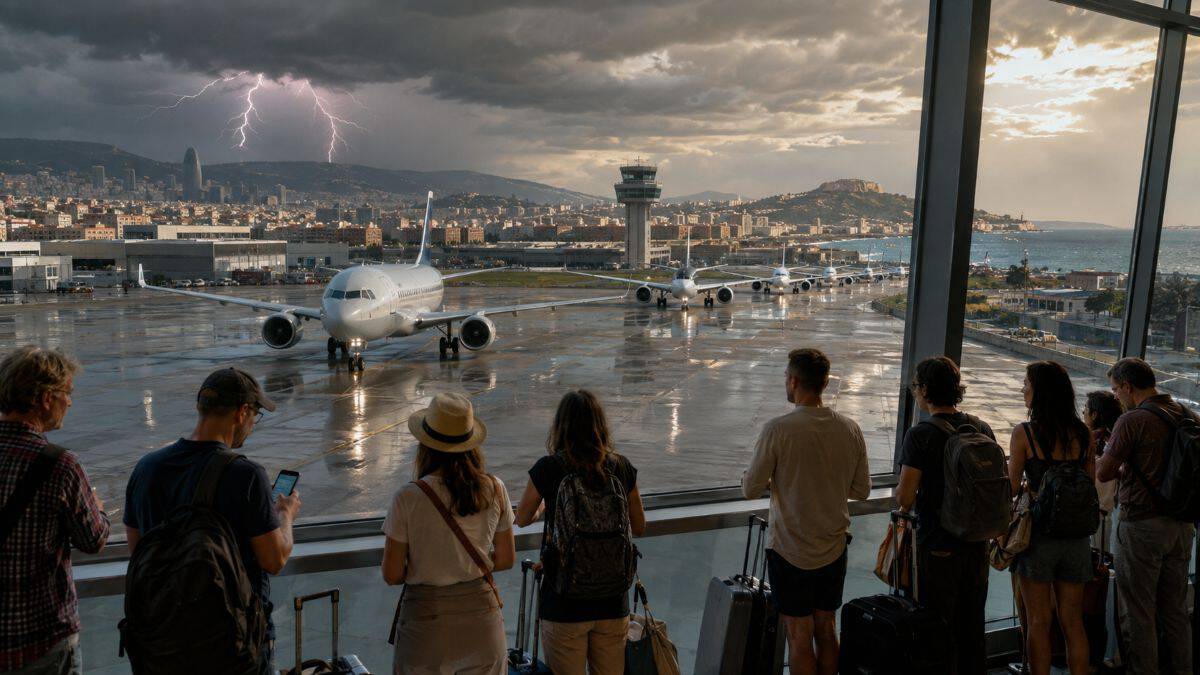
Image generated with Ai
Europe’s biggest summer flight-delay risk now stretches far beyond crowded terminals. It sits in the skies above France, Spain and Greece, where weather, limited airspace capacity and controller shortages are slowing journeys across the continent. The three countries generated 71% of Europe’s en-route air traffic flow management delays during 10–16 August 2026. France contributed 38%, Spain produced 22%, and Greece added 11%. EUROCONTROL recorded an average of 87,280 en-route delay minutes every day. Air traffic control capacity and staffing caused 56% of the disruption. Weather created another 40%.
This concentration affects far more than travellers visiting Paris, Barcelona or Athens. Flights can receive restrictions while crossing these countries, even when they start and finish elsewhere.
Advertisement
Five airspaces created 84% of Europe’s en-route delay minutes during the measured week.Rank Country or airspace Share of European delays Main pressure point 1 France 38% Marseille, Reims, Brest and Bordeaux 2 Spain 22% Barcelona and Madrid 3 Greece 11% Athens and Makedonia 4 Germany 7% Karlsruhe 5 Serbia and Montenegro 6% Balkan air traffic capacity
France, Spain and Greece produced an estimated 61,970 delay minutes per day, based on EUROCONTROL’s rounded national shares. France and Spain alone generated about 52,368 minutes.
Advertisement
Advertisement
The pattern exposes a critical weakness. Europe’s disruption does not spread evenly across the network. A small group of strategic control centres can slow thousands of flights because they manage routes linking northern Europe, the Mediterranean, North Africa and the Middle East.
France created more en-route delay than any other European country during the week. Marseille Area Control Centre alone represented 21 percentage points of the continental total. Reims contributed 6%, while Brest and Bordeaux each added 5%.
Marseille averaged 4.1 delay minutes per flight, Europe’s highest control-centre rate. Several pressures struck at once:
Marseille controls a crucial corridor between northern Europe, Spain, Italy, southern France and North Africa. A restriction there can delay an aircraft, disrupt its next departure and spread the impact across several countries.
Advertisement
Advertisement
France’s wider performance offers important context. It generated 32% of Europe’s year-to-date en-route delays by 23 August, but its average delay performance improved 31% from 2025. France has strengthened its network overall, yet Marseille, Reims and Brest remain exposed when storms and staffing problems collide.
Spain produced 22% of European en-route delays. Barcelona generated 17 percentage points, while Madrid added four. Barcelona averaged 3.6 delay minutes per flight, placing it immediately behind Marseille.
Strong holiday demand kept sectors busy. Thunderstorms then forced aircraft into smaller areas of safe airspace. On 12 August, a power failure at Barcelona Airport’s control tower caused significant delays and ten diversions.Spain aviation pressure Official result Average daily arrivals and departures 6,420 Traffic growth from 2025 6% Barcelona Airport growth 5% Madrid Barajas growth 6% Year-to-date en-route delay share 17% Change in average delays from 2025 Up 12%
These figures reveal a narrowing margin between demand and available capacity. Extra flights do not automatically create disruption. However, when storms remove part of the available airspace, heavily used sectors can quickly form queues.
For travellers, the shortest advertised itinerary may not offer the safest choice. A connection with more breathing room can provide greater protection when a route crosses Barcelona or Madrid-controlled airspace.
Greece generated 11% of Europe’s en-route delay minutes. Athens contributed six percentage points, while Makedonia produced five.
Makedonia averaged 1.8 delay minutes per flight. Athens recorded 1.6 minutes. Both centres faced daily staffing restrictions, while thunderstorms sometimes reduced capacity further.
Greece managed around 2,801 daily arrivals and departures, up 5% from 2025. Changing traffic flows linked to the Middle East crisis added complexity across Greek airspace.
The sharp year-on-year movement deserves attention. Greek average en-route delays climbed 59% above the comparable 2025 level. Greece did not produce Europe’s largest total delay, but its performance weakened faster than France or Spain.
Flights serving Athens, Thessaloniki, Crete, Rhodes, Corfu and other islands can feel the impact. So can aircraft crossing Greece towards the eastern Mediterranean.
Germany generated 7% of European en-route delays, mainly through Karlsruhe Upper Area Control Centre. Severe weather drove much of the disruption.
Serbia and Montenegro contributed 6%, largely because staffing and capacity could not fully match demand. Skopje averaged 1.7 delay minutes per flight while handling 15% more traffic than in 2025.
The causes matter. Weather disruption can appear suddenly and fade quickly. Staffing and structural capacity problems can return during every major traffic peak, making them harder for passengers and airlines to avoid.
EUROCONTROL’s next update, covering 17–23 August, showed how quickly conditions could change. European traffic reached 36,372 daily flights, up 2.5% from 2025, while worsening weather pushed total ATFM delay 11% above the previous week.European network measure Official result Total ATFM delay per flight 3.44 minutes En-route delay per flight 2.71 minutes Airport delay per flight 0.73 minutes Flights facing ATFM restrictions 55,062 Share of flights affected 22% Arrival punctuality 72% Departure punctuality 66%
Marseille, Barcelona and Athens remained major capacity and staffing hotspots. Karlsruhe continued to face weather disruption.
The full summer picture remained stronger than the weekly headlines suggest. From 1 June to 23 August:
Europe’s aviation network therefore handled more flights with fewer delays across the summer as a whole. The problem lies in intense, fast-moving disruption concentrated around a handful of control centres.
An en-route ATFM delay starts when air traffic authorities limit aircraft entering congested or weather-affected airspace. Controllers may assign the restriction before the aircraft leaves its departure gate.
A London-to-Rome flight can receive a French restriction. A Germany-to-Portugal service may cross both France and Spain. The location causing the delay does not need to match the passenger’s destination.
EUROCONTROL considers a flight punctual when it arrives or departs within 15 minutes of schedule. An assigned ATFM delay may not become an identical arrival delay because pilots can sometimes recover time during the flight.
Travellers should therefore judge risk through three factors:
Passengers cannot stop thunderstorms or create more air traffic control capacity. They can prevent one delay from destroying an entire itinerary.
Early departures can offer an advantage. EUROCONTROL recorded first-rotation arrival punctuality of 86.7% and departure punctuality of 80.7% in July. Morning services still face weather and ATC restrictions, but they carry less accumulated disruption from earlier aircraft rotations.
Under official EU air-passenger rules, weather and air traffic management decisions may qualify as extraordinary circumstances. Fixed compensation depends on the cause, although care, rerouting and accommodation duties may still apply.
The EUROCONTROL Week 33 European Aviation Overview, Week 34 Flash Briefing and July Network Operations Report deliver a clear answer: France, Spain and Greece drive 71% of Europe’s en-route flight delays because crucial air corridors face a powerful mix of heavy summer demand, severe weather and limited air traffic control capacity.
In conclusion, France, Spain and Greece drive 71% of Europe’s en-route flight delays as summer pressure mounts because their busiest air corridors face record traffic, unstable weather, restricted sector capacity and controller shortages. The city of Marseille, as well as Barcelona, Athens and Makedonia, are such hubs of north-south and Mediterranean traffic that disruption can quickly be felt in the wider network. The most flights are processed in Europe and even the flights go through these hotspots, passengers are still most at risk when it comes to delay, missed flights or disrupted vacations.
Advertisement
Tags: Europe flight delays, France and Spain Aviation, Greece flight delays, summer travel disruption
Advertisement
Advertisement












Wednesday, September 2, 2026

Tuesday, September 1, 2026

Wednesday, September 2, 2026

Wednesday, September 2, 2026

Tuesday, September 1, 2026

Tuesday, September 1, 2026

Tuesday, September 1, 2026

Tuesday, September 1, 2026