
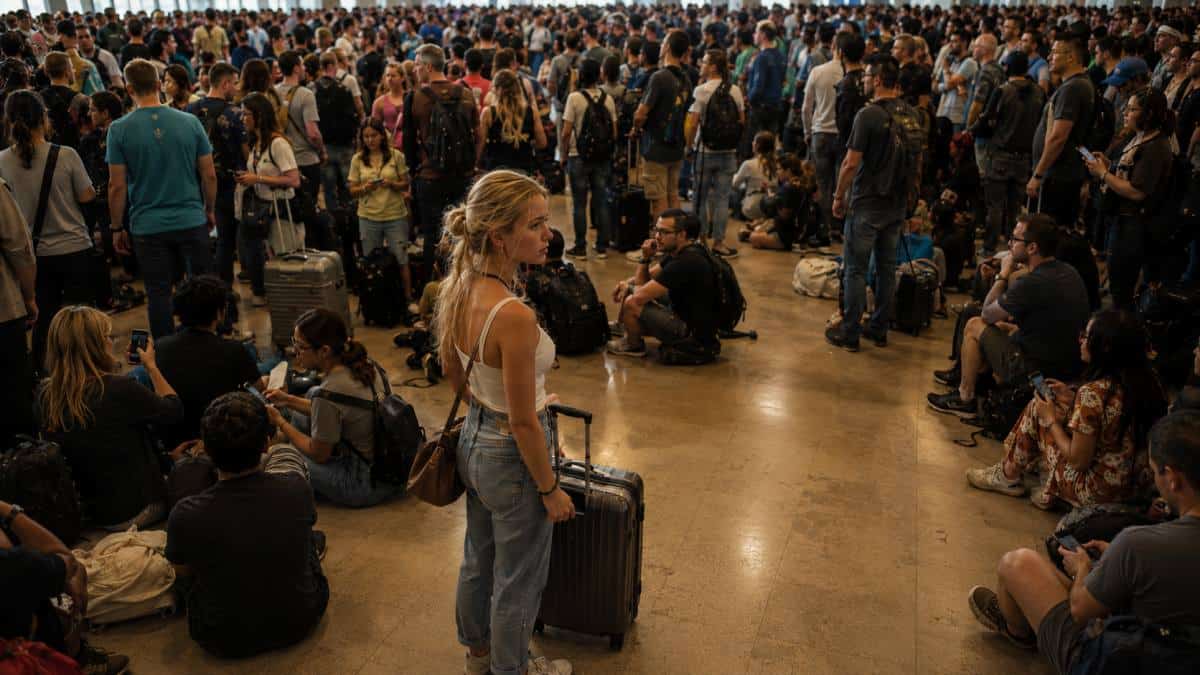
Image generated with Ai
Thousands of travelers abandoned as Asia faces intensifying pressure, with 10,162 delays and 2,323 cancellations rippling through Japan, China, Hong Kong, Taiwan, Thailand, and beyond.
The scale of disruption stretches from weather-battered southern China to busy Middle Eastern hubs, with Shenzhen Bao’an emerging as the worst-hit airport for cancellations while Guangzhou Baiyun recorded the highest number of delays.
Together, those two airports accounted for more than 10% of all cancellations and delays recorded today, underscoring the concentration of disruption in southern China.
China Southern leads all carriers with 1,155 delays and 575 cancellations, accounting for roughly 11% of all delays and nearly one-quarter of all cancellations.
China Eastern, Air China, Cathay Pacific, and Saudia are also experiencing significant disruption as Typhoon Noul lashes southern China and Hong Kong while separate operational challenges continue to affect airport networks across Japan, Southeast Asia and the Middle East.
Meanwhile, military tensions in the Middle East are adding another layer of uncertainty.
Today’s disruption pattern shows two distinct stories unfolding simultaneously.
The first is a weather emergency centered on southern China, where airports across Guangdong Province and neighboring regions absorbed the largest concentration of delays and cancellations as airlines adjusted schedules around deteriorating conditions.
The second is a broader operational slowdown extending across Japan, Southeast Asia and the Middle East, where airports continued functioning but experienced rolling delays caused by aircraft rotations, busy hub operations and schedule recovery.
China overwhelmingly dominates today’s disruption because many of its largest aviation hubs were affected at the same time. When airports such as Guangzhou Baiyun, Shenzhen Bao’an, Shanghai Pudong, Beijing Daxing, Beijing Capital, Hangzhou Xiaoshan and Qingdao Jiaodong all experience operational pressure within the same network, delays quickly cascade across multiple airlines. Aircraft arriving late into one hub often depart late for the next destination, creating a chain reaction throughout the day.
Japan presented a different picture. Major airports including Tokyo Haneda, Narita, New Chitose, Kansai, and Osaka Itami continued handling substantial traffic, producing high delay totals but relatively limited cancellations. Southeast Asia showed a similar trend at hubs such as Singapore Changi, Kuala Lumpur, Bangkok Suvarnabhumi, Jakarta Soekarno-Hatta, and Manila, where airports largely maintained operations despite localized congestion.
Advertisement
Advertisement
The Middle East displayed another operational pattern altogether. King Abdulaziz, King Khalid, Dubai, Sharjah, and Hamad International remained active, but cancellations became more concentrated at several Saudi airports, reflecting localized operational pressures rather than a region-wide weather event.
The biggest driver of today’s disruption is Typhoon Noul, which continues tracking across the South China Sea toward Guangdong with sustained winds reaching 145 km/h. Forecasters expect the system to approach the vicinity of Huizhou and Shanwei, placing one of China’s busiest aviation corridors directly in its path.
Authorities have responded aggressively. Hong Kong has raised Signal No. 8, while mainland China has issued its highest-level Red Typhoon Alert. More than 340,000 people have been evacuated across Guangdong, and rail services across the province have been suspended as heavy rain and damaging winds spread across Guangdong and southeastern Fujian. Rain bands are also extending into Taiwan.
For airlines, severe weather creates far more than immediate flight cancellations. Strong crosswinds can temporarily reduce runway capacity, heavy rain slows aircraft movements on the ground, and reduced visibility forces wider spacing between arrivals and departures. Aircraft that cannot reach their scheduled destinations remain out of position for later flights, while flight crews and maintenance schedules also become disrupted. The result is a rolling wave of delays that spreads well beyond the airports directly affected by the storm, particularly across southern China and Hong Kong.
Advertisement
Advertisement
Mainland China accounted for the overwhelming share of today’s disruption. Major hubs including Guangzhou Baiyun, Shenzhen Bao’an, Shanghai Pudong, Beijing Daxing, Beijing Capital, and Wuhan Tianhe all experienced significant operational pressure.
Southern airports bore the brunt of the weather, while eastern and northern hubs continued to feel the effects of network congestion.
China Southern Airlines, China Eastern, Air China, Shenzhen Airlines, XiamenAir, and Hainan Airlines faced the greatest operational strain because their networks are deeply concentrated across these airports.
At Hong Kong International, the approach of Typhoon Noul significantly affected operations, with Cathay Pacific and Hong Kong Express Airways among the most heavily impacted carriers. Nearby Taiwan Taoyuan also experienced disruption as rain associated with the storm extended across parts of Taiwan, although conditions there remained less severe than in Guangdong.
Japan’s busiest airports—including Tokyo Haneda, Narita, New Chitose, Kansai, and Osaka Itami—recorded extensive delays while avoiding the widespread cancellations seen in southern China. Japan Airlines, All Nippon Airways, and ANA Wings continued operating dense domestic schedules, demonstrating how high-frequency networks can remain active even when delays accumulate.
Across Southeast Asia, operations remained busy rather than severely disrupted. Singapore Changi, Kuala Lumpur International, Jakarta Soekarno-Hatta, Manila, Bangkok Suvarnabhumi, and Phuket all experienced notable delays as airlines balanced heavy passenger demand with ongoing operational constraints. While cancellations were comparatively modest, carriers still faced schedule recovery challenges as aircraft arrived behind schedule from other parts of Asia.
The Middle East experienced a different operating environment. King Abdulaziz International and King Khalid International handled significant disruption alongside Dubai International, Sharjah International, and Hamad International. Saudia carried the greatest operational burden within the region, while FlyDubai, Air Arabia, Flynas, and Qatar Airways also experienced pressure. At the same time, airlines continued operating against a backdrop of heightened regional security concerns that require continual assessment of routing, scheduling and operational resilience.
With the highest totals for both delays and cancellations, China Southern Airlines has been affected across nearly every major mainland Chinese hub, particularly those in Guangdong where Typhoon Noul has disrupted normal operations. Its extensive domestic network means disruptions at one hub quickly affect flights elsewhere.
China Eastern experienced widespread delays because of its strong presence at Shanghai Pudong, Shanghai Hongqiao, Beijing Daxing, Xi’an, Nanjing, and several eastern Chinese airports. The carrier has had to absorb the cumulative effects of congestion across multiple hubs.
Operating major networks through Beijing Capital, Beijing Daxing, Chengdu, Guangzhou, and western China, Air China has been heavily affected by both weather-related disruption and network-wide schedule pressure.
Although based in Hong Kong, Cathay Pacific appears prominently because its international network connects many of today’s affected airports. Disruption in Hong Kong, combined with widespread impacts across mainland China, has increased pressure on both regional and long-haul operations.
Saudia recorded substantial disruption across Saudi Arabia, particularly at King Abdulaziz, King Khalid, Abha, Najran, and Gizan. Concentrated cancellations at several domestic airports significantly increased operational challenges.
Today’s disruption stems from multiple overlapping factors rather than a single event.
Typhoon Noul introduced heavy rain, strong winds and reduced airport capacity across southern China and Hong Kong, forcing airlines to adjust schedules and cancel flights where safe operations could not be maintained.
Elsewhere, airport congestion and airline network pressure became equally important.
Large hub airports depend on tightly coordinated aircraft rotations. When an aircraft departs late from one airport, subsequent flights throughout the day may also depart behind schedule.
Within China, busy air corridors and operational constraints can further amplify recovery times, while high traffic volumes across Japan and Southeast Asia contributed to rolling delays even in areas unaffected by severe weather.
The combined result is a region-wide network disruption where weather initiates delays in one area and operational complexity spreads them across many others.
Although today’s largest disruption is weather-driven, airlines operating in the Middle East continue to navigate an environment shaped by broader regional security concerns.
Ongoing military activity involving Saudi coalition operations against Houthi forces, missile interceptions, security risks around the Red Sea and attacks targeting shipping have increased the complexity of aviation planning in parts of the region.
Broader Iran-related tensions also require airlines and regulators to continuously evaluate airspace availability and routing decisions.
Even when airports remain fully operational, carriers may choose longer flight paths, adjust fuel planning, revise schedules or build additional operational buffers to account for changing security conditions.
These measures can reduce flexibility within airline networks and make recovery from unrelated disruptions more challenging.
Today’s operational picture in Saudi Arabia, Qatar and the United Arab Emirates illustrates how aviation systems can face pressure from several directions at once.
While no single security event explains today’s flight disruptions, the regional environment adds another layer of complexity for airlines already managing high traffic volumes, fleet utilization and schedule reliability.
Passengers traveling through Guangzhou Baiyun, Shenzhen Bao’an, Hong Kong International, Shanghai Pudong, Beijing Capital, Tokyo Haneda, Singapore Changi, King Abdulaziz, and other major hubs should expect operations to remain fluid throughout the day. Departure times may continue changing as airlines recover aircraft and crews from earlier disruptions.
Travelers connecting through southern China and Hong Kong are most likely to encounter rolling weather-related delays and additional rebooking activity. Elsewhere in Asia, longer departure queues, aircraft arriving behind schedule and temporary gate congestion may continue even where weather is favorable because disruptions at major hubs often propagate throughout airline networks.
Learn More
Today’s disruption stands out because it combines a major weather emergency with broader network congestion across one of the world’s busiest aviation regions.
Typhoon Noul is clearly the dominant catalyst in southern China, yet it does not explain the entire operational picture.
Japan, Southeast Asia and parts of the Middle East also experienced meaningful disruption despite operating under very different conditions.
Aviation professionals will notice how concentrated China’s disruption became.
Multiple high-capacity hubs experienced operational pressure simultaneously, increasing the likelihood of network-wide delay propagation.
By contrast, Japan demonstrated stronger schedule resilience, maintaining high traffic volumes with comparatively fewer cancellations, while Saudi Arabia saw cancellations concentrated at specific airports rather than across its entire network.
Over the next 24 hours, the pace of recovery will depend largely on Typhoon Noul’s movement inland and how quickly airlines can reposition aircraft, restore schedules and clear accumulated congestion across interconnected hub airports.
Today’s disruptions in Asia affected major cities including Beijing, Shanghai, Guangzhou, Shenzhen, Hong Kong, Tokyo, Osaka, Sapporo, Seoul, Singapore, Kuala Lumpur, Jakarta, Manila, Bangkok, Doha, Dubai, Sharjah, Jeddah and Riyadh. As of 4:50 p.m. ET on July 25 (2:20 a.m. IST), Asia has recorded 10,162 flight delays and 2,323 cancellations.
Airlines including China Southern Airlines, China Eastern, Air China, Cathay Pacific, Saudia, Shenzhen Airlines, XiamenAir, Hainan Airlines, Japan Airlines, and FlyDubai have all faced varying levels of operational pressure as they work to stabilize schedules.
Across the region, airlines are adjusting flight timings, repositioning aircraft, accommodating displaced passengers and gradually rebuilding normal operations where conditions permit. With Typhoon Noul continuing to influence southern China while congestion and operational pressures persist elsewhere, the aviation picture remains dynamic and flight schedules are likely to continue evolving as weather and regional operating conditions change.
Data Verification Notice
The Data is extensively curated by me with figures derived from Flightaware dated 25th July 4:50 pm ET USA (2:20 am IST)
Primary Source: Real-time data aggregated via FlightAware.
Verification Protocol: Statistics are cross-checked by our human editorial desk. Timestamped logs and feed snapshots are securely archived internally to maintain historical accuracy.
Note: Real-time tracking figures represent active airspace data and may experience minor variances from local airport terminal gates.
Travelers are advised to check respective airline and airports for more latest information and updates
Advertisement
Tags: Asia flight cancellations today, Cathay Pacific Flight Cancellations Today, Hong Kong Typhoon, Saudi Houthi, Thailand Flights Cancelled Today
Advertisement
Advertisement













Friday, September 4, 2026

Friday, September 4, 2026

Friday, September 4, 2026

Thursday, September 3, 2026

Wednesday, September 2, 2026

Friday, September 4, 2026

Friday, September 4, 2026