

Israel, Along With The US and Other Countries Face Steep Tourism Drops: Key Factors Behind the Global Decline

Published
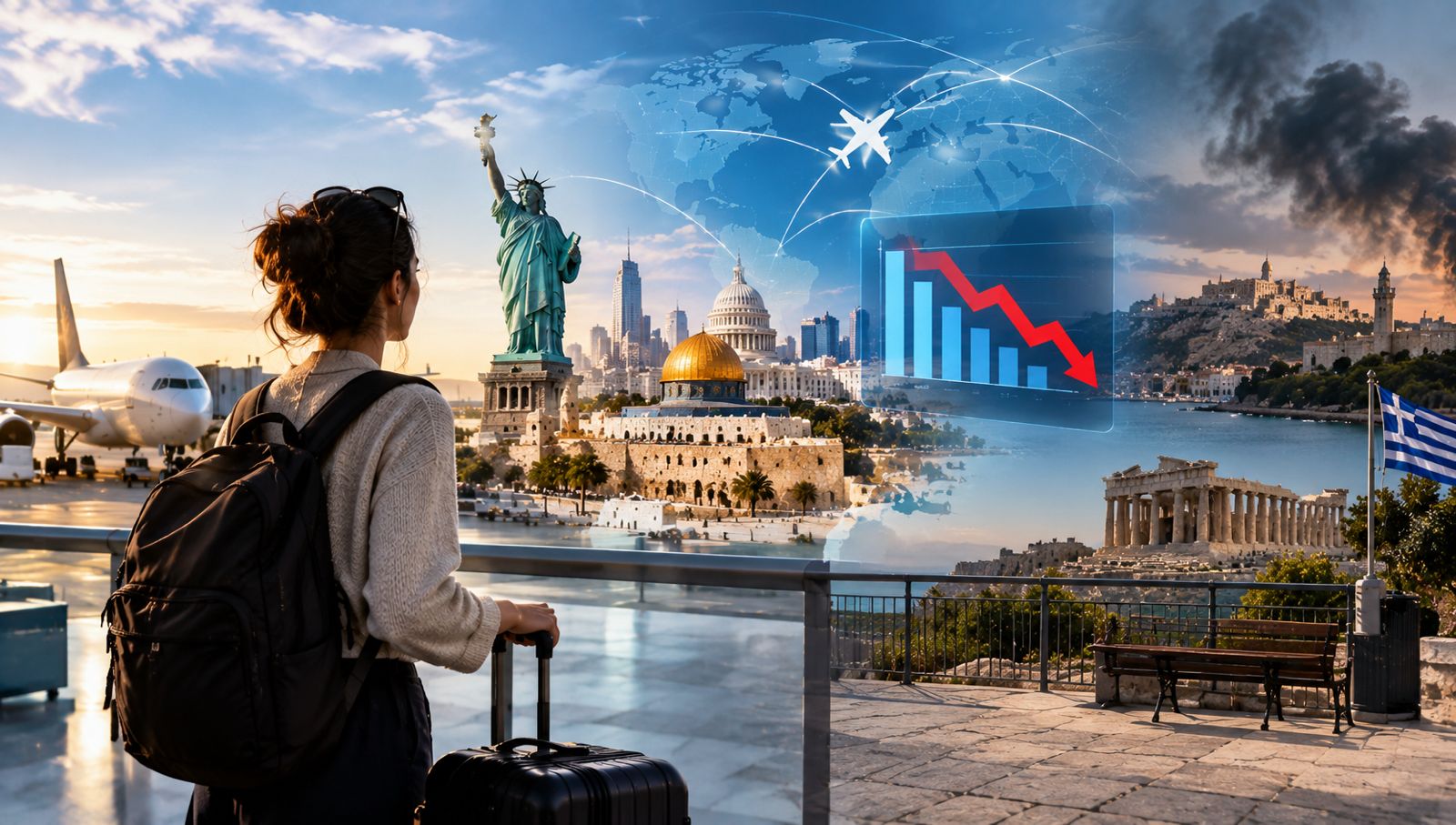 Image generated with Ai
Israel, along with the US and various other countries are seeing steep tourism declines that pose a threat to the modern-day economic stability on a global scale. As such, the international travel markets are witnessing an unprecedented contraction due to an array of regional conflicts as well as high visa backlogs. Moreover, industry analysts report a significant financial hurdle experienced by travellers when it comes to overseas holidays. As such, tourism boards need to adapt to the changing consumer patterns in order to survive this crisis.
Global tourism data reflects significant variation between countries that was influenced by geopolitical tensions, visa complications, policy-related constraints and economic factors. For instance, Israel’s inbound tourism demand dropped by 71 percent, while that of the United States, Thailand and India decreased by 14 to 17 percent compared to the 2019 levels.
How Has Geopolitical Conflict Crippled Israel’s Tourism Sector?
Israel has faced an unprecedented contraction in international arrivals, registering a staggering seventy-one per cent drop relative to pre-pandemic benchmarks. This sharp decline stems directly from regional military escalations that erupted in late 2023 and continued to disrupt travel infrastructure. Immediate airspace closures, widespread cancellations by international carriers, and stringent global travel advisories severely crippled inbound leisure and religious tourism.
The security crisis immediately choked off vital economic inflows that typically sustain local hospitality businesses, tour operators, and historic sites across the region. Consequently, the local economy lost billions in projected tourism revenue while stakeholders scrambled to manage indefinite cancellations. Furthermore, rebuilding international confidence requires stable security guarantees that remain elusive amidst ongoing volatility. International aviation authorities continue to monitor regional airspace safety closely before permitting commercial carriers to resume regular flight schedules.
Advertisement
Advertisement
For official statistics and policy frameworks on inbound travel shifts, consult the Ministry of Tourism, Government of India
or the UN Tourism portal.
What Structural Pressures Are Fueling the United States Tourism Lag?
The United States continues to lag behind its historical 2019 visitor volumes, recording a stubborn fourteen per cent deficit in inbound international travel. Unlike destinations impacted by sudden military conflicts, the American slowdown stems from complex structural barriers and broader economic headwinds. Chief among these deterrents are prolonged consular visa interview wait times in high-demand outbound markets across Latin America and Asia.
Advertisement
Advertisement
An appreciating United States dollar has simultaneously made North American holidays comparatively expensive for foreign leisure travellers seeking better value elsewhere. High domestic inflation has also translated into inflated ground-handling fees, car rental rates, and hotel accommodation costs across major metropolitan hubs. Industry analysts argue that streamlining visa processing and targeted marketing campaigns are essential for reversing these persistent inbound deficits.
“Global tourism growth remains remarkably fragile as ongoing geopolitical conflicts, sticky inflationary pressures, and complex visa backlogs continue to disrupt international travel flows. While certain domestic markets are experiencing a remarkable internal boom, long-haul inbound travel recovery across Western and Asian nations requires aggressive structural modernization, streamlined consular processing, and enhanced air connectivity to restore absolute consumer confidence and ensure sustainable, long-term economic resilience across the entire hospitality sector worldwide.”
— Anup Kumar Keshan, Founder and Editor-in-Chief, Travel And Tour World
Why Is Thailand Experiencing Slower Recovery Margins?
Thailand remains a premier travel destination in Southeast Asia, yet its visitor recovery numbers linger roughly seventeen per cent below pre-pandemic baseline figures. This prolonged deficit stems from a sluggish structural rebound in high-spending long-haul markets and shifting regional travel dynamics. Changing economic conditions and outbound travel caps in key East Asian source markets have restricted the expected surge of mass tourism.
Although regional short-haul arrivals have steadily rebounded, attracting lucrative European and trans-Pacific visitors has proven considerably more challenging for local tourism boards. Competitors in the Mediterranean and Middle East have aggressively captured market share by offering more competitive pricing and flexible holiday packages. Strategic diversification into niche segments like wellness and sustainable tourism remains Thailand’s primary pathway toward full market recovery.
How Has India Balanced Domestic Tourism Growth With International Deficits?
Official assessments indicate that India’s foreign tourist arrivals remain roughly sixteen per cent below its 2019 peak, reflecting a unique national policy shift. This international lag contrasts sharply with a massive internal boom where domestic leisure trips have scaled past historic milestones. Consequently, government policy, hospitality investments, and infrastructure developments have leaned heavily into catering to the domestic consumer base.
Advertisement
Advertisement
This domestic pivot inadvertently caused a comparative neglect of international marketing, global competitiveness, and inbound foreign receipts relative to fast-rising regional competitors. Addressing lingering international air connectivity gaps and upgrading global promotional campaigns will be vital for capturing a larger share of foreign travellers. Ultimately, balancing robust internal travel demand with renewed international outreach will determine the future trajectory of the nation’s visitor economy.
Comparative Tourism Metrics Overview
| Country | Baseline Drop / Deficit | Primary Catalyst | Core Economic Impact |
| Israel | -71% | Geopolitical conflict & active security alerts | Severe contraction in inbound leisure and religious travel receipts. |
| United States | -14% | Consular visa backlogs & strong currency value | Sustained deficit in long-haul international visitor arrivals. |
| Thailand | -17% | Slow regional long-haul recovery & market shifts | Reduced high-spending tourist volume from key Asian source markets. |
| India | -16% | Domestic tourism pivot & air connectivity gaps | Shift toward internal travel volume over global inbound marketing. |
The main reason for the decline is the tension between geopolitical, inflation, and visa-consular factors. The situation can be resolved only when states start to digitize and simplify a visa regime and promote domestic tourism. The latter is the key to the problem, as the majority of tourists are now value-conscious and safety-focused and tend to avoid high-risk long-haul travel. The global tourism industry is highly competitive and extremely fragile, as it faces a constant threat of multiple economic and political factors beyond business control. Therefore, to attract tourists, states need to establish beneficial partnerships with airlines and stimulate demand while also building consumer trust. At the same time, industry participants should keep a close eye on market fluctuations and stay ahead of market changes.
Advertisement
