
IndiGo Embraer E2 Order Could Revolutionise Regional Travel as India’s Aviation Market Enters New Phase

Updated
Published
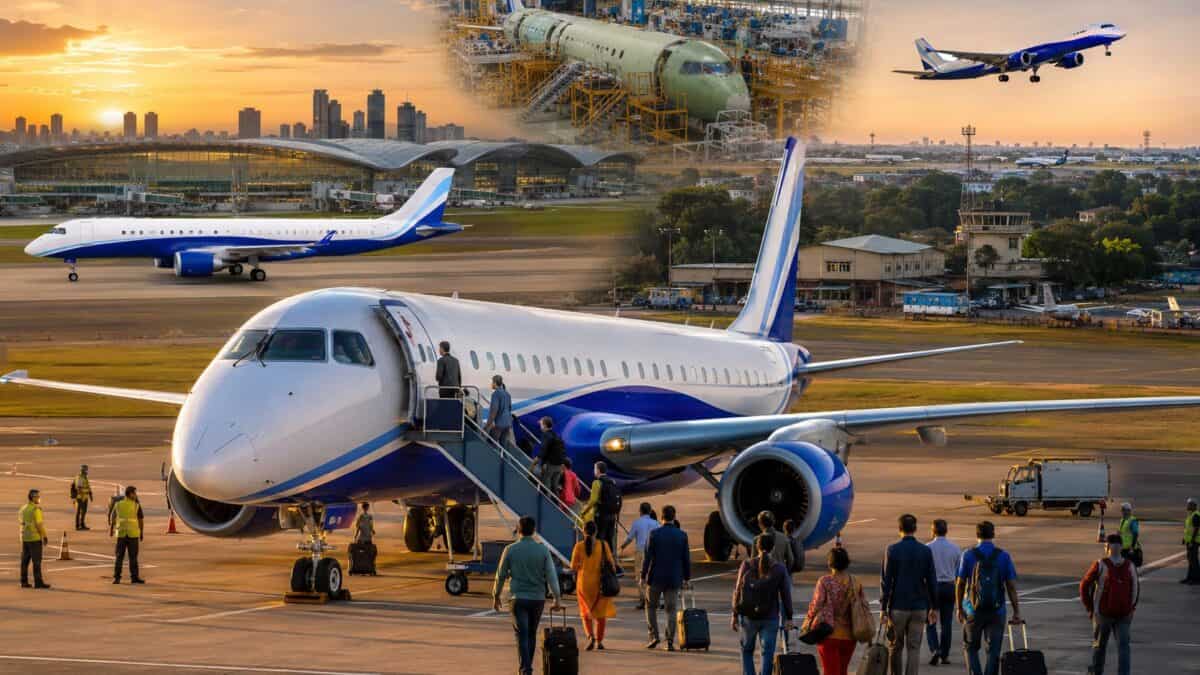
Image generated with Ai
IndiGo Embraer E2 order talks could reshape India’s regional aviation landscape. IndiGo’s parent, InterGlobe Aviation, is reportedly considering a major purchase of Embraer E2 jets, although discussions remain preliminary. A deal involving dozens of aircraft could eventually help replace parts of IndiGo’s ATR turboprop fleet and strengthen regional connectivity. The airline operated 441 aircraft at March-end, including 46 ATRs. For travellers, the move could mean better capacity and more direct regional links. Meanwhile, Embraer’s push for an E175 assembly line in India adds a wider manufacturing dimension to the potential deal.
IndiGo Examines a New Regional Fleet Strategy
InterGlobe Aviation is reportedly evaluating Embraer’s E2 family as part of its long-term fleet planning. The discussions are understood to be at an early stage, meaning the aircraft type, quantity and commercial terms could still change.
That distinction matters because an aircraft negotiation is not an aircraft order. Airlines routinely evaluate several manufacturers before committing billions of dollars to fleet expansion. IndiGo has not publicly confirmed a final E2 purchase based on the reported talks.
Nevertheless, the reported discussions are significant because IndiGo has historically built its core narrowbody fleet around Airbus aircraft. Its regional operation also includes ATR turboprops, which remain useful on thinner routes and shorter sectors.
Advertisement
Advertisement
At 31 March 2026, IndiGo operated 441 aircraft. Its fleet included 31 A320ceo aircraft, 177 A320neo aircraft, 172 A321neo aircraft and one A321XLR. It also had 46 ATRs, three A321 freighters and other damp-leased aircraft.
Advertisement
Advertisement
| IndiGo Fleet Snapshot at 31 March 2026 | Aircraft |
|---|---|
| A320ceo | 31 |
| A320neo | 177 |
| A321neo | 172 |
| A321XLR | 1 |
| ATR aircraft | 46 |
| A321 freighters | 3 |
| Other aircraft under damp lease | 11 |
| Total fleet | 441 |
The potential E2 acquisition would therefore represent more than another fleet addition. It could create a new capacity layer within IndiGo’s network.
That layer would sit above the ATR in passenger capacity while remaining smaller than IndiGo’s principal Airbus narrowbodies. Such flexibility could become increasingly valuable as Indian regional markets mature.
Why Embraer E2 Aircraft Matter for Travellers
The strongest travel implication lies in aircraft economics. Regional airlines need aircraft that can carry enough passengers without requiring the demand of a larger narrowbody.
Advertisement
Advertisement
An aircraft that is too large can make a thin route financially difficult. Conversely, an aircraft with insufficient capacity can constrain growth when a route begins attracting more passengers.
That is where regional jets can become strategically important.
Advertisement
Advertisement
The E2 family gives airlines a modern jet option for markets that may have outgrown turboprops. For passengers, the change could mean more seats, faster journey times and additional frequency opportunities on selected regional routes.
However, passengers should not interpret the reported talks as an immediate route expansion announcement. IndiGo would need to finalise the aircraft purchase, receive deliveries and then determine where the aircraft deliver the greatest network value.
The impact would probably emerge gradually.
An E2 deployment could support routes linking major metropolitan hubs with emerging business and tourism centres. It could also help airlines develop secondary city pairs without immediately committing an A320-family aircraft.
For tourism, that distinction matters.
Advertisement
Advertisement
Many Indian destinations depend on convenient domestic air access. Better regional aircraft economics can help connect smaller cities with major gateways. That can reduce dependence on long road journeys and improve access for leisure travellers.
Regional Connectivity Is Already Expanding
The potential IndiGo Embraer E2 order arrives as India continues expanding regional connectivity through government-backed programmes.
The Ministry of Civil Aviation’s UDAN programme had reached 95 airports, including heliports and water aerodromes, by 30 June 2026. The scheme had also supported 677 routes and 3.58 lakh flights, carrying 168 lakh passengers.
| UDAN Regional Connectivity Data | Position by 30 June 2026 |
| Airports, heliports and water aerodromes | 95 |
| Routes | 677 |
| Flights | 3.58 lakh |
| Passengers | 168 lakh |
| Operators | 9 |
| Viability Gap Funding | ₹4,881.10 crore |
The government has also approved a revised UDAN framework targeting 100 new airports, 200 helipads and 441 airstrips. That ambition creates a potentially larger addressable market for regional aircraft.
However, infrastructure alone cannot guarantee connectivity.
Advertisement
Advertisement
Airlines still need aircraft that can operate routes sustainably. They also need suitable yields, airport facilities, crew availability and reliable demand.
Consequently, fleet planning will remain central to the success of India’s regional aviation ambitions.
The IndiGo discussions therefore arrive at an important moment. India is expanding the infrastructure for regional connectivity while manufacturers are competing to supply the aircraft needed to operate it.
India’s Aviation Demand Keeps Rising
India’s broader aviation market provides the commercial backdrop for the reported negotiations.
IATA describes India as the world’s third-largest aviation market by passenger traffic. Its data also show that Indian domestic passenger demand continued to expand in 2025.
Advertisement
Advertisement
Domestic India recorded 5.2% RPK growth in 2025, according to IATA. Capacity, measured by available seat kilometres, increased by 6.7% during the same period.
| Indian Domestic Aviation Indicator | 2025 Annual Change |
| Revenue Passenger Kilometres | +5.2% |
| Available Seat Kilometres | +6.7% |
| Passenger Load Factor | 85.2% |
| Global domestic RPK share | 1.7% |
The figures illustrate why airlines continue to consider substantial fleet investments.
Yet India’s opportunity is not restricted to the largest airports. Growth increasingly depends on creating viable links beyond the traditional metropolitan corridors.
That is particularly relevant for tourism.
Destinations with strong leisure demand can experience sharp seasonal peaks. Regional aircraft can potentially provide a better capacity match than larger narrowbodies on some routes.
Advertisement
Advertisement
For travellers, that could eventually mean greater choice between flying and lengthy surface journeys.
IndiGo Could Bridge the Aircraft Capacity Gap
The reported E2 discussions become particularly interesting when IndiGo’s fleet is viewed as a capacity ladder.
Its ATR aircraft serve smaller regional markets. Its Airbus A320 and A321 families serve much larger passenger flows. An Embraer regional jet could occupy the space between those two categories.
| Aircraft Category | Strategic Role | Potential Travel Use |
| ATR turboprop | Smaller regional markets | Shorter and thinner routes |
| Embraer regional jet | Intermediate capacity | Growing regional and secondary-city markets |
| Airbus A320 family | Mainline narrowbody | High-volume domestic and international routes |
| Airbus A321 family | Higher-capacity narrowbody | Dense domestic and international corridors |
This structure could allow IndiGo to optimise capacity more precisely.
Instead of assigning a large narrowbody to a developing route, the airline could potentially deploy a smaller regional jet. If demand grows, the route could later graduate to an Airbus aircraft.
Advertisement
Advertisement
That approach could also help IndiGo test new markets with less capacity exposure.
Still, fleet diversification introduces complexity.
A new aircraft family requires pilot training, engineering capabilities, spare parts, maintenance arrangements and operational planning. Those costs can offset some of the efficiency benefits of the aircraft.
Therefore, IndiGo would need to assess the E2 opportunity across the entire operating ecosystem.
Embraer Has Bigger Plans for India
The reported IndiGo talks also intersect with Embraer’s broader Indian strategy.
Advertisement
Advertisement
In January 2026, Embraer and Adani Defence & Aerospace announced a strategic partnership covering aircraft manufacturing, supply chains, aftermarket services and pilot training. The partnership aims to establish an integrated regional transport aircraft ecosystem in India.
One month later, the companies announced an enhanced MoU proposing a final assembly line for the E175.
That programme should not be confused with the reported E2 discussions. The E175 is part of Embraer’s first-generation E-Jet family, while the E2 represents its newer generation.
The distinction is commercially important.
Embraer CEO Francisco Gomes Neto said in March that an Indian E175 assembly line would require at least 200 aircraft orders to make the investment viable. Reuters reported that the manufacturer could potentially begin deliveries from India in 2028 if those commitments were secured by the end of 2026.
Advertisement
Advertisement
Embraer has also identified substantial potential for regional aircraft in India. Gomes Neto said the company had identified around 1,800 Indian routes suitable for E175 operations.
That underlines the size of the opportunity.
Manufacturing Could Change India’s Aviation Ambition
India currently remains heavily dependent on overseas aircraft manufacturers for commercial passenger aircraft.
That makes the Embraer-Adani programme strategically significant.
The Ministry of Civil Aviation has long promoted domestic aerospace manufacturing. Its National Civil Aviation Policy specifically envisaged encouraging global aircraft manufacturers to establish assembly plants in India.
Advertisement
Advertisement
The current Embraer initiative provides a tangible example of that ambition.
The company is also expanding its Indian supply-chain presence. In May 2026, Embraer announced its first forged raw-material supply contract with Indian manufacturer Bharat Forge.
Together, these developments suggest that Embraer’s India strategy extends beyond selling aircraft.
It is seeking a broader industrial footprint involving manufacturing, suppliers, maintenance and skills development.
A major IndiGo order could strengthen that ecosystem. However, the relationship between an E2 purchase and the proposed E175 assembly line should remain clearly separated.
Advertisement
Advertisement
An IndiGo E2 order would not automatically trigger E175 production in India.
The two programmes have different aircraft and commercial requirements.
Travellers May Gain More Regional Choice
For passengers, the biggest potential benefit would be network flexibility rather than the aircraft itself.
A regional jet can allow airlines to serve markets that cannot immediately support a larger narrowbody. That can create opportunities for direct connections between cities that currently require a metropolitan connection.
Tourism destinations could benefit particularly strongly.
Advertisement
Advertisement
A new direct flight can shorten total journey times and make weekend travel more practical. It can also improve accessibility for international visitors arriving through major Indian gateways.
However, travellers should expect any benefits from the reported talks to emerge over several years.
Aircraft orders involve production slots, financing, training, certification and delivery schedules. Airlines then need to integrate new aircraft into their operating networks.
Therefore, the reported negotiations should be viewed as a potential medium-term development, not an immediate travel change.
A New Competition for India’s Regional Skies
The potential IndiGo deal also highlights a broader contest among aircraft manufacturers.
Advertisement
Advertisement
Airbus and Boeing dominate India’s large commercial aircraft market. Embraer, meanwhile, is positioning itself around the regional and smaller narrowbody segment.
That market could become increasingly important as India’s airport network expands.
The revised UDAN programme indicates that policymakers expect regional connectivity to penetrate deeper into the country. Airlines will consequently need aircraft capable of serving different levels of demand.
For Embraer, India offers both an enormous customer base and an opportunity to build an industrial ecosystem.
For IndiGo, the equation is different.
Advertisement
Advertisement
The airline must determine whether adding a new aircraft family can improve network economics enough to justify the additional complexity.
That calculation will ultimately decide whether the reported E2 discussions become a firm order.
What the IndiGo E2 Talks Mean Next
IndiGo Embraer E2 orders are still open for discussion rather than an established deal. Reports indicate the preliminary negotiations have not settled the final number of aircrafts orders or the terms of the order.
There is still evidence of India’s quickly expanding aviation market, which majorly concerns IndiGo, as it indicates a strong demand for travel.
For travelers, the expansion of IndiGo since it means they will have a strong regional presence. This strengthens connections across major regional markets and facilitates access to new regional tourism hotspots.
Advertisement
Advertisement
The order of new aircraft to sustain an airline’s presence in a new market promotes regional travel access. This facilitates travel to different cities across the region.
However, the routes need to be commercially viable. The negotiations represent more than an airline considering an order. It suggests the start of a new regional system of travel based in India, where a variety of air travel options, local manufacturing, and expanding regional airports support each other.
Advertisement
