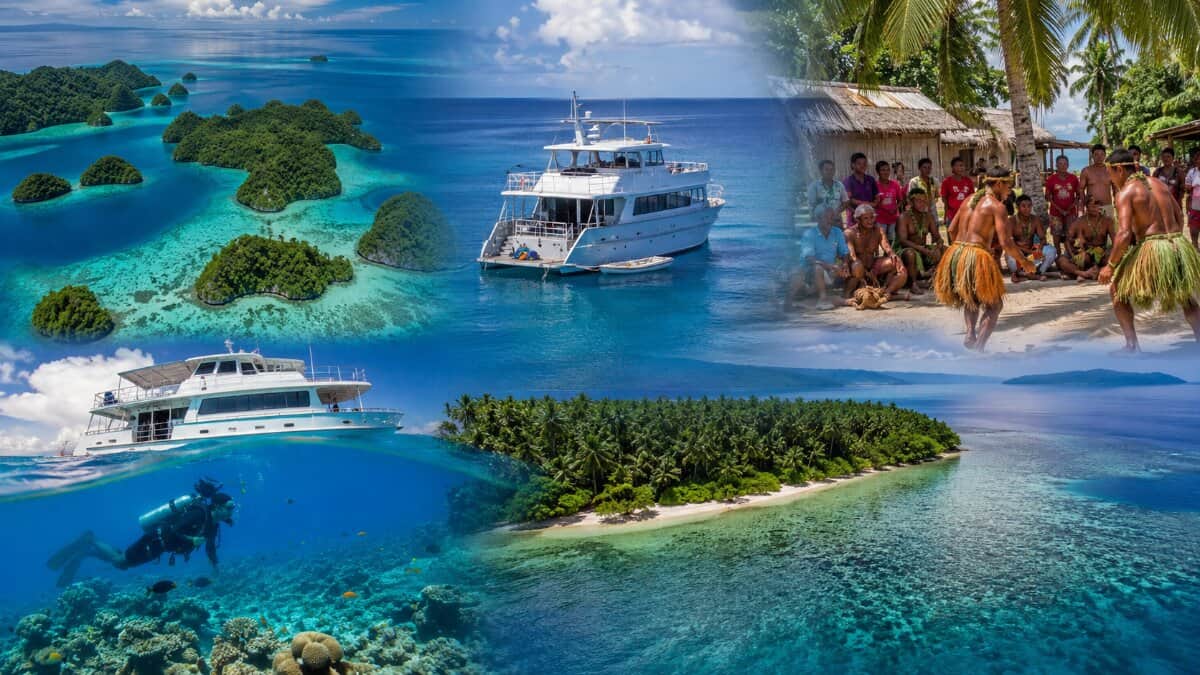
Image generated with Ai
Palau is slowly creating one of the controlled tourism models on the Pacific islands around Sonsorol also called Dongosaro. This place is approximately 300 kilometers southwest of Koror. Even though the total number of visitors in Palau went up to 51,040 between January and July 2026 that is mainly a 27% increase compared to the period last year. However Sonsorol is still an Entry-Stage destination. It has limited transport options and no regular places to stay listed in the tourism plan. A different plan from the government, in 2026 connects Koror with Sonsorol and other islands in the Southwest. Official tourism plans focus on liveaboards, special ecotourism activities and planned buildings instead of large-scale development.
The important story for the travel trade is not simply that Palau wants more tourism in Sonsorol. The more significant development is how little conventional capacity Palau appears prepared to place there while still creating a pathway towards visitor growth.
According to the Palau Sustainable Tourism Strategy 2025–2028, Sonsorol sits within the Far South Islands tourism cluster alongside Hatohobei and is identified in its detailed destination profile as an Entry-Stage destination. Its future tourism opportunities specifically include servicing liveaboards. The strategy records that liveaboard activity already brings a small number of visitors and tourism revenue into the state.
The same official assessment identifies no accommodation supply and no tour operators or guides in Sonsorol at the time of the strategy assessment. Rather than recommending large resorts, major visitor terminals or high-capacity development, it identifies opportunities in small-scale niche tourism, ecotourism, cultural tourism, community skills, limited infrastructure and stronger collaboration with private liveaboard operators.
Advertisement
That creates a fundamentally different tourism proposition from Koror, where hotels, dive businesses, tour operators, international air connectivity and established visitor services are concentrated.
This contrast has become more important during 2026 because Palau’s international tourism recovery is gathering momentum.
According to the Palau Visitors Authority July 2026 Visitor Arrival Report, the country received 51,040 visitors during January–July 2026, compared with 40,339 during the corresponding seven months of 2025, representing growth of 27%. July alone generated 6,963 arrivals, recovering from 5,925 in June.Official January–July 2026 market Visitors Year-on-year change China 18,394 +46% Taiwan 8,524 +4% USA and Canada 7,032 +2% Japan 6,998 +80% Europe 3,525 +11% Others 3,172 -10% Australia 2,531 +68% South Korea 864 +57% Total 51,040 +27%
Source: Palau Visitors Authority, July 2026 Visitor Arrival Report
Advertisement
Advertisement
International access to the Koror area has also broadened. The July PVA report records United Airlines at ten scheduled services a week into Koror, comprising six from Guam, two from Manila and two from Tokyo Narita. China Airlines was operating four weekly services from Taiwan, Qantas a weekly Brisbane service, while Philippine Airlines had begun twice-weekly Manila flights on 30 March 2026. Hong Kong and Macau-linked charter operations were also part of the market.
For specialist travel companies, the consequence is important. Getting clients into Palau is becoming easier than moving them onward to Sonsorol. That imbalance creates the scarcity underpinning the destination’s expedition value.
The strongest new evidence comes from a Palau Government procurement issued on 9 March 2026.
Government RFP PCS-2026-19 sought marine transportation for government services, medical services and field trips between Koror and six Southwest Island locations: Hatohobei, Helen Reef, Sonsorol, Merii, Pulo Anna and Fanna.
The specification is unusually detailed.2026 Palau marine-transport requirement Official specification Origin Koror Included Sonsorol State destinations Sonsorol, Merii, Pulo Anna and Fanna Wider Southwest Islands Hatohobei and Helen Reef also included Proposed voyage duration 8 days or 10 days Passenger capacity Up to 45 Cargo requirement 2,500–3,000 pounds per voyage Possible frequency Monthly, up to 12 voyages annually, or quarterly, up to 4 Contract period Initial 12 months Operational considerations Weather, sea state, fuel planning and contingencies Primary purpose Government, medical and field-trip transportation
This procurement must not be misreported as the launch of a scheduled tourist ferry. The document describes government-related transport, medical services, passenger movement, cargo and official field trips. It does not establish a commercially bookable tourist service.
That distinction is essential.
However, from a destination-development perspective, the procurement demonstrates that Palau is trying to strengthen the maritime logistics architecture connecting Koror with the Southwest Islands. Better baseline connectivity can indirectly improve the environment in which carefully controlled tourism operates, even where visitor access itself continues to depend principally on specialist vessels.
The marine-access problem predates the current tourism strategy.
According to the Palau Development Plan 2023–2026, Sonsorol and Hatohobei historically depended on privately operated charter vessels for essential state services. The plan documented very limited voyage frequency and substantial costs associated with these arrangements. It recommended a larger multipurpose passenger-and-cargo vessel capable of improving services to the outer islands.
The same government plan directly connects Palau’s marine transport economy with tourism. It identifies local vessels used for diving, sports fishing, snorkelling and sightseeing and notes the operation of liveaboard vessels for divers in Palauan waters.
The significance is therefore structural. Palau’s tourism policy and transport policy are moving along parallel tracks.
The first seeks high-value, environmentally responsible and geographically dispersed tourism. The second recognises that remote states cannot develop economically without safer and more efficient maritime links.
Sonsorol sits directly where those two policies intersect.
Palau Visitors Authority identifies Sonsorol State as four islands: Sonsorol or Dongosaro, Pulo Anna or Puro, Merir or Melieli, and Fanna. The state lies approximately 300 kilometres southwest of Koror. Official visitor information describes the Southwest Islands as accessible periodically by government field-trip vessels or by liveaboard.
This geography eliminates the usual mass-tourism formula.
There is no road connection from Koror. There is no conventional inter-island tourism corridor comparable with a short ferry transfer. The national strategy identifies limited infrastructure, limited formal tourism management and transport constraints as fundamental barriers to scaling the destination.
Yet those barriers simultaneously create Sonsorol’s strongest commercial differentiator.
A destination without large hotel inventories, extensive excursion fleets or continuous visitor circulation can potentially command value through rarity, expedition character, remoteness, diving and cultural access, provided local communities retain control over development.
That is why liveaboards make strategic sense. Accommodation, transport and expedition logistics can be consolidated aboard the vessel rather than immediately requiring extensive permanent construction ashore.
Sonsorol’s official strategy profile provides perhaps the clearest indication of this model.
It identifies Sonsorol Reef and Pulo Anna as diving resources and lists servicing liveaboards as a future tourism opportunity. It also records existing liveaboard collaboration and notes that one visitor option had operated only four trips per year, illustrating the exceptionally low-volume nature of present access.
This means tourism monetisation does not necessarily have to wait for a hotel-development cycle.
Liveaboards can bring small groups into the marine environment while communities progressively develop guided cultural experiences, local products, crafts, environmental interpretation and other shore-based activities.
For B2B travel companies, this potentially shifts Sonsorol away from the conventional accommodation-led destination model towards an itinerary-led model, in which vessel capacity determines visitor numbers.
That offers a natural mechanism for managing carrying capacity.
The timing matters because Palau is no longer operating against a uniformly weak post-pandemic tourism environment.
The 27% increase in January–July arrivals shows that international demand is rebuilding strongly. Japan rose 80%, Australia 68%, South Korea 57% and China 46% compared with the corresponding 2025 period.
The July Palau Entry Form report also reinforces the relevance of specialist ocean products. Among 6,608 tourist-entry records analysed separately from total visitor arrivals, 80% were first-time visitors and 88.3% travelled for leisure. Swimming and snorkelling ranked as the leading visitor activity, followed by sightseeing and scuba diving. Tour agents represented the largest booking channel in the official trip-booking analysis.
For travel intermediaries, that combination matters. Palau has an expanding first-time leisure market, strong marine-product demand and a remote destination that cannot absorb conventional visitor volumes.
Sonsorol therefore provides a potential product for experienced operators seeking differentiation rather than scale.
Another 2026 development makes the Sonsorol question particularly timely.
According to the Palau Visitors Authority, PVA and the Bureau of Tourism undertook a strategic tourism-policy review with Nippon Koei in June 2026. The research is examining current tourism policy and services and is scheduled to culminate in a report to the Office of the President in September 2026.
That places Palau immediately before another potentially important tourism-policy checkpoint.
There is currently no official evidence that the review will introduce a new Sonsorol programme. Nevertheless, the existing Sustainable Tourism Strategy already establishes the direction: small-scale development, liveaboard cooperation, stronger transport, local capacity and environmental protection.
Any September recommendations affecting outer-island transport, visitor dispersal, marine tourism or state-level product development will therefore deserve close scrutiny from expedition operators.
Sonsorol should not be interpreted as Palau preparing another resort island. The official evidence points in almost the opposite direction.
Palau is recovering international visitor volume, strengthening links into Koror and examining how its national tourism policy should evolve. At the same time, its remote Southwest Islands remain difficult to reach, environmentally sensitive and unsuitable for immediate large-scale visitor development.
That combination creates the real 2026 story.
Sonsorol could become a controlled expedition destination in which liveaboards provide the accommodation and mobility, Koror supplies the international gateway and commercial ecosystem, Dongosaro provides the remote destination experience, and local infrastructure expands only as community and environmental capacity permit.
If successfully implemented, the model would give Palau something increasingly valuable in global tourism: growth without requiring every destination to pursue volume. For expedition specialists, dive operators and high-value adventure sellers, that makes Sonsorol a destination to watch long before it becomes easy to visit.
Advertisement
Advertisement
Advertisement











Wednesday, September 2, 2026
Tuesday, September 1, 2026

Wednesday, September 2, 2026
Wednesday, September 2, 2026
Tuesday, September 1, 2026

Tuesday, September 1, 2026

Tuesday, September 1, 2026

Tuesday, September 1, 2026