
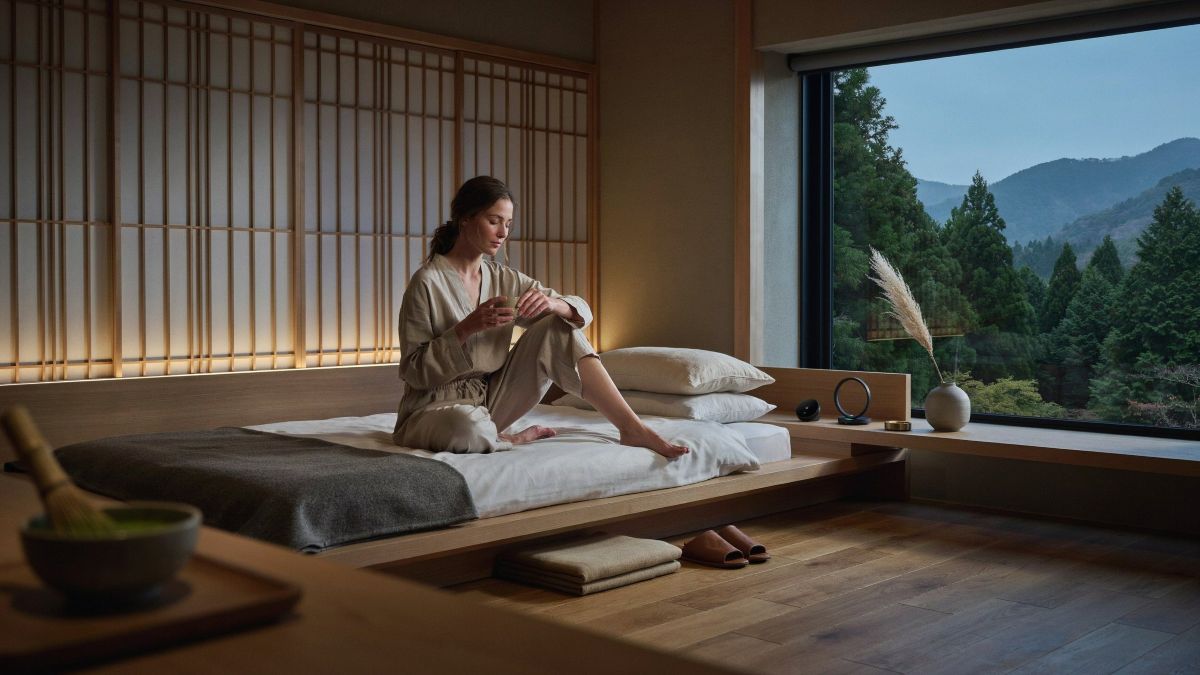
Image generated with Ai
Japan is revolutionising the way travelers view rest as the nation transforms its focus on quality sleep into a revolutionary new luxury travel experience in 2026. Modern hotels and wellness resorts are no longer focusing on providing comfortable sleeping facilities but are now offering sleep tracking, meditation, wellness assessment, breathwork and personalized therapies. In addition, destinations like HOSHINOYA Karuizawa and Six Senses Kyoto are incorporating rest in the travel itinerary itself. Thus, this innovation provides travelers yet another reason to travel to Japan while also allowing hotels to provide their guests with luxurious wellness experiences. Therefore, quality sleep has become a revolutionary luxury experience in 2026.
The most important change in sleep tourism is simple. Hotels are no longer treating sleep only as a basic part of a night’s stay.
Advertisement
For years, the hospitality industry promoted large beds, comfortable pillows, quiet rooms and blackout curtains. Those features still matter. However, the new generation of sleep programmes goes much further.
The official-source audit deliberately excluded ordinary hotel comfort. A property entered the research only when its official hotel, group or tourism source marketed a dedicated sleep programme, sleep room, sleep pathway, treatment or retreat.
Advertisement
Advertisement
That difference is creating a new commercial category.
Hotels are beginning to sell sleep as something that can be analysed, improved and personalised.
The research identified 73 hotel-programme records across 32 countries.
That figure does not mean there are only 73 sleep-focused hotels in the world. There is no single international registry.
Instead, the audit represents properties and programmes that could be supported through official hotel, resort, hotel-group, government or destination-tourism sources.
This makes the finding important.
Sleep tourism is no longer confined to a handful of experimental resorts. It now appears across Europe, Asia, the Indian Ocean, the Middle East and the Americas.
It also appears across very different kinds of properties.
Some hotels sell medical-style sleep recovery.
Others use smart-room technology.
Some sell meditation, Ayurveda and circadian routines.
Others sell silence itself.
One of the clearest trends in 2026 is the move from comfort towards measurement.
Six Senses uses sleep tracking.
Chiva-Som Hua Hin uses overnight respiratory monitoring and tests connected with cortisol and melatonin.
Lanserhof Sylt uses neurofeedback.
Santani Wellness Kandy restructures daily routines around circadian rhythm.
Chenot Palace Weggis uses programmable light and natural sound.
Equinox Hotel New York uses an adaptive sleep system and environmental personalisation.
These examples show how premium hospitality increasingly treats sleep as something that can be assessed rather than simply advertised.
That shift may be one of the most important developments in luxury wellness travel.
Thailand offers one of the strongest examples of the shift.
Chiva-Som Hua Hin currently sells a Sleep Enhancement Specialisation priced at THB 29,400++.
The resort recommends a stay of at least five nights.
The programme can involve ApneaLink overnight monitoring. It also uses repeated melatonin and cortisol testing. Guests can then receive consultation with the resort’s resident naturopath.
This moves the experience far beyond a relaxing massage.
The hotel is using assessment as part of the product.
Kamalaya Koh Samui offers another Sleep Enhancement programme with stays of five, seven, nine, 14 and 21 nights.
THE BARAI HUA HIN also lists sleep recovery within its current wellness pathways.
Japan shows another important development.
At HOSHINOYA Karuizawa in Nagano, the hotel explicitly markets a Sleep Tourism Program.
Its seasonal Karuizawa Summer Sleep Retreat runs as a three-day, two-night experience centred on high-quality rest in the Karuizawa environment.
The wider sleep-tourism programme is listed throughout the year.
Six Senses Kyoto goes further.
Its Sleepcation package remains valid through 31 December 2026.
The package combines sleep-oriented room amenities, wellness screening, Yoga Nidra, pranayama, a Dreamcatcher treatment, sleep tracking, biohacking recovery, bathing rituals and sleep-focused meals.
Japan therefore turns sleep from a hotel function into a reason for taking a trip.
India has another strong advantage.
Its wellness industry can connect modern sleep recovery with Ayurveda, yoga and traditional health practices.
Ananda in the Himalayas currently offers a Sleep Enhancement programme lasting seven, 14 or 21 nights.
The programme combines Ayurveda, Traditional Oriental therapies, yoga, breathwork, lifestyle changes and dietary interventions. A March 2026 Ananda case study confirms active use of the programme during 2026.
Long stays matter commercially.
A seven-night wellness stay produces more accommodation revenue than a weekend spa break.
A 14-night or 21-night programme can produce even more.
Sleep tourism may therefore help wellness resorts increase length of stay as well as spa and treatment spending.
The Maldives is also widening its tourism proposition through sleep.
JOALI BEING operates a Tranquil Sleep programme built around personalised wellbeing and better sleep patterns.
Visit Maldives has independently promoted JOALI BEING and described its programmes as customisable for restorative sleep.
The wider wellbeing programmes can run from five nights to three weeks.
Hilton Maldives Amingiri Resort & Spa currently maintains a Sleep Wellness Menu.
Soneva Fushi markets Float to Sleep.
Six Senses Kanuhura and Six Senses Laamu also sit within the Six Senses Sleep network.
This gives the Maldives another premium travel product beyond beaches, villas and diving.
Santani Wellness Kandy shows how traditional wellness can be combined with modern sleep language.
Its Sleep & Recovery programme begins with consultation and dosha analysis by an Ayurvedic physician.
Possible therapies include Shirodhara, Takradhara, Shiro Pichu, Abhyangam and reflexology.
The programme also considers meal timing, light exposure and daily physical activity.
A structured 45-minute pre-sleep sequence can combine breathwork, Yoga Nidra and herbal support.
The minimum stay is five nights, while seven to 14 nights are recommended.
The commercial model is clear.
The resort is not simply selling a room.
It is selling a longer recovery journey.
Europe contains some of the most technology-heavy sleep programmes in the research.
Lanserhof Sylt in Germany offers Neuro Sleep Reset.
The programme includes a three-day intensive module within a minimum seven-night stay.
The hotel describes repeated high-intensity neurofeedback sessions designed around theta-wave activity linked with deep relaxation and sleep.
The current published starting price is €7,394 per person for seven nights, excluding supplements and medication.
This shows how far sleep tourism can move from conventional hotel wellness.
A traveller may now pay several thousand euros for a stay where sleep forms a central part of the value proposition.
Chenot Palace Weggis takes a different technological approach.
Its Sleep Cycles module uses programmable light and natural sound sequences linked with the guest’s sleep pattern or chronotype.
The module can be added to the resort’s Recover & Energise programme.
Chenot’s current website displays a Sleep Cycles offer at CHF 7,960, although travellers should reconfirm exact package inclusions before booking.
This is important because hotel design is becoming part of sleep technology.
Lighting is no longer only decorative.
Sound is no longer only entertainment.
Both can become part of a premium sleep proposition.
Six Senses Douro Valley provides one of the clearest examples of sleep becoming a priced hospitality product.
Its three-day programme costs €1,300.
Five days costs €2,030.
Seven days costs €2,885.
The longer programme can include wellness screening, sleep consultation, personalised treatments, fitness or wellness activities, nutritional guidance and post-programme analysis.
This pricing structure shows how hotels can turn sleep into an additional revenue stream.
The guest does not simply pay for accommodation.
The guest pays for a defined sleep journey.
SHA offers another business model.
Its Sleep Well programme can be added to a broader health stay.
At SHA Spain in Alicante, the programme is designed to identify underlying causes of disturbed sleep and improve circadian rhythm.
It combines a tailored protocol with neurostimulation and acupuncture.
Prices start at €1,350.
SHA Mexico also offers the programme, with prices starting from US$1,450.
This model may be particularly attractive for wellness resorts.
Sleep does not need to replace the main health programme.
It can become a high-value addition to it.
Sleep tourism is not limited to isolated retreats.
Urban hotels are also entering the market.
COMO Metropolitan Singapore markets Sleep Dreams.
Its rooms and suites include SleepHub technology using low-frequency sound.
The dedicated programme also brings together hyperbaric oxygen therapy, massage, heat therapy, an ENT sleep consultation and a sleep kit.
Conrad Singapore Orchard operates another model.
Its Signature Sleep-to-Wake Ritual includes botanical tea, an in-room sound bath, pillow and linen choices and a morning greenery walk.
The city-hotel model matters.
It suggests sleep tourism does not always require a remote wellness destination.
Zedwell Hotels in London takes almost the opposite approach.
Its sleep-first Cocoon rooms are deliberately windowless.
They focus on silence, filtered air, gentle lighting and fewer distractions.
Televisions are removed.
At Piccadilly Circus, the hotel describes its rooms as purpose-built to enhance sleep.
Park Lane uses an underground setting built around silence and rest.
Zedwell proves that sleep tourism does not always require complicated equipment.
A hotel can also differentiate itself by removing noise, light and unnecessary stimulation.
That makes the sleeping environment itself the product.
American hotels are helping push smart-bedroom technology into mainstream luxury hospitality.
Equinox Hotel New York operates a Sleep Lab.
It uses an Eight Sleep adaptive mattress and lets guests personalise temperature, light, sound and ambience.
Circadian rituals and sleep-oriented wellness also form part of the wider experience.
Park Hyatt New York has a Sleep Suite by Bryte.
Park Hyatt Chicago also uses Bryte technology.
Santa Monica Proper Hotel combines Eight Sleep mattresses with air purification, water filtration and sunrise-alarm technology.
The bedroom itself is becoming a technology platform.
The research shows that sleep tourism is not one product category.
It has divided into at least four clear commercial models.
Medical-wellness resorts such as Chiva-Som, Lanserhof, Santani, SHA and Euphoria use assessment and intervention.
Luxury wellness resorts such as Six Senses combine several wellness methods.
Hotels such as Equinox, Park Hyatt and Proper put technology into the accommodation.
Zedwell and Hästens focus heavily on the sleeping environment itself.
This matters for hotel investors and operators.
There is no single formula.
A beach resort, city hotel, wellness retreat or boutique hotel can all enter the sleep economy in different ways.
The pricing shows why hotels are taking the trend seriously.
Chiva-Som lists its Sleep Enhancement specialisation at THB 29,400++.
Six Senses Douro Valley charges up to €2,885 for seven days.
SHA Spain starts from €1,350.
SHA Mexico starts from US$1,450.
Mandarin Oriental Prague lists a two-hour Deep Sleep treatment at CZK 7,000.
Mandarin Oriental Jumeira Dubai lists a two-hour Sleep Support Therapy at AED 1,400.
Lanserhof Sylt begins at €7,394 per person for seven nights.
Sleep is therefore moving into the same premium spending territory as advanced wellness and longevity travel.
Length of stay may become one of the most important commercial benefits.
Traditional hotel wellness often involves one massage or one spa visit.
Sleep programmes can last much longer.
Ananda offers seven, 14 and 21-night formats.
Kamalaya offers five to 21-night programmes.
Santani recommends stays of seven to 14 nights.
Euphoria Retreat offers programmes lasting seven, 10, 14 or 21 days.
Longer programmes can generate room revenue, treatment revenue and food-and-beverage spending.
That could make sleep particularly attractive to destination resorts looking for high-value guests.
One surprising finding is how hotel-led the market remains.
The research did not identify a national government operating a dedicated nationwide sleep-tourism hotel accreditation scheme.
However, some tourism organisations have started promoting sleep-focused properties.
Visit Maldives has promoted JOALI BEING’s restorative-sleep programming.
Centro de Portugal promotes Hästens Sleep Spa in Coimbra.
These examples may become important.
If sleep tourism continues to grow, tourism boards may eventually market quiet environments, wellness infrastructure and sleep-focused accommodation as destination strengths.
There is one important warning.
Hotels increasingly use terms such as sleep medicine, restorative sleep, circadian optimisation and neurotechnology.
Those terms can sound highly scientific.
However, an official hotel page proves what the hotel sells. It does not automatically prove that every health claim has independent clinical validation.
The research therefore distinguishes hospitality marketing from medical evidence.
Travellers with genuine sleep disorders should not assume that every hotel programme is equivalent to medical diagnosis or treatment.
That distinction will become more important as the market grows.
The biggest impact may eventually appear inside the hotel room.
For decades, hotels competed through location, views, restaurants, pools and room size.
Sleep tourism adds another layer.
Future premium rooms may compete through acoustic insulation, air quality, mattress intelligence, temperature control, circadian lighting and fewer digital distractions.
Hotels may also use sleep data to personalise the guest experience.
That could change how rooms are designed, marketed and priced.
The bedroom may become one of the most technologically valuable spaces in hospitality.
Sleep tourism in Japan is being redefined due to the fact that hotels are incorporating improved sleep into an attractive form of luxury travel experience for 2026. Hotels have started offering a comprehensive package of sleep with the aid of sleep diagnostics, advanced technology, spa, meditation, and personal wellness. In addition, the incorporation of improved sleep will offer a valid reason to choose Japan for a healthy vacation. In addition, this innovation can be used by hotels to provide extended vacations with greater value to visitors. Thus, improved sleep is no longer a mere necessity but a potential luxury product.
Advertisement
Tags: hotel sleep technology, Japan sleep tourism, luxury travel Japan, Restorative Travel, sleep hotels Japan
Advertisement
Advertisement













Friday, September 4, 2026

Friday, September 4, 2026
Friday, September 4, 2026

Friday, September 4, 2026

Thursday, September 3, 2026

Wednesday, September 2, 2026
Friday, September 4, 2026
Friday, September 4, 2026


