
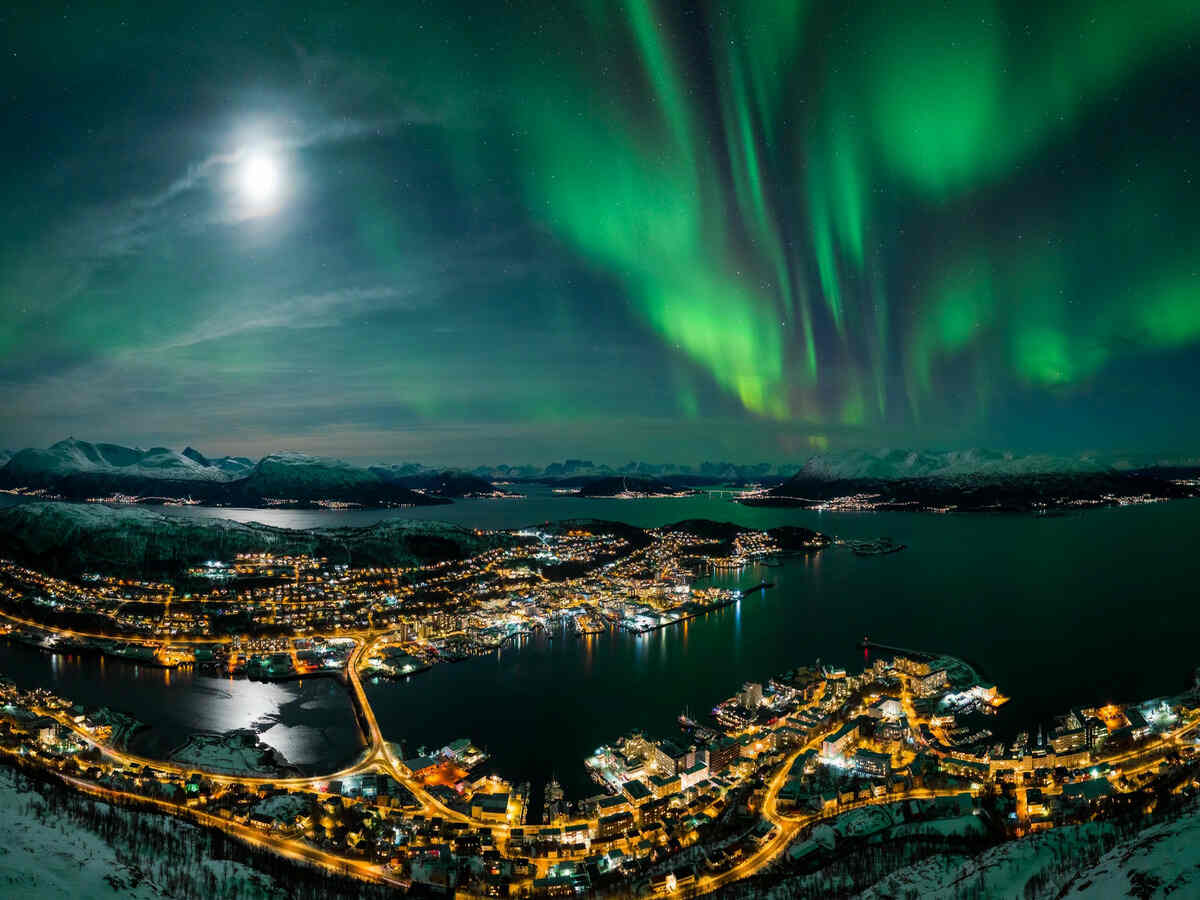
Image generated with Ai
Tourism numbers in Norway grow by over 7%, as Sweden, Poland and other parts of Europe help boost foreign visits. Norway continues to become one of the best tourism destinations in Europe in 2026, as there is still rising demand from abroad despite the record period for Norway’s hotel business. The international tourist arrival figures in Norway growing by 7.2% in the period January to April 2026, as revealed by UNWTO Tourism Statistics.
The growth, highlighted by UN Tourism data showing Norway’s international tourist arrivals rising by 7.2% between January and April 2026, is being supported by travellers from across Europe. Sweden, Denmark, the United Kingdom, Germany, France, Poland, Switzerland, Italy, Portugal and the Netherlands are all important contributors to Norway’s international visitor economy, although their performances vary by season and month. Sweden is particularly significant because its June guest-night volume stood well above Poland’s, while Denmark and the UK delivered some of the strongest growth signals during the winter period, reinforcing the broader international tourism momentum reflected in the latest UN Tourism figures.
Norway’s tourism story, however, extends beyond visitor numbers. The country is pursuing international marketing, year-round tourism, regional dispersal, nature experiences, winter holidays, food tourism and sustainable destination development as it seeks to turn rising international interest into greater tourism value.
The 7.2% increase in international tourist arrivals from January through April 2026, based on the UN Tourism data under discussion, puts Norway’s performance into sharp focus.
Advertisement
This growth comes after an exceptionally strong period for Norwegian tourism. Norway recorded 40.6 million commercial guest nights in 2025, while foreign visitors accounted for approximately 14.2 million international overnight stays. That represented a new high for international accommodation demand and placed the country well above its pre-pandemic international guest-night level.
The important distinction is that international tourist arrivals and guest nights measure different things. An arrival counts a visitor entering or registering as an international tourist under the relevant tourism methodology, while guest nights measure nights spent in registered accommodation. Both indicators nevertheless point towards substantial foreign demand for Norway.
| European Market | 2026 Indicator Discussed | How It Supports Norway Tourism |
|---|---|---|
| Sweden | 149,824 guest nights in June, +7.1% | Large neighbouring market supporting regional and summer demand |
| Poland | 68,705 guest nights in June, +5.4% | Expanding Central European visitor market |
| United Kingdom | June +7.9%; February hotel nights +19% | Major winter, Arctic and year-round market |
| Denmark | June +9.9%; January around +28% | Strong winter, skiing and short-haul market |
| Germany | 438,031 June guest nights | Norway’s biggest established European source market |
| Netherlands | 160,294 June guest nights | Major summer, road-trip and outdoor market |
| France | 94,317 June guest nights, +2.6% | Supports nature, culture and experiential tourism |
| Switzerland | 65,734 June guest nights, +7.6% | Strong outdoor and nature-oriented demand |
| Italy | 37,854 June guest nights, +3.3% | Growing Southern European market |
| Portugal | 8,939 June guest nights, +15% | Smaller market showing rapid percentage growth |
Sweden stands out prominently in Norway’s European tourism picture.
Statistics Norway recorded 149,824 Swedish commercial guest nights in June 2026, representing growth of 7.1% compared with June 2025. Sweden therefore generated more than twice the guest-night volume recorded from Poland during the month.
This is hardly surprising given the geographical and economic relationship between the two Nordic neighbours. Easy cross-border access makes Norway attractive for Swedish visitors seeking city breaks, road trips, mountain holidays, coastal experiences and outdoor recreation.
Sweden was already one of Norway’s biggest international markets before 2026. It generated roughly 1.3 million commercial guest nights in 2025, placing it among the country’s most important European tourism sources.
Its combination of large existing volume and continued growth makes Sweden especially valuable for Norway.
Poland may remain considerably smaller than Sweden by total guest nights, but it is contributing positively to Norway’s tourism expansion.
Norway registered 68,705 Polish commercial guest nights in June 2026, an increase of 5.4% year-on-year.
The Polish market adds diversification to Norway’s European visitor base. Norway’s spectacular mountains, fjords, hiking opportunities, northern landscapes and city experiences provide an increasingly broad proposition for Central European travellers.
Poland’s growth is particularly relevant because Norway does not need to depend exclusively on its traditional Western and Nordic markets. Expanding demand from Central Europe creates another potential stream of international visitors for hotels, attractions, transport businesses and regional destinations.
Denmark has produced one of the most striking European growth signals during 2026.
Around 110,000 Danish guest nights were registered in January, representing approximately 28% year-on-year growth. Danish visitors accounted for a substantial share of Norway’s foreign accommodation demand during the month.
Denmark’s contribution is particularly valuable because it strengthens Norway during winter rather than concentrating all demand into the summer peak.
Skiing, snow holidays, mountain resorts and winter family trips give Norway a natural advantage in the Danish market. Destinations in Buskerud and Innlandet, together with Oslo and other accessible tourism centres, can benefit from this demand.
June also remained positive, with 79,700 Danish guest nights, up 9.9% year-on-year.
The United Kingdom is another powerful component of Norway’s international tourism economy.
British visitors generated approximately 93,000 hotel guest nights in February 2026, an increase of around 19% compared with February 2025. By June, total commercial guest nights from the UK reached 99,201, representing 7.9% growth.
This makes Britain particularly useful for Norway’s goal of becoming a stronger year-round destination.
Northern Lights trips, Arctic experiences, winter breaks, skiing, fjords, cruises and city holidays give Norway multiple products to sell to British travellers. The relatively short journey from Britain also supports weekend and short-break travel alongside longer itineraries.
Growing UK demand can therefore support hotels and tourism businesses during periods traditionally outside Norway’s busiest summer season.
While Sweden, Denmark and Britain are producing compelling growth stories, Germany remains Norway’s largest established European tourism source market.
German travellers generated almost 2.6 million commercial guest nights in 2025, demonstrating the extraordinary scale of this relationship.
In June 2026 alone, Germany produced 438,031 guest nights, making it Norway’s biggest foreign market during the month despite a 5.5% year-on-year decline.
That decline needs context. Germany’s sheer visitor volume means it remains crucial even during a softer month.
German tourists have a long-established appetite for Norwegian fjords, mountains, camping, road trips, hiking, coastal landscapes and nature-based holidays. This demand becomes especially important during summer.
Germany therefore remains a foundation of Norway’s international tourism economy rather than simply another growth market.
The Netherlands is another major European tourism source for Norway.
Dutch visitors generated approximately 985,000 guest nights during 2025, placing the Netherlands among Norway’s biggest European markets.
In June 2026, Dutch travellers accounted for 160,294 commercial guest nights. The figure was 3.5% below June 2025, meaning the Netherlands was not a growth market during that particular month, but its absolute scale remained substantial.
Dutch travellers are particularly important for summer tourism, including camping, touring holidays and nature-based travel.
For Norway, retaining this market is strategically important because these travellers can distribute tourism spending across smaller communities and rural destinations rather than concentrating solely in major cities.
France also contributed positively during June.
French travellers generated 94,317 commercial guest nights, representing 2.6% year-on-year growth.
Norway has a strong proposition for French travellers looking for outdoor experiences, fjords, culture, Arctic landscapes, sustainable tourism and distinctive food.
France is also one of the European markets Norway actively targets through international tourism promotion and travel-trade activity.
That makes French growth useful not only in numerical terms but also strategically, as Norway seeks travellers interested in experiences extending beyond conventional sightseeing.
Switzerland recorded one of the stronger European growth rates among the larger markets highlighted in June.
Swiss travellers generated 65,734 commercial guest nights, up 7.6% year-on-year.
The Swiss market fits naturally with Norway’s outdoor tourism offering. Mountains, hiking, dramatic scenery, winter sports and nature-led itineraries are products familiar to Swiss travellers, while Norway offers a very different Nordic landscape.
Swiss demand can also support Norway’s efforts to attract visitors motivated by quality experiences rather than purely low-cost mass tourism.
Norway is also attracting growing interest from Italy.
Italian travellers generated 37,854 guest nights in June 2026, an increase of 3.3% compared with the previous year.
Although Italy remains smaller than Germany, Sweden, Britain or the Netherlands as a Norwegian source market, growth from Southern Europe helps diversify Norway’s visitor economy.
The Northern Lights, Arctic landscapes, fjords and cooler summer temperatures can differentiate Norway from traditional Mediterranean destinations. Cultural tourism and Scandinavian food experiences provide additional reasons for Italian visitors to explore the country.
Portugal provides one of the most interesting percentage-growth stories.
Portuguese visitors accounted for 8,939 guest nights in June 2026, up 15% year-on-year.
The absolute number remains relatively small compared with Norway’s major European markets, so the percentage should be interpreted carefully. Nevertheless, double-digit growth indicates expanding interest from another Southern European source market.
Emerging markets such as Portugal can become increasingly useful as Norway seeks a more geographically diverse visitor portfolio.
The visitor growth is occurring alongside a wider national effort to strengthen tourism.
Norway’s 2026 tourism policy places significant emphasis on year-round tourism, rather than relying overwhelmingly on summer visitors.
That matters because different European markets have different seasonal strengths. Germany and the Netherlands are particularly important during summer, while Denmark and Britain can provide powerful winter demand.
This balance can help ski destinations, Northern Lights operators, restaurants, hotels, tour companies and transport providers maintain business across a longer portion of the year.
Norway is also using international destination marketing to turn global interest into bookings.
Campaigns associated with Visit Norway and Innovation Norway are broadening the country’s image beyond its famous fjords. Nature remains central, but tourism promotion increasingly incorporates culture, food, cities, Viking heritage, snow experiences, wellness and slower forms of travel.
Family travel and road trips are another opportunity. Encouraging international visitors to stop in multiple destinations can spread tourism spending beyond Oslo, Bergen and the country’s most famous attractions.
Norway is therefore selling not merely a landmark, but an entire portfolio of travel experiences.
Norway entered 2026 from an exceptionally strong position.
The country recorded 40.6 million commercial guest nights during 2025, while foreign guest nights reached approximately 14.2 million.
International overnight stays were around 32% above their 2019 level, demonstrating how strongly Norway’s inbound tourism market has expanded beyond the pandemic recovery phase.
European travellers remain central to that success.
Germany, Sweden, the Netherlands, Denmark, Britain, France and other European markets provide the volume, while expanding countries including Poland, Switzerland, Italy and Portugal add further momentum and diversification.
Norway’s next challenge is managing its popularity.
Tourism growth creates employment and expenditure, but large visitor concentrations can place pressure on infrastructure, communities and natural attractions.
Norway is therefore moving towards a model that places greater emphasis on sustainable destination management, regional dispersal and higher-value tourism.
The Visitor Contribution Act, which entered into force in July 2026, provides a framework under which tourism-intensive municipalities can eventually raise additional resources from visitors to support tourism-related public infrastructure and facilities.
Norway is also working on tourism quality, guide standards, digitalisation and improved use of data.
This suggests the country does not simply want ever-higher visitor numbers. It wants tourism growth that produces stronger economic value while remaining manageable for communities and destinations.
Norway’s tourism performance in 2026 is ultimately being shaped by a remarkably diverse mix of European travellers.
Sweden is combining scale with growth and sits comfortably ahead of Poland in June guest-night volume. Denmark is strengthening winter tourism. Britain is helping extend Norway’s tourism season. Germany remains the European heavyweight. The Netherlands continues to deliver substantial summer demand, while France, Switzerland, Poland, Italy and Portugal provide additional momentum.
At the same time, Norway is reinforcing that demand through international marketing, year-round tourism development, winter experiences, food and cultural tourism, regional travel and more sustainable destination management.
The 7.2% increase in international tourist arrivals during January–April 2026 therefore represents more than a single statistical milestone. It sits within a much larger transformation of Norway’s visitor economy.
With record accommodation demand behind it and European travellers continuing to explore its cities, fjords, mountains, Arctic landscapes and winter experiences, Norway has entered 2026 with considerable tourism momentum. The next stage will be turning that popularity into sustainable, year-round economic value — ensuring that the country’s tourism triumph benefits destinations across Norway rather than only its most famous visitor hotspots.
Advertisement
Advertisement
Advertisement













Thursday, September 3, 2026

Thursday, September 3, 2026

Thursday, September 3, 2026

Thursday, September 3, 2026

Thursday, September 3, 2026

Wednesday, September 2, 2026

Thursday, September 3, 2026

Thursday, September 3, 2026


