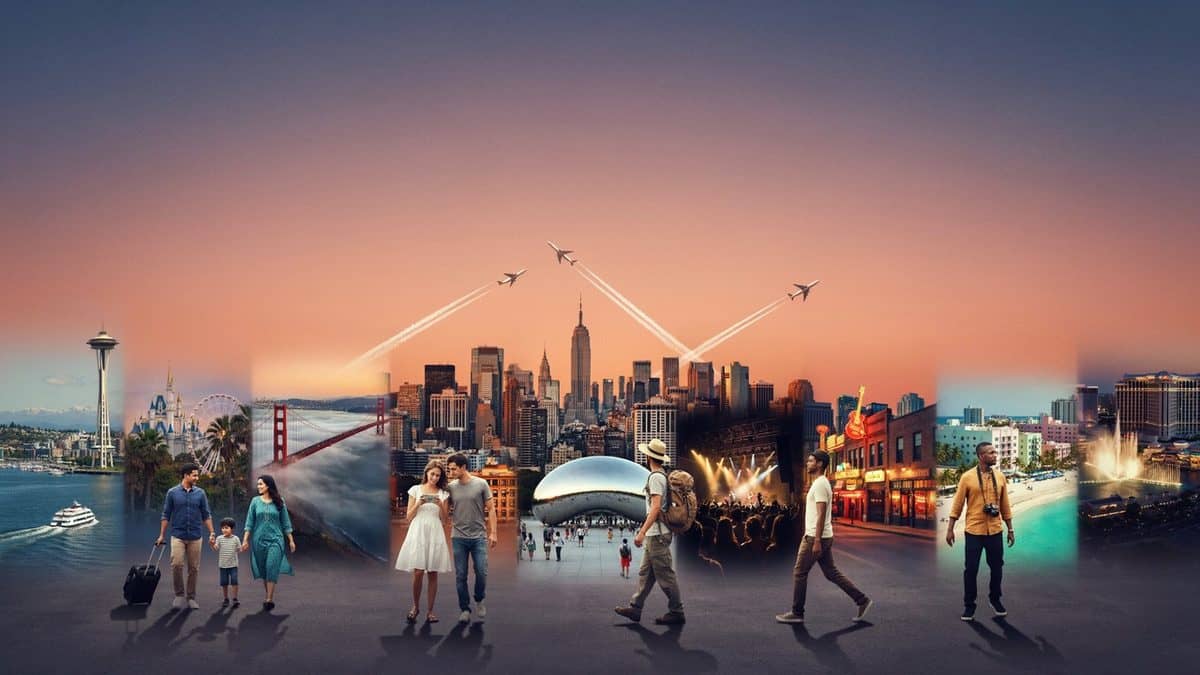
Image generated with Ai
US cities are entering a September travel shift as Seattle, Orlando and San Francisco lead demand, while events, hotels and changing international travel reshape America’s tourism market. San Francisco and more US cities are winning visitor momentum as September approaches, creating hopeful signs for the fall tourism season.
Visitor numbers, hotel demand and major events are giving destinations fresh confidence. Moreover, San Francisco is emerging as a standout market, while other US cities are also attracting travellers with stronger leisure and business demand. The shift matters because September can expose whether summer travel strength will continue into autumn. Now, cities are competing harder for visitors, spending and hotel stays. As a result, the September fall tourism season could become a crucial test of whether America’s urban travel recovery has entered a stronger phase.
US cities are entering a September travel shift, with Seattle, Orlando and San Francisco leading demand as America’s tourism market moves into a decisive month. September travel is no longer simply the quiet period after summer. Hotel performance, major events, business travel and domestic demand are creating new patterns across major US cities. Seattle is benefiting from exceptional visitor momentum. Orlando continues to attract strong hotel and airport demand. San Francisco is recording one of the country’s sharpest hotel recoveries. Meanwhile, Las Vegas is moving in the opposite direction. These contrasting results reveal how uneven America’s September travel economy has become.
The US travel industry is entering September with a stronger and more complicated picture than the traditional post-summer slowdown would suggest.
Advertisement
Advertisement
The latest U.S. Travel Association data shows that corporate hotel booking pace for September is 8.6% ahead of the comparable period, while group hotel demand remains one of the strongest-performing parts of the domestic market. The organisation has also upgraded its 2026 hotel outlook, forecasting RevPAR growth of 2.8%.
At the same time, the national hotel market recorded its 19th consecutive week of year-on-year growth through August 22. Occupancy reached 66.7%, up 2.1%, while ADR increased 2.3% and RevPAR rose 4.4%.
But the national figures conceal a more important story: cities are performing very differently.
San Francisco is arguably the most important hotel-market story entering September.
National hotel performance data through August 22 showed San Francisco recording the largest occupancy increase among the top 25 US markets, with occupancy up 13.2%. RevPAR increased 26%, reaching $165.
That is a striking contrast with the city’s previous tourism challenges.
San Francisco Travel expects 24.4 million visitors in 2026, with visitor spending forecast at roughly $9.94 billion. The city’s convention calendar is also providing an important demand engine, with major events generating substantial hotel room nights.
The city’s September story is therefore closely linked to conventions, technology, business travel and major events.
San Francisco is showing that urban tourism recovery can be accelerated when leisure and business demand begin working together.
Chicago demonstrates another force shaping September: event-led tourism.
The city has a dense September calendar featuring the Chicago Jazz Festival, ARC Music Festival, El Grito, Chicago Exhibition Week and the World Music Festival.
The Chicago Jazz Festival alone runs from September 3 to 6 at Millennium Park, with free performances attracting music audiences from across the city and beyond.
Chicago Exhibition Week then brings activity to more than 50 galleries and creative spaces.
This matters to hotels and restaurants because events distribute visitor demand across several weekends rather than concentrating it around one holiday.
Chicago is consequently turning September into an active cultural tourism month.
Seattle is emerging as one of the clearest examples of a US city benefiting from sustained tourism demand.
AAA’s 2026 Labor Day booking data placed Seattle at the top of its domestic destination rankings, ahead of Orlando, Boston, Denver and New York.
The city also enters September after an exceptional summer.
Downtown Seattle recorded more than 3.7 million unique visitors in July, reaching 112% of July 2019 levels. Nearly 432,000 downtown hotel rooms were sold during the month, representing 108% of comparable 2019 demand.
The World Cup contributed to the surge, but the city’s waterfront activity and wider visitor economy also played an important role.
For the travel industry, Seattle demonstrates how a major event can create a longer tourism effect rather than a temporary spike.
September therefore arrives with the city already operating from a position of strength.
Orlando remains another major September travel winner.
Orlando ranked second in AAA’s Labor Day domestic destination list, confirming the continued strength of Florida’s most important tourism market.
The underlying numbers are equally significant.
Orlando-area hotels generated more than 18 million room nights of demand through June 2026, up 1.1% from the same period in 2025 and close to pre-pandemic levels. Passenger traffic at Orlando International Airport reached 25.2 million through May, an increase of 3.1% year on year.
This matters because Orlando’s tourism economy is unusually diversified.
Theme parks remain central, but hotels, airports, restaurants, conventions, attractions and family travel all contribute to demand.
That gives Orlando greater resilience as the calendar moves beyond the peak summer period.
Boston enters September with strong holiday demand and the return of the city’s wider autumn travel economy.
AAA ranked Boston third among its top US Labor Day destinations.
Local reporting indicates that the city is preparing for heavier traffic and higher costs during the holiday period.
Boston’s significance extends beyond Labor Day.
September is an important transition month for business travel, universities, events and city tourism. The combination can create a powerful demand base just as traditional summer leisure travel begins to decline.
The result is a city where September can remain commercially valuable despite the end of the main summer holiday season.
New York is facing a different September challenge.
The city remains one of America’s leading domestic destinations, ranking fifth in AAA’s Labor Day list.
However, New York is also attempting to rebuild international visitor momentum, particularly from Canada.
Canada remains New York City’s second-largest international market, with approximately 820,000 Canadian visitors forecast for 2026. The city launched the Northern Neighbour Deal, offering discounts of up to 30% across hotels, restaurants, attractions, museums and Broadway, with the campaign running through September 7.
September also has a major cultural demand driver.
NYC Broadway Week runs from September 8 to September 20, offering two-for-one tickets for 25 participating shows.
New York therefore illustrates how destination marketing is increasingly being used not simply to attract visitors, but to respond to changes in international travel behaviour.
Las Vegas provides the sharpest warning that national growth does not benefit every city equally.
While the US hotel market posted another positive week, Las Vegas recorded the steepest decline among the top 25 markets through August 22.
Occupancy fell 17.4% to 60%, while RevPAR dropped 20% to $95.15.
The city is also trying to rebuild Canadian visitor demand. Canadian visits to the US have weakened considerably, prompting Las Vegas tourism operators to introduce promotions aimed at restoring this important market.
Las Vegas therefore enters September with a paradox.
It remains one of America’s best-known tourism destinations, yet its recent hotel performance shows that brand recognition alone cannot guarantee demand.
Nashville illustrates the growing importance of experience-led tourism.
New data released at the end of August shows that visitors generated a record $11.6 billion in Davidson County spending during 2025, an increase of 3.5% over the previous year. Visitors spent an average of $31.8 million per day in the county.
Music remains fundamental to Nashville’s identity, but the economic effect now extends across restaurants, entertainment, accommodation, events and local businesses.
The city’s performance demonstrates why US cities are increasingly competing through experiences rather than accommodation alone.
Austin has built one of the strongest September calendars in the country.
The month includes the Lone Star Le Mans endurance race from September 4 to 6, LEVITATION from September 10 to 13, the Pecan Street Festival and Fantastic Fest from September 17 to 24.
These events attract different visitor segments.
Motorsport brings international and specialist audiences. Music attracts younger leisure travellers. Film creates another cultural travel market.
Austin shows how cities can use multiple event categories to keep visitor demand moving throughout September.
Miami enters the month from a position of considerable strength.
Greater Miami and Miami Beach recorded 28.3 million visitors in 2025, generating $32.2 billion in total economic impact.
The figures underline the importance of Miami’s combined leisure, luxury, business, convention and international tourism economy.
Its September outlook is therefore not simply about beaches.
The city’s ability to attract high-value travellers, events and business visitors makes Miami an important indicator of how the premium end of US tourism is performing.
Cause: September demand is being supported by corporate travel, group bookings, major events, cultural festivals and strong domestic tourism. Answer: US cities are replacing the traditional post-summer slowdown with more specialised tourism strategies that combine leisure, business, entertainment and destination marketing. Reason: Visitor behaviour is becoming more event-led, while international markets are uneven and hotel performance varies sharply by city. Seattle and Orlando show resilient demand, San Francisco demonstrates a strong hotel recovery, while Las Vegas exposes the risks of weaker international traffic. Together, these markets show why September 2026 is becoming an important test of America’s broader urban travel economy.
The emerging September pattern is clear.
America’s travel market is growing, but it is not growing evenly.
Seattle is benefiting from exceptional visitor momentum. Orlando continues to rely on resilient leisure and aviation demand. Boston combines holiday travel with business activity. New York is balancing domestic strength against international-market challenges. San Francisco is producing one of the strongest hotel recoveries. Chicago and Austin are using events to sustain visitor flows, while Nashville is converting tourism into broader economic activity.
Las Vegas is the important counterexample.
Its decline proves that national tourism growth cannot automatically be translated into city-level success.
For travel companies, hotels, airlines, destination marketing organisations and investors, September is therefore becoming a useful indicator of what comes next.
The most important shift is that the shoulder season is becoming less predictable.
Cities that can create compelling events, sustain business travel, attract domestic visitors and rebuild international markets are better positioned to capture demand.
Those that depend too heavily on a single visitor segment face greater volatility.
The US Travel Association’s latest figures support this broader interpretation: corporate hotel booking pace for September is 8.6% ahead of the comparable period, while group demand remains strong.
That makes September 2026 more than another busy travel month.
It is becoming a test of how America’s major cities will compete for visitors in the next phase of the tourism economy.
September 2026 is revealing a more fragmented US travel market than the national numbers suggest. Seattle and Orlando are entering the month with strong visitor and hotel demand, while San Francisco is recording an exceptional hotel recovery. New York is combining cultural programming with efforts to rebuild Canadian tourism, and Chicago and Austin are using events to extend demand. Nashville continues to demonstrate tourism’s wider economic value, while Miami maintains strong visitor spending. Las Vegas stands apart, with falling hotel performance highlighting the risks of weaker international demand. The result is a competitive September in which city-level strategy increasingly determines tourism performance.
San Francisco and more US cities are entering September with stronger visitor momentum and a hopeful outlook. The fall tourism season is gaining importance as hotels, attractions, airlines and destination organisations prepare for continued demand. San Francisco stands out because improving hotel performance is combining with business, convention and leisure activity. Other US cities are also benefiting from events, domestic travel and renewed visitor interest. However, the recovery remains uneven, and September will reveal which destinations can sustain momentum beyond summer. The immediate outlook is encouraging, but competition will remain intense. For America’s travel industry, this fall season could signal another important stage of urban tourism recovery.
Advertisement
Tags: Fall Tourism Season, San Francisco, September, usa
Advertisement
Advertisement












Wednesday, September 2, 2026

Tuesday, September 1, 2026

Wednesday, September 2, 2026

Wednesday, September 2, 2026
Tuesday, September 1, 2026

Tuesday, September 1, 2026

Tuesday, September 1, 2026

Tuesday, September 1, 2026