
USA Aligns With Canada And More Welcoming Global Hikers Across New England Epic Corn Maze

Published
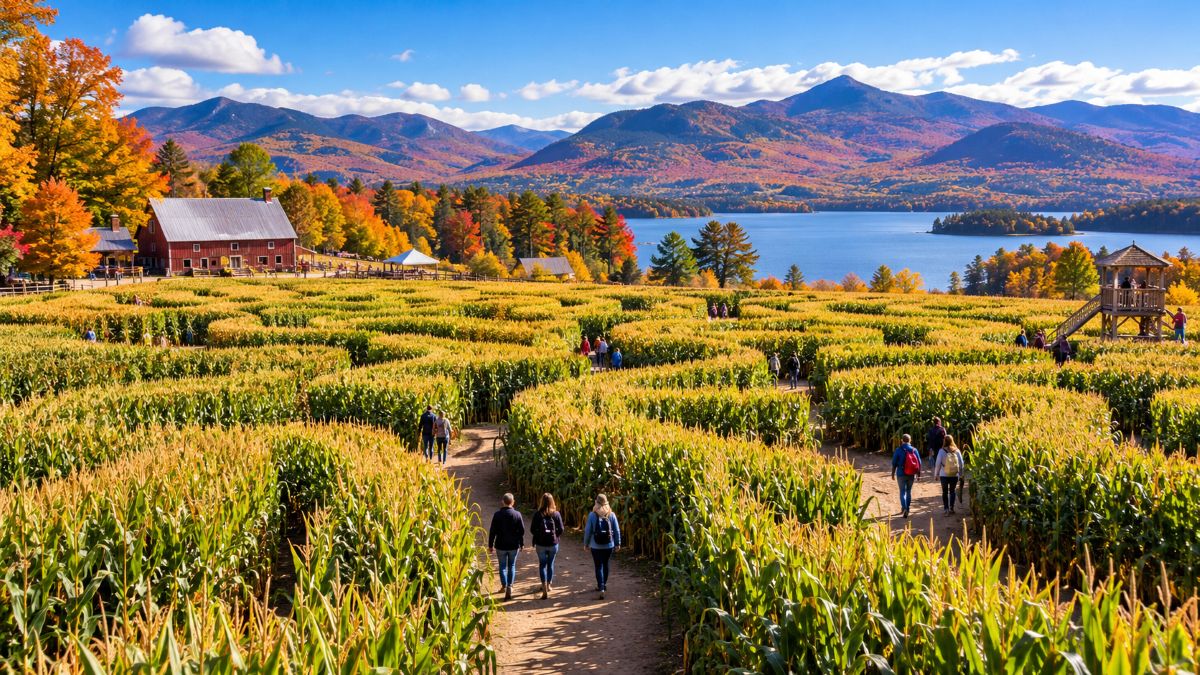
Image generated with Ai
Tucked away in the pastoral hills of North Danville, the Great Vermont Corn Maze has evolved from a modest local diversification project into New England’s most formidable autumn expedition. Covering twenty-four uninterrupted acres of farmland, this colossal living labyrinth attracts adventurous wanderers from across the North American continent and far overseas, providing an outdoor pursuit that blurs the boundary between leisure hiking and rigorous puzzle-solving. Operating continuously for nearly three decades, the destination redefines autumnal recreation by replacing standard scenic strolls with an immersive, physical journey through towering crops designed intentionally to challenge directional instincts and personal endurance.
Now commemorating the upcoming two-hundred-and-fiftieth anniversary of the United States, the estate welcomes hikers seeking authentic agritourism experiences steeped in regional cultural heritage. Unlike conventional autumn attractions built primarily for relaxed family outings or hurried digital snapshots, this sprawling rural destination delivers an intensive three-to-four-hour excursion. Visitors find themselves completely detached from modern screen routines as they step between dense stalks rising ten feet into the sky. The farm stands as an authentic testament to sustainable rural enterprise, celebrating regional Vermont identity whilst engaging travellers eager to test their navigation skills against an elaborate natural terrain.
Advertisement
Advertisement
Architectural Craftsmanship Across Twenty-Four Acres of Living Canvas
Creating an intricate terrestrial puzzle of this magnitude requires an exceptional balance of agricultural expertise, spatial geometry, and seasonal dedication. Long before autumn brings vibrant foliage across Caledonia County, the groundwork commences in the early warmth of May when the field is planted. Conception relies not upon computerised algorithms, but upon disciplined draftsmanship executed by hand on quad-ruled paper. The vast topography is divided methodically into four quadrants, allowing designers to map deceptive corridors, disorienting circuits, and tactical sight-line disruptions that prevent explorers from deciphering their true location relative to the perimeter of the field.
Once the fragile seedlings reach a height of barely one inch, the field paths are precisely carved into the soil using heavy mowing apparatus. As summer advances, the green walls surge upward to ten feet, transforming two-dimensional sketches into an enclosed expanse punctuated by one hundred feet of timber bridges and thirty-two feet of buried underground passages. The engineering provides elevated vantage points that intentionally offer limited perspective, ensuring hikers cannot easily memorise paths ahead. Maintaining several kilometres of winding earth tracks requires substantial weekly labour to eliminate obstructive growth, secure structural bridges, and maintain hidden emergency access lanes intended for weary guests needing an early departure.
Advertisement
Advertisement
Structural Specifications of the North Danville Agricultural Course
| Characteristic Feature | Operational Specification | Practical Visitor Relevance |
|---|---|---|
| Total Maze Acreage | 24 continuous acres | Largest documented agricultural maze within New England |
| Canopy Stalk Elevation | Approximately 10 feet | Completely obscures external horizon landmarks and terrain |
| Bridge Network Span | 100 feet of timber spans | Elevates travellers without revealing surrounding paths |
| Subterranean Corridors | 32 feet of tunnel network | Introduces light transitions and distinct elevation shifts |
| Average Completion Time | 3 to 4 uninterrupted hours | Demands adequate trail fitness, stamina, and hydration |
| Trail Maintenance Demand | 10 hours per week | Ensures clear footing, debris clearing, and route safety |
| Annual Course Layout | Annually renewed motif | Guarantees an entirely fresh navigation trial every autumn |
The Artistry of Wilson Bentley Inspires Seasonal Geometry
The seasonal iconography embedded within this vast labyrinth pays distinct homage to local history through a series of interlocking, crystalline snowflake formations. The configuration honours Jericho-born pioneer Wilson “Snowflake” Bentley, who achieved international acclaim during the nineteenth century as the earliest known specialist to successfully capture photomicrographs of individual ice crystals. Bentley established that no two snowflakes share identical physical structures, a scientific milestone that serves as the visual and thematic foundation for this year’s landscape design, symbolising collective cultural diversity during milestone national commemorations.
Translating delicate microscopic ice crystals into expansive, walkable green corridors presents distinct logistical hurdles that dictate every footstep within the boundary. Intricate branches, geometric spurs, and sudden dead ends mirror the crystalline arms documented in Bentley’s historical archival portfolio. Rather than merely presenting an aesthetically pleasing design from high-altitude aircraft, the configuration is modified rigorously to maintain navigational tension. Wide, open portraits often produce dull, predictable routes on foot; consequently, snowflake fractals are modified to loop back upon themselves, providing travellers with an intellectually stimulating labyrinth rather than a hollow walk through living portraiture.
Advertisement
Advertisement
Operational Hurdles Across Wildlife Pressures and Shifting Economies
Sustaining a working farm that doubles as a world-class experiential travel venue involves ongoing friction with native fauna and wider international headwinds. Throughout the crop cycle, local wildlife poses an immediate threat to the structural integrity of the corridors. Raccoons present a nocturnal annoyance by chewing on sensitive stalk bases, yet local black bears pose a far greater hazard to the enterprise. A solitary foraging bear can easily decimate an entire quadrant of standing maize in a single night of feeding, requiring round-the-clock vigilance to prevent extensive structural damage to the pathways before the seasonal gates open.
External economic fluctuations and cross-border developments have likewise exerted pressure on independent rural agritourism operations. Substantial rises in agricultural inputs, such as a thirty percent price spike on essential soil fertilisers, raise the baseline expenditure required to cultivate high-density crop walls each season. Furthermore, fluctuations in transatlantic leisure travel patterns and shifting sentiment among international vacationers have influenced attendance profiles across North America. Despite these real-world disruptions, the attraction continues to preserve an authentic, grounded rural identity, resisting commercial superficiality in favour of offering an unfiltered, uncompromising personal journey through the Vermont countryside.
Embracing Genuine Frustration and the Final Chime of Triumph
The prevailing ethos governing this northern New England institution deliberately repels modern commercial leisure trends that favour brief tourist photo opportunities. Hikers arriving in immaculate leisure footwear expecting manicured garden lanes are swiftly greeted by the realities of deep loam, steep gradient shifts, and misleading routes designed to produce genuine disorientation. The operation proudly champions genuine mental frustration as an essential component of personal adventure, recognising that authentic satisfaction cannot be achieved without real obstacles, missed cues, and collective perseverance across rugged trail paths.
Each autumn, upwards of seven thousand domestic and foreign adventurers undertake the journey through North Danville, with a remarkable proportion arriving as repeat visitors determined to best their previous completion times. Wandering beneath the rustling leaves on a crisp October afternoon, travellers share moments of laughter, mutual commiseration, and unexpected camaraderie as they cross paths at identical intersections. The culmination of this arduous expedition arrives at the exit gate, where travellers vigorously strike an enormous cast bell. The loud chime reverberating across the rolling green valley signals far more than the conclusion of an afternoon walk; it affirms collective determination, physical endurance, and the timeless appeal of tackling nature on its own terms.
Frequently Asked Questions
What is the precise geographic setting of this renowned New England maze? The estate is situated along the rural hill roads of North Danville within the Northeast Kingdom area of northern Vermont.
How much time should travellers realistically allocate to conquer the course? A typical traverse demands between three and four full hours of continuous, active hiking across uneven rural farm paths.
Advertisement
Advertisement
What specific seasonal motif informs the architectural layout this season? The current pattern honours pioneer Wilson Bentley by recreating intricate microscopic snowflake designs celebrating diverse national identity.
What is the overall land measurement occupied by this living labyrinth? The operational grounds encompass twenty-four acres, making it the largest documented agricultural maze throughout the New England territory.
Are hidden structural mechanisms integrated throughout the paths to enhance exploration? The course incorporates one hundred feet of elevated wooden footbridges alongside thirty-two feet of enclosed subterranean tunnel passageways.
How does the management team safeguard guests who become exhausted or unwell? Strategically placed emergency egress corridors are carved directly throughout the quadrants to ensure expeditious evacuation to the perimeter.
When does the annual design phase for the following autumn journey commence? Conceptual layout design starts on paper in May, aligning with springtime planting schedules well before the crops emerge.
Which native wildlife varieties present recurring hazards to the standing vegetation? Night-foraging raccoons frequently target lower roots, whilst rare incursions by local black bears can devastate broad sections of standing corn.
Advertisement
Advertisement
What styles of personal equipment are recommended for international visitors navigating the grounds? Sturdy, weather-resistant hiking boots with aggressive grip, layered seasonal attire, ample drinking water, and appropriate sun protection are vital.
Why does the venue encourage challenging frustration rather than leisurely strolls? The hosts believe authentic recreation requires genuine effort, ensuring the eventual victory bell chime represents an earned physical achievement.
Advertisement
