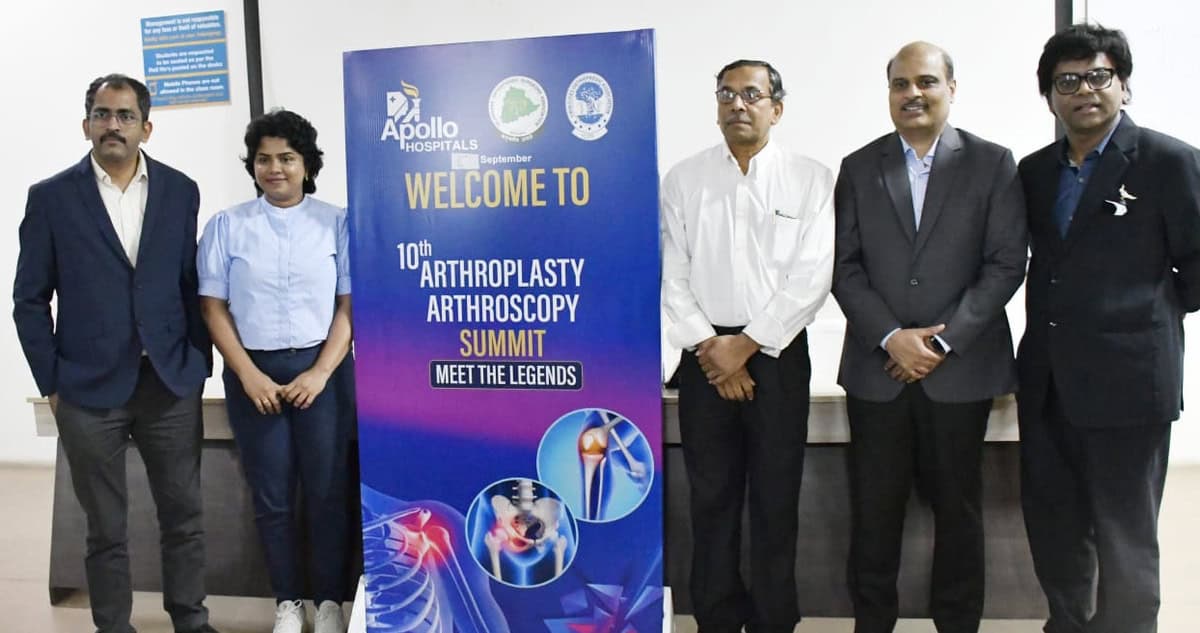
Apollo Hospitals, Secunderabad, organized the 10th Arthroplasty Arthroscopy Summit AAS 2026, a one-day advanced academic program. This program was jointly organized with the Telangana Orthopaedic Surgeons Association (TOSA) and the Twin Cities Orthopaedic Society (TCOS). The summit was held at the Apollo Institute of Medical Sciences and Research, Jubilee Hills, with the objective of bringing the distinguished faculty in the field of orthopaedic surgery for advanced academic discourses.
The latest developments in joint replacement and arthroscopy techniques were discussed during the summit, with insights shared by Dr N. Somashekar Reddy, Organising Chairman of AAS and Senior Orthopaedic & Joint Replacement Surgeon at Apollo Hospitals, Hyderabad, and Dr Mithin Aachi, Course Director of AAS and Senior Orthopaedic & Joint Replacement Surgeon at Apollo Hospitals, Secunderabad.
Advertisement
The scientific gathering witnessed participation from over 250 orthopaedic surgeons from different parts of India, including young and emerging specialists. The summit provided a collaborative platform for experts representing diverse orthopaedic subspecialties to deliberate on complex clinical challenges, advanced surgical practices, and evidence-based approaches.
Through interactive sessions and knowledge exchange, the event focused on strengthening clinical expertise and sharing practical solutions that can be integrated into routine patient care to improve treatment outcomes in arthroplasty and arthroscopy.
Advertisement
Advertisement
Dr Mithin Aachi,Course Director, AAS and Senior Ortho & Joint Replacement Surgeon, Apollo Hospitals, Secunderabad; said, Robotic Knee Replacement was highlighted as an excellent treatment option, with technology continuing to evolve rapidly. However, the Congress emphasised the need for long-term evaluation of patient outcomes and a careful assessment of its cost-effectiveness, particularly in the Indian context. Another key discussion centred on the role of injections for knee pain in patients with severe arthritis who are candidates for knee replacement. The consensus was that injections are unlikely to provide meaningful or lasting benefit in cases of advanced arthritis, where knee replacement may be the more appropriate treatment option. The Congress also deliberated on the latest keyhole procedures for ACL tears, including the use of newer synthetic ligament technology as an alternative to conventional ligament repair, and explored how these advancements could be made accessible and cost-effective for Indian patients. The latest clinical guidelines and advancements in knee and ligament treatment were also discussed extensively during the Congress.
Dr N. Somashekar Reddy, Organizing Chairman, AAS and Sr. Ortho & Joint Replacement Surgeon, Apollo Hospitals, Hyderabad; said, The Congress focused on the latest evidence-based developments in orthopaedic treatment and on disseminating this knowledge among orthopaedic specialists from six states. The scientific sessions also provided an opportunity to critically evaluate emerging techniques, assessing their clinical efficacy, safety and long-term outcomes, while distinguishing genuinely beneficial advances from those that lack sufficient evidence or meaningful clinical value and should therefore be approached with caution.
Dr Satish Mutha, Hinduja Hospitals Mumbai & President Elect of Mumbai Orthopaedic Society; said, We regularly conduct medical education programmes, but this Congress was unique in its discussion-driven and highly interactive format. The sessions encouraged healthy scientific debate, with several emerging developments, evolving treatment modalities, and areas of clinical controversy being discussed in depth. The objective was not merely to present new techniques, but to critically evaluate the available evidence, understand their benefits and limitations, and arrive at informed clinical perspectives. This made the Congress particularly enriching and fruitful. We believe this model of open, evidence-based discussion and knowledge sharing has great potential and would like to see similar programmes replicated across the country.
Dr Samundeeswari, Care Sports Injury Centre, Chennai; said, I specialise in joint replacement and arthroscopic surgery, including minimally invasive treatment for ligament and other joint-related conditions. The Congress examined the appropriate integration of emerging robotic-assisted surgery in India to improve outcomes while remaining cost-effective and accessible. It also addressed the long-term role of intra-articular injections in younger patients with knee osteoarthritis, including their indications and potential to delay knee replacement. Other topics included arthroscopic synthetic ligament augmentation or reconstruction for ACL injuries and cell-based therapies, including autologous stem-cell approaches, for knee osteoarthritis, with discussion of the current evidence, benefits and limitations. Advances in shoulder arthroplasty, including implant design, surgical techniques and the emerging use of robotic assistance to improve planning, precision and functional outcomes, were also highlighted.
Advertisement
Advertisement
The summit featured comprehensive discussions covering various aspects of modern orthopaedic practice, including joint replacement, arthroscopy and sports-related injuries, joint preservation and cartilage management, spine surgery, trauma care, periprosthetic joint infections (PJI), shoulder and elbow procedures, foot and ankle disorders, orthopaedic oncology, regenerative orthopaedics, and other emerging fields.
A key focus of the summit was the rapid advancement of orthopaedic treatments and technologies transforming patient care. Experts highlighted the latest developments in joint replacement procedures, including the growing application of robotic-assisted surgery, innovative single-stage cartilage repair techniques for knee lesions aimed at delaying arthritis progression, advanced joint preservation strategies, and minimally invasive shoulder surgery approaches designed to improve recovery and clinical outcomes.
The discussions also examined the expanding role of robotic technology in joint replacement procedures. While robotic systems offer enhanced precision, improved surgical planning, and greater consistency during operations, experts noted that ongoing research is required to determine whether these technological benefits consistently deliver superior long-term patient outcomes and cost advantages.
The summit also addressed the application of Platelet-Rich Plasma (PRP) therapy in osteoarthritis management. Discussions highlighted that PRP may have a role in selected cases but should not be viewed as a definitive cure or a cartilage-restoring solution for advanced osteoarthritis. In patients with severe joint degeneration, treatments such as Total Knee Replacement may remain the appropriate option based on individual clinical assessment.
Another important topic was the emerging use of synthetic ligaments and internal bracing techniques in ligament repair and reconstruction procedures. Experts discussed their potential benefits in carefully selected patients while emphasising the importance of evidence-based application, proper patient selection, and further evaluation of long-term outcomes.
The summit concluded with a strong emphasis on balancing innovation with clinical judgement. Experts agreed that advanced technologies should be adopted thoughtfully, ensuring that every treatment approach is tailored to the right patient, supported by scientific evidence, surgical expertise, patient expectations, and overall healthcare value.
Advertisement
Tags: Advanced Orthopaedic Care, Apollo Hospitals Secunderabad, Arthroplasty Arthroscopy Summit 2026, Joint Replacement Surgery, Orthopaedic Innovation
Advertisement
Advertisement













Monday, September 7, 2026

Monday, September 7, 2026

Monday, September 7, 2026

Monday, September 7, 2026

Monday, September 7, 2026

Monday, September 7, 2026