
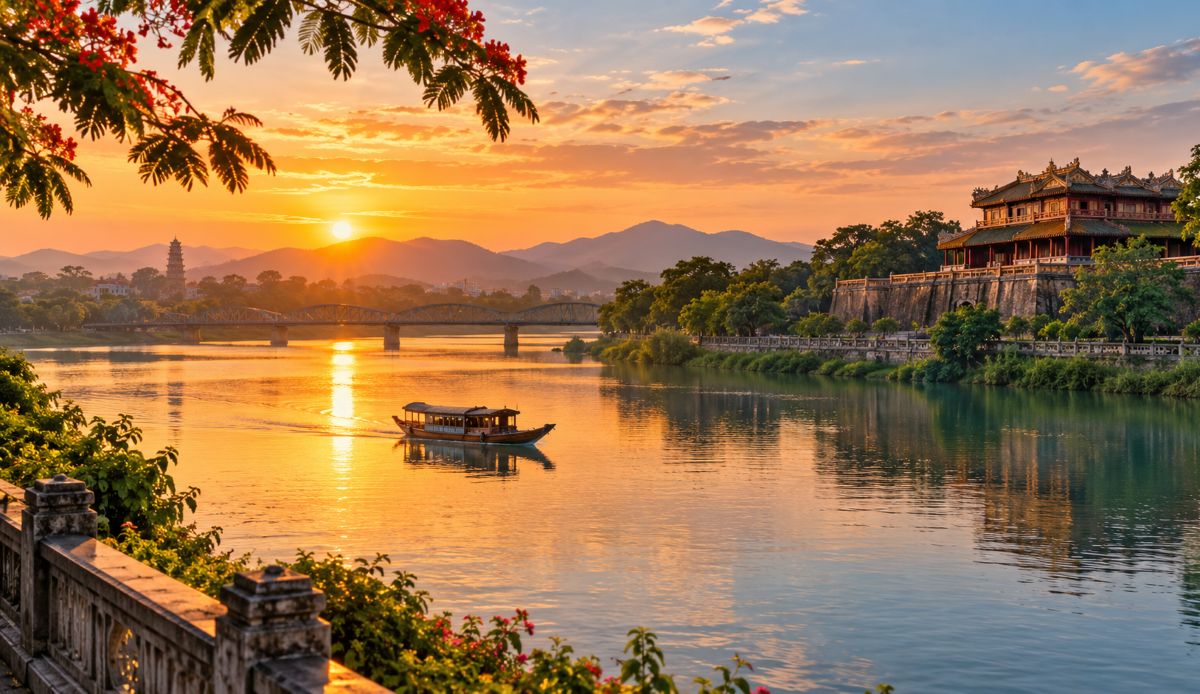
Image generated with Ai
You experience something unique the moment you step foot in Hue. The rest of the world is filled to the brim with hectic energy, whereas Hue contains a calm energy of its own and a unique tempo thanks to the presence of the Perfume River and the imperial monuments such as the imperial citadel and Nguyen Dynasty. Traveling to the center of Vietnam lets you tour the various chapters of the still intact living book of the nation. You don’t have to rush because you aren’t trying to check off the number of boxes on your travel spots list.
You can bring yourself to unwind here. The calm reverberates and you realize you’ve arrived at the right time when you feel it. When you decide to travel here, you find you have a chance to go for the cool, peaceful spring weather. While most travel to ancestral Vietnam, you can go for the historical travels with some relaxation mixed with beach time at Lang Co and Thuan An, and you can go for the fall weather. You travel here, you let others travel here. You let them support the heritage of Vietnam and you support the local heritage crafts with your travel.
Advertisement
Strategic Packing Guidelines, Recommended Lengths of Stay, and Practical Equipment for Visiting the Imperial Sanctuary
It was highlighted that thorough trip preparation requires packing suitable gear tailored strictly to the specific time of year. Tourists traveling during the warm summer months are advised to pack high-protection sunscreen, wide-brimmed hats, and breathable, lightweight clothing. Conversely, autumn and winter visitors should bring reliable rain gear, such as umbrellas and waterproof jackets! Furthermore, durable and comfortable walking shoes are strongly recommended year-round because exploring the extensive historic grounds of the Imperial Citadel and surrounding royal tombs involves substantial foot travel.
Advertisement
Advertisement
Regarding length of stay, experts suggest planning trips ranging from a concise 2-day/1-night excursion to a comprehensive 4-day/3-night heritage-focused itinerary.
From an industry viewpoint, proper visitor preparation directly raises the overall quality of the travel experience. When tourists arrive equipped with appropriate clothing and realistic expectations regarding walking distances, satisfaction scores increase substantially. Consequently, this yields positive online reviews, organic word-of-mouth recommendations, and higher repeat booking rates across global travel markets!
Ultimately, providing clear recommendations on trip duration assists itinerary planners in creating balanced schedules that prevent tourist fatigue. By offering flexible visit lengths, ranging from two-day stops to four-day deep dives, the regional hospitality market successfully accommodates both fast-paced tour groups and slow-travel enthusiasts!
Yearly Weather Patterns, Dynamic Seasonal Shifts, and Ideal Exploration Windows for Travelers
It was explained that the premier time to explore the city occurs between February and April, when the region experiences mild, pleasant weather featuring temperatures from 20–30°C, clear skies, and low rainfall levels! This favorable climatic window allows tourists to comfortably visit open-air monuments like the Imperial Citadel, Thien Mu Pagoda, and various royal tombs. On the other hand, the summer season spanning May through August brings intense sunshine, warm weather with temperatures between 28–38°C, and long daytime hours. These bright summer conditions favor coastal trips to Thuan An and Lang Co, water sports, and major cultural events like the Hue Festival, making it an ideal time for active itineraries that combine Hue, Da Nang, and Hoi An.
During the autumn months running from September to November, the city transitions into its rainy season, marked by elevated humidity, frequent rainfall, temperatures of 22–30°C, and occasional tropical storms. Nevertheless, this period offers reduced accommodation prices, smaller tourist crowds, a quiet romantic atmosphere, and cultural celebrations such as the Hon Chen Temple Festival along the Perfume River! Subsequently, winter arrives from December through January, bringing cooler, drizzly days with temperatures fluctuating between 17–24°C. This quieter season provides a tranquil, nostalgic environment suitable for unhurried sightseeing, indoor museum visits, and sampling warm local dishes.
The pronounced seasonal climate shifts in Hue significantly shape international travel pricing models and targeted marketing initiatives. Wholesalers and travel agencies routinely adjust package rates between the high-demand spring months and the discounted autumn rainy season! This dynamic pricing approach helps maintain steady year-round tourism activity while effectively regulating crowd density at world-famous historical sites.
For international travelers, understanding these distinct seasonal transitions ensures superior trip preparation and realistic expectations. Whether seeking sunny weather for coastal excursions at Lang Co or lower prices during the peaceful rainy months, clear knowledge of weather conditions empowers tourists to customize their travels according to individual tastes and budgets!
Critical Transport Links, Regional Access Corridors, and Transit Systems Connecting the Ancient Capital
It was noted that traveling to Hue is remarkably convenient thanks to several well-established transportation channels. Passengers flying into the region can land directly at Phu Bai Airport, located roughly a 30-minute drive from the central urban district! Alternatively, rail passengers can arrive at Hue Station, where the scenic North-South railway line travels across the dramatic Hai Van Pass, rewarding passengers with views of lush mountains and ocean scenery. Furthermore, budget-conscious road commuters frequently choose bus services taking approximately 2–3 hours from Da Nang, or undertake self-driven road trips along coastal highways.
Efficient transport links significantly raise the commercial destination value of the region! Seamless connections between Phu Bai Airport, Hue Station, and neighboring urban centers like Da Nang eliminate transportation friction for international tour operators. As a result, multi-destination travel itineraries across Central Vietnam become increasingly popular, driving higher passenger volumes and growing regional transit revenue!
Global travelers benefit directly from these diverse transport choices. Whether tourists prefer quick air travel, scenic train journeys through mountain passes, or affordable bus options, excellent accessibility ensures that Hue remains a major highlight on Southeast Asian travel routes. This reliable transit infrastructure reinforces global confidence when booking long-haul Asian vacations!
Comprehensive Scientific Oversight and Conservation Investments Safeguard Historic Monuments Across Central Vietnam
Maintaining historic structural integrity requires substantial long-term financing combined with rigorous technical management across Central Vietnam. The expansive Complex of Hue Monuments, which encompasses more than 500 hectares of historically significant terrain within Hue, demands constant physical upkeep to safeguard intricate stone masonry, ancient brickwork, and timber architecture against severe monsoon weathering. In recent years, dedicated public conservation funding exceeding VND 1.5 trillion (approximately 60 million USD) has been allocated toward comprehensive restoration initiatives. These substantial capital injections support vital structural interventions across primary historical sites, including the Imperial Citadel, Khai Dinh Tomb, and Minh Mang Tomb.
Additionally, precise environmental monitoring confirms that atmospheric moisture levels during rainy periods routinely spike to 85–90% relative humidity. These elevated levels create persistent decay risks for delicate royal palace assets, particularly hand-carved wooden elements, structural pillars, and traditional painted lacquerware. To combat physical degradation, regional heritage managers systematically evaluate material erosion indicators alongside daily foot-traffic statistics, which regularly top 10,000 visitors daily during peak operating periods. By monitoring these operational data points, conservation authorities can enforce daily entry thresholds, ensuring that high tourist volumes do not accelerate wear on irreplaceable historic artifacts.
Culinary Tourism Expansion and Economic Revenue Metrics Driven by Royal Gastronomy in Hue
The celebrated imperial food traditions of Hue act as a major catalyst for service sector revenue and regional economic development. The city boasts a remarkably diverse gastronomic landscape featuring more than 1,700 distinct dishes, ranging from elaborate multi-course royal court feasts to widely popular local street preparations such as Bun Bo Hue and Banh Beo. Industry data reveals that food and beverage expenditures represent approximately 25–30% of total tourist spending across the municipality, injecting billions of VND into local culinary businesses, street market stalls, and specialized cooking workshops.
Market observations also indicate rising international interest in immersive culinary experiences, including riverboat food tours along the scenic Perfume River. Participation in hands-on cooking classes has surged by nearly 40% year-on-year, with foreign visitors spending an estimated 25 to 50 USD per interactive session. By formalizing food safety standards, implementing strict hygiene controls, and showcasing authentic heritage recipes, the local food tourism economy strengthens agricultural supply networks, supports river fishing communities, and boosts regional food production.
Ecological Expansion and Biodiversity Indices Across Bach Ma National Park and Coastal Lagoons
Nature-focused travel surrounding Hue offers a vital environmental complement to urban historical sightseeing. Situated roughly 40 kilometers outside the central urban area, Bach Ma National Park spans over 37,000 hectares of protected tropical rainforest, providing habitat for more than 1,400 flora species and 1,300 fauna species. Ecological tracking reveals that eco-tourism interest in these protected ecosystems grows at a steady annual rate of 15%, drawing outdoor adventurers, wildlife photographers, and birdwatching enthusiasts to explore primary forest trails.
Parallel eco-tourism initiatives thrive across the Tam Giang – Cau Hai Lagoon System, which stands as Southeast Asia’s largest lagoon network, covering over 22,000 hectares. This extensive brackish water ecosystem supports regulated aquaculture activities and community-led eco-boat tours. These sustainable tourism operations provide stable income streams for more than 3,000 coastal families, helping transition workers away from intensive overfishing practices. Consequently, these ecological initiatives improve water quality parameters while preserving vital habitats for local and migratory bird species.
Hospitality Infrastructure Expansion, Luxury Resort Capital Investments, and Hotel Occupancy Metrics
The overall lodging infrastructure in Hue has undergone significant expansion to accommodate growing volumes of domestic and international visitors. The destination currently features more than 800 lodging facilities, providing approximately 13,000 room keys across diverse categories, from boutique heritage guesthouses to luxury 5-star oceanfront resorts along Lang Co Bay. Statistical reporting from regional tourism authorities indicates that hotel occupancy levels regularly rise to 80–95% during major holiday periods, reaching 100% full capacity at luxury properties during high-demand festival weekends.
Capital investment in high-end hospitality projects continues to accelerate, with multi-million-dollar beachfront resort projects launching along Thuan An Beach and nearby coastal strips connecting toward Da Nang. Average daily room rates (ADR) range from 40 USD per night for mid-scale urban hotels to over 350 USD per night for high-end coastal villas. Furthermore, revenue per available room (RevPAR) indicators reflect a healthy annual increase of 20–25%, signaling strong commercial investor confidence in the regional luxury travel market.
Socio-Economic Opportunities and Community Workforce Impact in Heritage Communities
Heritage-based tourism serves as an essential pillar of financial stability and workforce development throughout Hue and its neighboring rural communes. Official labor statistics establish that the travel, transport, and hospitality sectors directly and indirectly employ over 80,000 local residents, representing roughly 20% of the active regional labor force. Employment avenues encompass diverse professional roles, ranging from certified tour guides and hotel staff to skilled artisans operating in traditional craft locations such as Thuy Xuan Incense Village.
Financial evaluation studies show that total tourism service revenues exceeded VND 1.5 trillion (approximately 57 million USD) during major festive periods alone, reflecting an extraordinary year-on-year revenue increase of over 380%. This direct capital flow into community-based enterprises helps lower rural poverty rates, supports women-led artisan workshops, and funds essential municipal infrastructure projects across Central Vietnam.
Airport Logistics Upgrades and Air Passenger Handling Expansion at Phu Bai Airport
Modern air transportation links remain essential for attracting long-haul international visitors to Hue. The opening of Terminal 2 at Phu Bai International Airport, constructed with a total investment exceeding VND 2.6 trillion (approximately 110 million USD), expanded overall passenger processing capacity to 5 million passengers annually. This state-of-the-art terminal infrastructure integrates automated baggage handling systems, digital self-service check-in kiosks, and modern international customs facilities.
Logistics performance data demonstrates that expanded regional flight frequencies and direct charter routes from major Asian aviation hubs have boosted air passenger arrivals by over 45% year-on-year. Furthermore, optimized passenger processing workflows at Phu Bai Airport have reduced customs clearance times to an average of under 15 minutes per traveler. These transit efficiency gains directly support expanded flight schedules connecting Hue with key domestic hubs like Hanoi and Ho Chi Minh City, as well as international feeder airports.
MICE Sector Development, Corporate Event Revenues, and Regional Conference Trends
Hue continues to strengthen its commercial footprint within the Meetings, Incentives, Conferences, and Exhibitions (MICE) industry. The city’s blend of historic venues and modern conference facilities enables it to host major international gatherings, including the Hue International Music Festival and regional trade summits, which frequently gather over 70,000 attendees per event. Corporate event hosting yields elevated per-capita spending, with MICE delegates spending an estimated 180–250 USD daily, compared to 80–120 USD for typical leisure visitors.
Additionally, hosting corporate events during off-peak winter months from December to January helps stabilize seasonal revenue drops for urban hotel operators. Sector data indicates that corporate MICE bookings increase by 30% annually, establishing Hue as a major corporate gathering hub alongside nearby commercial destinations like Da Nang and Hoi An. This structural growth diversifies municipal tourism income and attracts high-spending business travelers throughout the year.
Sustainable Waste Reduction and Green Hospitality Certifications Across Heritage Properties
Managing high visitor numbers requires comprehensive environmental protection protocols to preserve the natural and cultural heritage of Hue. Municipal sustainability programs have introduced green initiatives aimed at eliminating single-use plastics across historic districts, targeting a 50% reduction in plastic waste across major heritage zones like the Imperial Citadel and Thien Mu Pagoda. Dedicated municipal teams manage over 200 metric tons of urban solid waste daily during peak travel periods using eco-friendly collection fleets.
In parallel, over 40 hospitality establishments across the region have earned formal national and regional “Green Lotus” eco-certifications. Properties achieve these standards by deploying solar-powered water heating arrays, advanced graywater recycling setups, and systematic organic composting units. These environmental metrics highlight a clear transition toward sustainable heritage stewardship, ensuring that long-term travel growth preserves the environmental integrity of Central Vietnam.
Your Legacy in Hue
Parting from Hue has its obstacles. There is a lot more to leaving Hue than photos can capture. It is Bun Bo Hue. It is the sweet and spicy beef noodle soup on a rainy day. It is the stones of the Imperial Citadel that have stood the test of time along the river. It is the beautiful sounds of bells on the river. Bun Bo Hue captures your love for travel. Hue has forever put its mark on humans. It is the beautiful sight of fog covering the royal tombs and the geese flying South all along Lang Co Bay. Hue restores you after you have taken the long walk down the ancient paths during spring. It is witnessing the cold, thick wintry fog that engulfs Hue. You are an important part of this place that is home to many families. You are preserving Hue’s legacy and tradition of making Bun Bo Hue. Peace and serenity of your soul is Hue. Hue will forever call you back.
Advertisement
Tags: Hue, tourism destination, Travel News, Vietnam
Advertisement
Advertisement













Monday, September 7, 2026

Monday, September 7, 2026
Monday, September 7, 2026

Monday, September 7, 2026

Monday, September 7, 2026

Monday, September 7, 2026
Monday, September 7, 2026