
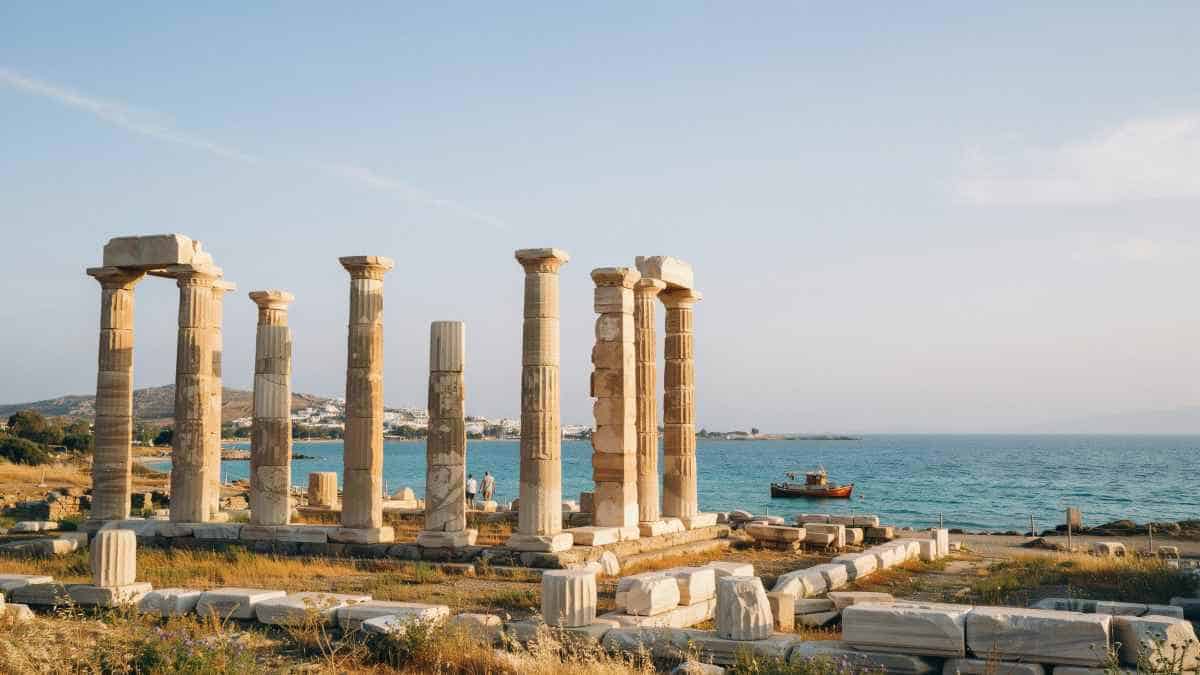
Image generated with Ai
Delos continues to captivate travellers seeking to explore the origins of Greek civilisation, offering one of the most significant archaeological and mythological destinations in the Mediterranean. Situated in the Cyclades archipelago near Mykonos, the island stands apart from other Greek destinations because it remains almost entirely devoted to preserving its ancient heritage. Free from modern urban development, Delos presents visitors with a rare opportunity to walk through the remains of a civilisation that shaped the cultural, religious and commercial history of the ancient Greek world.
Recognised globally for its archaeological importance, the island attracts historians, cultural travellers and heritage tourists eager to experience one of the best-preserved ancient settlements in Greece. Beyond its historical significance, Delos occupies a unique place in Greek mythology as the legendary birthplace of the twin deities Apollo and Artemis.
Advertisement
Today, the island remains one of Greece’s most valuable cultural tourism destinations, connecting visitors with thousands of years of mythology, religion and ancient history.
The island’s reputation begins with mythology.
Advertisement
According to ancient Greek tradition, Delos was the birthplace of Apollo, the god associated with light, music, prophecy and healing, and Artemis, the goddess linked to hunting, wilderness and the moon.
These mythological associations transformed the island into one of the most sacred locations in the ancient Greek world.
Pilgrims travelled from across the Aegean and mainland Greece to honour the deities through ceremonies, festivals and religious offerings.
The island’s sacred status contributed significantly to its development as a major religious centre.
Advertisement
Advertisement
Even today, these stories remain central to the visitor experience and continue attracting travellers interested in mythology and classical civilisation.
One of Delos’ most remarkable characteristics is the absence of modern urbanisation.
Unlike many historic destinations where ancient monuments coexist alongside contemporary buildings, Delos remains almost entirely dedicated to archaeological preservation.
Visitors encounter an environment where ancient ruins dominate the landscape and modern construction is largely absent.
This unique characteristic allows travellers to experience the site in a way that closely reflects its historical context.
The absence of extensive modern development contributes significantly to the island’s authenticity and educational value.
For cultural tourists, Delos provides one of the most immersive archaeological experiences available anywhere in Europe.
As Delos grew in religious importance, sanctuaries and temples were established across the island.
These structures served as places of worship and gathering for visitors arriving from throughout the Greek world.
The sacred precincts became centres of religious activity and played a key role in strengthening Delos’ influence within the ancient Mediterranean.
Many of these remains survive today, allowing visitors to observe the scale and sophistication of ancient Greek architecture.
The temples, ceremonial spaces and religious monuments illustrate how mythology influenced daily life, politics and trade throughout antiquity.
Their preservation remains one of the island’s greatest tourism assets.
Although Delos is widely known for its religious significance, it also developed into an important commercial hub.
Its location within the Cyclades positioned the island at the crossroads of maritime trade routes connecting different regions of the Mediterranean.
Merchants, sailors and travellers passed through Delos, contributing to its prosperity and cultural diversity.
The archaeological remains reveal evidence of marketplaces, residential districts and public spaces that supported economic activity.
This combination of religion and commerce helped transform Delos into one of the most influential centres of the ancient world.
Today, visitors can explore remnants of both sacred and commercial life throughout the site.
Delos is frequently regarded as one of the best-preserved archaeological landscapes in Greece.
The extensive ruins allow visitors to gain insight into urban planning, architecture and daily life in antiquity.
Among the most notable features are:
The concentration of archaeological remains within a relatively compact area makes the island particularly valuable for educational tourism.
Researchers, students and heritage enthusiasts continue visiting Delos to study its extraordinary historical record.
Its preservation contributes significantly to Greece’s cultural tourism sector.
Most visitors access Delos through nearby Mykonos, one of Greece’s leading tourism destinations.
The proximity between the two islands has created a complementary tourism relationship.
Travellers staying in Mykonos often undertake excursions to Delos to explore its archaeological treasures before returning to the modern resort destination.
This connection enables visitors to combine cultural exploration with leisure tourism.
The relationship also helps distribute tourism activity across the Cyclades while enhancing awareness of Greece’s historical attractions.
The global demand for heritage and cultural tourism has increased steadily in recent years.
Travellers increasingly seek experiences that provide historical context and deeper connections with destinations.
Delos aligns closely with these preferences.
Its combination of mythology, archaeology and preservation offers a travel experience centred on learning and exploration.
The island’s significance extends beyond Greece, attracting visitors interested in the broader history of Western civilisation and ancient Mediterranean cultures.
This enduring appeal continues supporting its position within international tourism markets.
Mythological Era – Delos becomes associated with the birth of Apollo and Artemis.
Ancient Greek Period – The island develops into a major religious sanctuary.
Classical and Hellenistic Eras – Delos emerges as an important commercial and maritime centre.
Modern Archaeological Period – Excavation and preservation efforts expand understanding of the site.
Present Day – Delos remains one of Greece’s leading cultural tourism destinations.
Delos is traditionally regarded as the birthplace of Apollo and Artemis, making it one of the most sacred locations in ancient Greece.
Travellers can explore temples, sanctuaries, residential districts, marketplaces and other archaeological remains.
Most travellers access the island via boat excursions from nearby Mykonos.
Delos remains one of the Mediterranean’s most extraordinary cultural destinations, preserving a unique combination of mythology, archaeology and ancient history. From its role as the legendary birthplace of Apollo and Artemis to its importance as a religious and commercial centre, the island offers visitors an immersive journey into the foundations of Greek civilisation. As cultural tourism continues to grow globally, Delos stands as a remarkable testament to the enduring legacy of the ancient world and one of Greece’s most significant heritage attractions.
Advertisement
Tags: ancient Greece attractions, Apollo birthplace, Artemis birthplace, Cyclades cultural tourism, Delos archaeological site
Advertisement
Advertisement













Friday, September 4, 2026

Friday, September 4, 2026

Friday, September 4, 2026

Thursday, September 3, 2026

Wednesday, September 2, 2026

Friday, September 4, 2026

Friday, September 4, 2026