
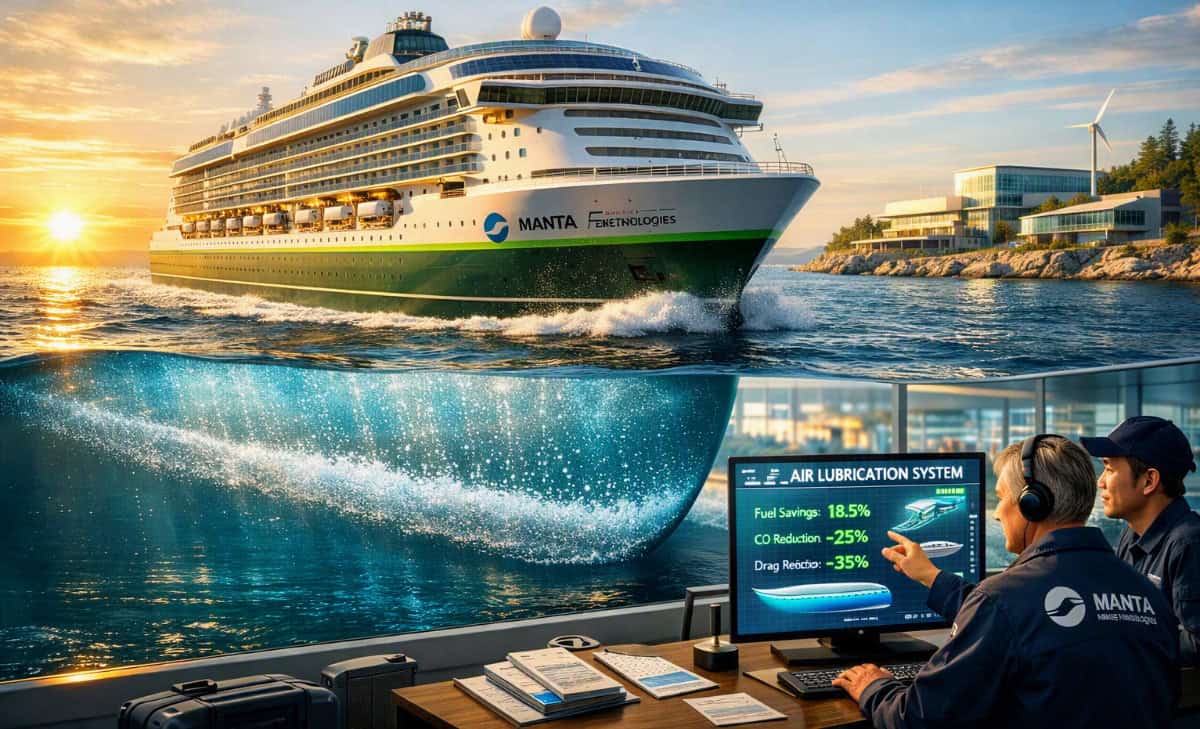
Image generated with Ai
More efficient and environmentally-friendly operations in the maritime industry seem to be coming into reach due to air lubrication technology for ships which is now being commercially supported through the collaboration of Manta Marine Technologies (MMT) and Foreship by RINA. Both companies have agreed on a framework deal to increase the deliveries of Manta Air Lubrication which is a system created to minimize friction, save fuel and assist in decarbonization.
As per the terms of the deal, MMT would be fully responsible for providing Manta Air Lubrication which is based on the air lubrication system design from Foreship. This system has been installed on more than 25 vessels and it is capable of being delivered on both the vessels which have already been built and on the ones that are yet to be built.
For cruise operators, passenger ships and maritime tourism industry, it might be quite significant to improve the efficiency of vessels in order to minimize their environmental impact.
The agreement brings together Foreship’s engineering expertise and MMT’s technology delivery capabilities to make air lubrication systems easier for shipowners to assess, install and operate.
Advertisement
Air lubrication works by creating a controlled layer of air beneath a vessel’s hull, reducing friction between the ship and the water.
| Area | Details |
|---|---|
| Companies involved | Manta Marine Technologies and Foreship by RINA |
| Technology | Manta Air Lubrication |
| Delivery responsibility | MMT will manage full project delivery |
| Engineering support | Foreship will provide hydrodynamic and CFD expertise |
| Applications | Retrofit and newbuild vessels |
| Existing installations | More than 25 vessels |
The partnership aims to simplify adoption by providing shipowners with support throughout the entire project process, from early feasibility assessments to installation and long-term support.
Although passengers may not directly see ship efficiency technologies, they influence the future of travel by helping operators reduce fuel use and emissions.
Cruise companies, ferry operators and other passenger vessel owners are under growing pressure to improve environmental performance while continuing to provide reliable global transport.
Advertisement
Advertisement
As sustainability becomes a larger factor in travel decisions, technologies that improve ship performance are expected to become increasingly important.
Air lubrication systems are designed to reduce resistance between a vessel’s hull and surrounding water.
When a ship moves through the ocean, friction between the hull and water creates resistance, requiring additional energy and fuel.
The air lubrication system introduces air beneath the hull, creating a smoother surface interaction.
MMT said the technology can typically deliver net fuel savings of between 3 percent and 8 percent, depending on vessel type and operational conditions.
The exact results depend on factors such as ship design, speed, route patterns and operating profile.
Shipping is one of the world’s most important transport sectors, connecting economies and supporting international tourism. However, reducing emissions from large vessels remains a major industry challenge.
Air lubrication represents one approach that allows shipowners to improve efficiency without completely replacing existing vessels.
The technology is particularly relevant for large vessels where even small efficiency improvements can create meaningful fuel savings.
A key part of the agreement is providing a complete project pathway rather than only supplying equipment.
MMT will oversee the full delivery process, helping shipowners move from initial evaluation to operational implementation.
This approach is designed to reduce uncertainty for operators considering air lubrication investments.
Foreship will continue supporting projects through technical analysis, including full-scale Computational Fluid Dynamics (CFD) studies.
CFD modelling helps engineers understand how water and air interact around a vessel’s hull before installation.
The companies said this process will help shipowners make more informed decisions before investing in new efficiency systems.
Cruise lines are increasingly exploring ways to reduce environmental impact through improved ship design, alternative fuels and energy-saving technologies.
While fuel alternatives such as methanol, LNG and other solutions receive significant attention, efficiency technologies can provide immediate improvements across existing fleets.
For cruise passengers, these developments could contribute to a future where greener operations become a standard part of the travel experience.
Passengers will not usually notice air lubrication systems during a voyage, but the technology could influence how future ships are designed and operated.
Travellers interested in sustainable cruising may increasingly consider how cruise operators invest in environmental technologies.
Technology adoption across the maritime sector will continue to depend on investment decisions, regulations and operational requirements.
Air lubrication technology reduces hull friction by creating a controlled layer of air beneath a vessel, helping improve efficiency.
According to MMT, typical net fuel savings can range from 3 percent to 8 percent depending on vessel type and operating conditions.
Yes. The system can be installed on both retrofit projects and newbuild vessels.
MMT said the technology has already been installed on more than 25 vessels.
It can help reduce fuel consumption, lower emissions and support wider maritime decarbonisation efforts.
The maritime industry is approaching greater efficiency and fewer emissions as air lubrication technology for ships moves toward commercial deployment in collaboration with Manta Marine Technologies (MMT) and Foreship by RINA. The two firms have signed a framework agreement to provide further distribution of the Manta Air Lubrication system, which is intended to help with friction reduction, fuel savings, and de-carbonization throughout the shipping industry.Pursuant to the agreement, MMT shall assume complete responsibility for the distribution of Manta Air Lubrication, which is a product using Foreship’s proven design for an air lubrication system. Manta Air Lubrication is already operational on more than 25 vessels and is suitable for existing ships via retrofit and new builds.In the case of cruise operators and passenger shipping companies, increased efficiency in vessels could help to minimize their environmental footprint.
Advertisement
Tags: air lubrication technology for ships, green shipping solutions, marine fuel efficiency, maritime decarbonisation, sustainable cruise technology
Advertisement
Advertisement













Friday, September 4, 2026

Friday, September 4, 2026

Friday, September 4, 2026

Thursday, September 3, 2026

Wednesday, September 2, 2026
Friday, September 4, 2026
Friday, September 4, 2026