
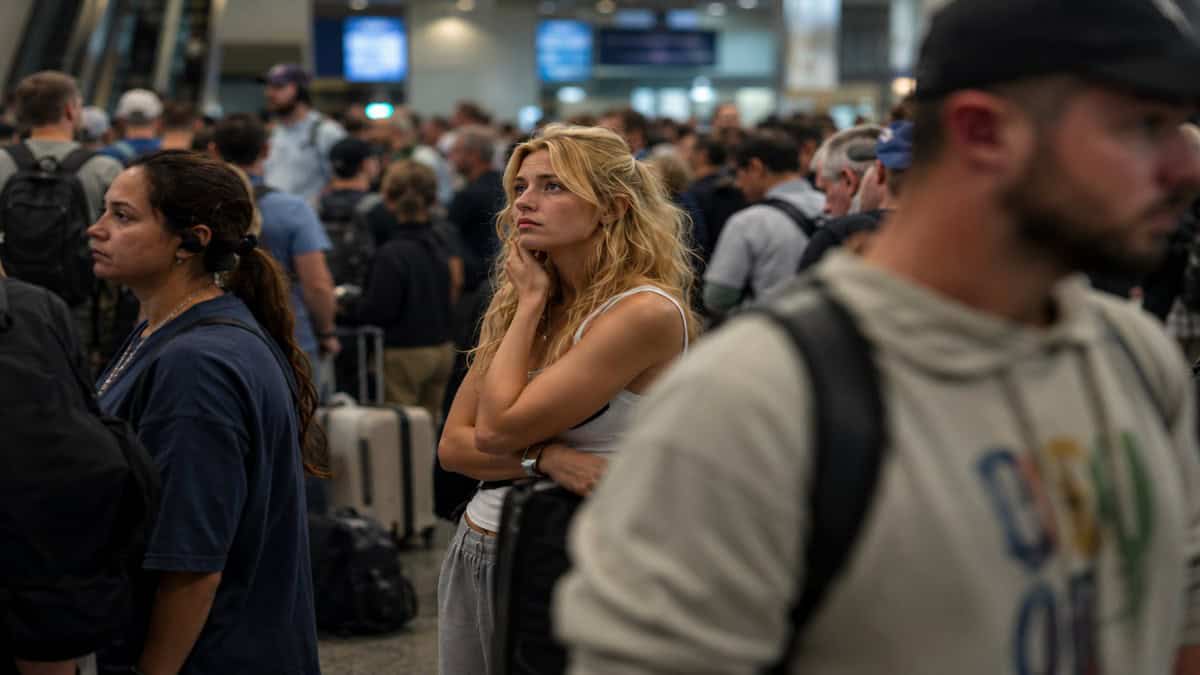
Image generated with Ai
New York, Boston, Philadelphia, Newark, and Washington emerged as the hardest-hit cities across the United States of America today. 3,356 flights are delayed throughout America. Another 646 flights have been cancelled.
JFK, LaGuardia, Newark Liberty, Reagan National, Philadelphia, and Boston Logan account for roughly 66% of the nationwide total.
The FAA has also imposed several traffic restrictions today. Thunderstorms are explicitly cited behind restrictions at Philadelphia. JFK’s ground-delay program averaged 127 minutes today. Newark’s ground-delay program averaged 100 minutes today.
American Airlines recorded 448 delays, the highest delay figure among US airlines. Delta Air Lines also recorded substantial disruption, including 94 cancellations.
New York and Philadelphia form today’s central disruption cluster in America. Newark, JFK, LaGuardia and Philadelphia face significant operational pressure.
FAA restrictions provide important context for this concentration. Philadelphia experienced a ground stop because of thunderstorms. Its ground-delay program followed the initial ground stop. That program averaged 76 minutes during the given period. Philadelphia also faced a 75-minute departure delay.
JFK faced a thunderstorm-related ground-delay program today. Its average ground delay reached 127 minutes. Newark faced another thunderstorm-related ground-delay program. Its average ground delay reached 100 minutes.
Advertisement
Newark also had a separate departure delay underway. That departure delay averaged 60 minutes and was increasing. LaGuardia faced a 30-minute departure delay today. That delay was also reported as increasing.
These restrictions regulate aircraft movements during constrained operations. They can create departure queues and additional arrival spacing. Aircraft can consequently wait before entering restricted traffic flows. Those delays can then affect later scheduled flights. Such network effects are operational implications, not confirmed causes.
Cancellation patterns reveal a different disruption picture today. Reagan National recorded the highest cancellations across America. Its 103 cancellations exceed every other listed airport today.
Newark followed with 85 cancellations. JFK recorded 71 cancellations. LaGuardia reported 64 cancellations during today’s operations. Atlanta recorded 58 cancellations. Philadelphia recorded 53 cancellations.
Boston reported 50 cancellations. Baltimore/Washington recorded 35 cancellations today. Orlando recorded 30 cancellations. Detroit recorded 26 cancellations. Dallas-Fort Worth recorded 21 cancellations today. Houston recorded five cancellations.
This pattern differs from the delay ranking across airports. Reagan National illustrates that distinction particularly clearly today. It has fewer delays than several major disruption hotspots. Yet its cancellation count is significantly higher.
For travelers, that difference has practical consequences. Delays generally mean longer waits or schedule changes. Cancellations can require rebooking and itinerary adjustments.
Delay pressure extends well beyond the Northeast today. Newark remains the largest delay hotspot currently. Dallas-Fort Worth also recorded more than 230 delays. JFK remained close behind Newark.
Boston and Atlanta both exceeded 200 reported delays today. Philadelphia also crossed the 200-delay threshold today. Orlando recorded 173 delays across America. LaGuardia reported 161 delays during today’s operations.
Reagan National recorded 127 delays today. Detroit reached 105 delays among today’s airport figures. Baltimore/Washington recorded 78 delays today. Houston recorded 71 delays.
The disruption therefore extends across multiple U.S. regions. However, the Northeast shows the densest concentration. Active FAA restrictions reinforce that regional operational pressure.
American recorded 448 delays. That was the highest delay figure among carriers in America. Its delay percentage was 13% today.
The figures establish operational pressure across its network. They do not establish specific causes for American’s delays. They also do not directly link delays with particular airports.
Southwest recorded 420 delays and 39 cancellations today. Its delay figure ranked second among US carriers. The figures show 13% for delays and 1% cancellations.
The difference between those figures is operationally significant. Southwest’s disruption was considerably more delay-heavy today.
Delta recorded 361 delays and 94 cancellations today. It therefore stands out across both measures. Its percentages were 11% for delays and 3% cancellations.
Delta’s position differs from the leading delay carrier. American led delays, while Delta had more cancellations.
JetBlue recorded 226 delays and 82 cancellations today. Its percentages were 21% for delays and 7% cancellations.
Its cancellation figure also places it among affected carriers. The data shows substantial pressure across both measures.
PSA recorded 154 cancellations and 173 delays today. Its cancellation figure leads all airlines across America. The percentages were 22% cancellations and 24% delays.
That makes PSA distinctive among the listed carriers. Its cancellation figure exceeds every other airline.
Republic recorded 59 cancellations and 161 delays today. Its percentages were 6% cancellations and 16% delays.
Its profile was substantially more delay-heavy than cancellation-heavy. That separates Republic from PSA.
An ordinary delay does not necessarily involve FAA restrictions. A traffic-management restriction indicates tighter control over aircraft movements.
Philadelphia faced several separate measures during today’s operations. These included a ground stop and ground-delay program. Its departure operations also faced additional delays.
JFK’s ground-delay program averaged 127 minutes today. Newark’s corresponding program averaged 100 minutes today. Those averages represent substantial waiting for affected flights.
A ground stop is particularly restrictive for departures. It temporarily holds affected aircraft from departing. That can create queues once normal operations resume.
Ground-delay programs instead regulate departures before takeoff. They help manage aircraft entering constrained traffic areas. This can mean longer waits before aircraft leave gates.
Restrictions can also create effects beyond one airport. A delayed aircraft can arrive late for another flight. That can disrupt subsequent aircraft rotations and schedules. These effects remain operational implications rather than confirmed causes.
The nationwide total alone misses today’s geographic pattern. The airport figures reveal a concentrated Northeast pressure point. Newark, JFK, LaGuardia and Philadelphia form that cluster.
Reagan National adds another important cancellation-heavy dimension. Its cancellation count stands above every airport. JFK also has one of the highest FAA delay average.
Newark combines heavy disruption with multiple FAA restrictions. Philadelphia experienced a wide range of restrictions. These details reveal operational pressure behind today’s broader totals.
The carrier leading delays differs from cancellation leader. American leads in delays among US airlines. PSA leads in cancellations.
That difference matters when assessing passenger disruption. Flight delays and cancellations create different travel consequences. A delay can shift schedules without requiring rebooking. A cancellation can force passengers onto different flights.
Passengers traveling through Newark should expect significant disruption. The airport has substantial delays and cancellations today. FAA restrictions are also affecting Newark’s operations.
JFK passengers face similarly significant schedule disruption today. Its FAA ground-delay program averages 127 minutes. Philadelphia passengers face several overlapping traffic restrictions. Thunderstorms are explicitly cited behind those restrictions.
LaGuardia passengers should monitor departure information closely today. Its departure delay averages 30 minutes and continues increasing. Reagan National passengers face particularly high cancellation pressure. Its cancellation figure is the highest among airports.
Boston passengers should also allow additional connection time.
Dallas-Fort Worth, Atlanta, Orlando and Detroit are affected. Their figures show substantial delays today.
Passengers should confirm flight status before leaving home. Allow additional time when connecting through affected airports. Keep essential items accessible during potentially longer waits. Monitor airline rebooking information when schedules change.
Thunderstorms remain the stated trigger for several FAA measures.
Philadelphia’s operations moved from a ground stop onward. Its restrictions then shifted into a ground-delay program. JFK and Newark also have extended restriction windows.
Operational conditions can change as airport capacity changes. Ground-delay programs can therefore be adjusted during operations. Departure delays can similarly increase or decline over time.
Even after restrictions ease, schedules can remain unsettled. Earlier aircraft delays can affect later scheduled rotations. That can produce rolling schedule changes across airline networks.
Today’s disruption spans several major aviation hubs in America. The Northeast remains the most concentrated operational pressure point. Newark, JFK, LaGuardia and Philadelphia face serious disruption.
Reagan National stands out for cancellation volume today. Dallas-Fort Worth, Atlanta and Boston also show heavy delays. American, Southwest and Delta lead delay figures. PSA stands out for its cancellation count.
Thunderstorms are explicitly driving several Northeast FAA restrictions. Those restrictions are shaping aircraft movements and departure schedules. The airport data also shows different disruption profiles.
Some airports are more delay-heavy than cancellation-heavy today. Others show particularly high cancellation pressure instead.
Today’s operational picture is therefore uneven across US aviation. Weather-related restrictions are shaping the Northeast situation. The wider airline network is absorbing those operational pressures.
Yesterday also saw significant flight cancellations. Read our earlier coverage here.
The data has been extensively curated by our editorial team using real-time aviation figures recorded on 8 August 2026 at 2:25 pm ET USA
Primary Source: FlightAware.
Verification Protocol: All statistics have been independently reviewed and cross-checked by our human editorial desk. Timestamped records, data logs and feed snapshots are securely archived internally to support historical accuracy and editorial transparency.
Note: Real-time flight-tracking figures reflect active airspace and operational data. Minor variations may occur when compared with information displayed at individual airport terminals or airline departure gates.
Travellers are advised to check directly with their respective airlines and airports for the latest flight status, schedule changes and operational updates.
Advertisement
Tags: America flight cancellations today, America Flight Delays Today, American Airlines flights cancelled today, Boston Logan International Airport Cancellations Today, New York JFK Cancelled Flights Today
Advertisement
Advertisement













Friday, September 4, 2026

Friday, September 4, 2026

Friday, September 4, 2026

Thursday, September 3, 2026

Wednesday, September 2, 2026

Friday, September 4, 2026
Friday, September 4, 2026