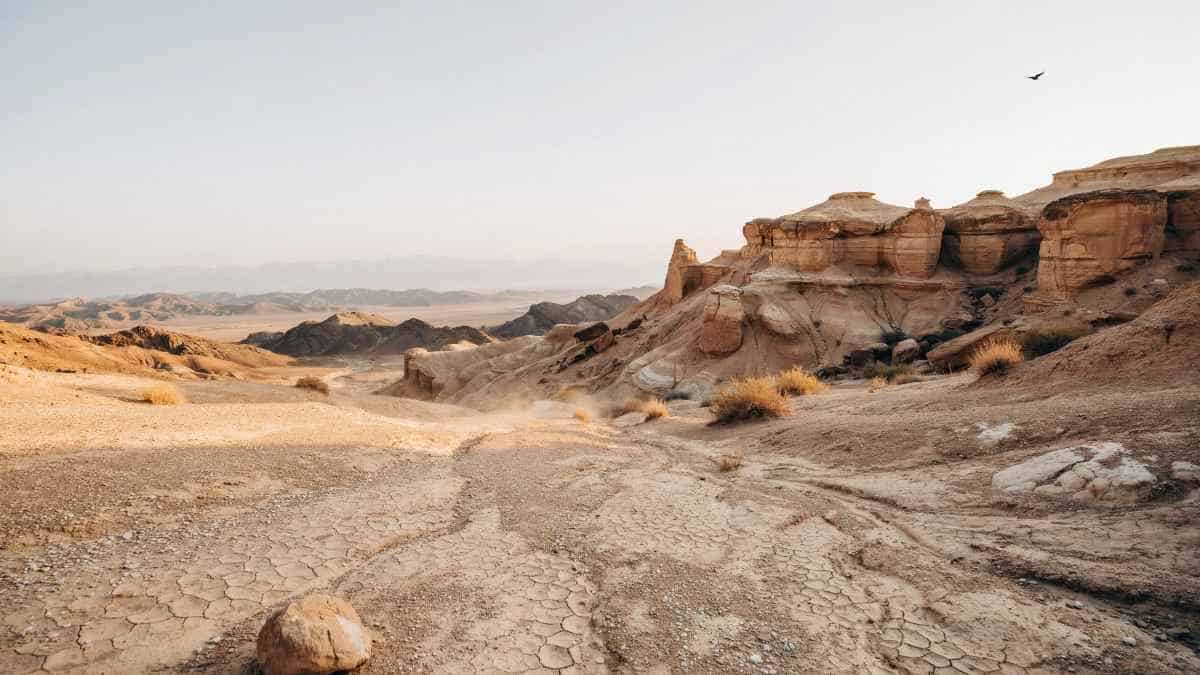
Image generated with Ai
There are new places like Turkmenistan, Koytendag and Yangykala Canyon, which have started to draw attention as the country tries to attract more tourists other than its well-known Darvaza Gas Crater. There are new routes that lead tourists to the dinosaur footprints, huge canyons, caves and the Caspian Sea shore, and Avaza is consolidating itself as an attractive place for a resort.
Let’s start with Koytendag, because this is where Turkmenistan’s geotourism story gets seriously prehistoric.
The mountain region in Lebap Velayat contains the Dinosaur Plateau near Hojapil, where fossilised dinosaur footprints form one of the area’s most distinctive attractions. UNESCO’s tentative-list documentation identifies Koytendag as an area containing fossil-rich geological formations from several periods of Earth’s history, including dinosaur footprint trails.
The wider landscape includes caves, canyons, karst formations, mountain ecosystems and rare wildlife.
Advertisement
Advertisement
Turkmenistan’s government is now actively promoting Koytendag as part of its developing ecotourism offer. At the Turkmentravel 2026 tourism forum, the country’s Minister of Culture identified the Koytendag caves and Dinosaur Plateau among natural destinations being developed for tourism. Scientific and archaeological studies are also being used to improve the information available to visitors.
The Koytendag experience extends beyond the footprints.
Government tourism information highlights mountain caves, gorges, underground lakes, springs and the Ayrybaba Ridge, the highest point in Turkmenistan. The region also contains rare flora and fauna, creating opportunities for nature-focused itineraries alongside the palaeontological attractions.
UNESCO’s documentation lists the Koytendag protected landscape at more than 122,000 hectares and notes its caves, geological formations, endemic species and important wildlife habitats.
Advertisement
Advertisement
For tourists, that creates a destination built around geology and wilderness rather than conventional urban sightseeing.
Then comes Yangykala Canyon, and honestly, the scenery does not need much introduction.
Located in Balkan Velayat, approximately 165 kilometres north of Balkanabat and 160 kilometres east of Turkmenbashi, Yangykala is known for towering cliffs coloured in red, white, yellow and orange. The canyon’s name translates as “Fiery Fortresses”, while its dramatic formations have made it one of Turkmenistan’s notable natural attractions.
The government is also studying the possibility of placing Yangykala on the UNESCO World Heritage List. A national UNESCO commission discussed the canyon’s potential inclusion in November 2024, describing it as a natural monument of international significance and a destination attracting both domestic and foreign tourists.
That makes Yangykala an important part of the country’s emerging geotourism strategy.
From red cliffs to blue water, Avaza offers another side of Turkmenistan.
The Avaza National Tourist Zone sits on the Caspian coast near Turkmenbashi and has developed as a resort area with hotels, health facilities, recreation complexes and a growing summer tourism programme.
In June and July 2026, Turkmenistan’s government reported strong domestic holiday activity at Avaza, with visitors using hotels, cottages, health resorts and recreational facilities along the Caspian coast.
Caspian cruises also form part of the destination’s tourism development story. A dedicated boat for tourist sea cruises was previously introduced at Avaza, while the government continues to promote the resort as a centre for coastal recreation and international tourism.
The shift towards natural attractions is part of a broader tourism strategy.
At Turkmentravel 2026, officials highlighted the expansion of cultural and ecological tourism and the development of new routes around natural landscapes. The government has also discussed geoparks as a mechanism for protecting geological heritage while supporting ecotourism and local economic activity.
That places destinations such as Koytendag and Yangykala alongside the Karakum Desert and established heritage attractions such as Ancient Merv and Nisa.
Ashgabat is Turkmenistan’s principal international gateway, while Turkmenbashi provides access to the Caspian coast and Avaza. Balkanabat is a useful reference point for journeys towards Yangykala.
Koytendag is in eastern Turkmenistan and is considerably more remote, making organised tours and local guides particularly important for accessing its caves, gorges and Dinosaur Plateau.
The country uses the Turkmenistan manat (TMT).
Travellers should confirm current entry requirements, tour arrangements, transport availability and access permissions before travelling, particularly for remote natural areas.
1. Is Koytendag open for tourism?
Koytendag is being developed as an ecotourism destination, with the government promoting its caves and Dinosaur Plateau and highlighting organised routes into the region.
2. What makes Yangykala Canyon special?
Its layered red, white, yellow and orange cliffs create one of Turkmenistan’s most distinctive geological landscapes.
3. Can tourists experience the Caspian Sea at Avaza?
Yes. Avaza operates as a coastal resort with accommodation, recreation and health facilities, while sea-cruise infrastructure has also been developed for tourists.
Turkmenistan’s 2026 tourism programme has placed greater attention on natural and ecological attractions. The April Turkmentravel forum specifically identified Koytendag and the Dinosaur Plateau among destinations being developed for ecotourism, while Yangykala continues to be assessed for potential UNESCO recognition. Avaza remains the country’s principal Caspian resort zone.
10 December 2021: Turkmenistan highlighted Yangykala Canyon as a major natural tourism attraction.
16 November 2024: Turkmenistan’s UNESCO commission discussed the potential inclusion of Yangykala among future World Heritage sites.
14–15 April 2026: Turkmentravel 2026 promoted new ecological and natural tourism routes, including Koytendag and the Dinosaur Plateau.
19 June 2026: The summer tourism season opened at Avaza National Tourist Zone on the Caspian coast.
Tourism in Turkmenistan is diversifying its natural tourist offering by going beyond the Darvaza Gas Crater, as three unique destinations have emerged in the form of Koytendag, Yangykala, and Avaza. Geotourism will come into existence through dinosaur footprints and caves in the eastern part of the country, the canyons will make the Balkan region attractive, and the Caspian resort of Avaza will have its own coast.
Advertisement
Advertisement
Advertisement











Wednesday, September 2, 2026

Tuesday, September 1, 2026

Wednesday, September 2, 2026
Wednesday, September 2, 2026
Tuesday, September 1, 2026
Tuesday, September 1, 2026

Tuesday, September 1, 2026

Tuesday, September 1, 2026