
Canada’s Wildfire Disaster Lays Out Smoke Blankets US and Sparks New Health Crisis – How the Climate Emergency Is Unfolding!

Published
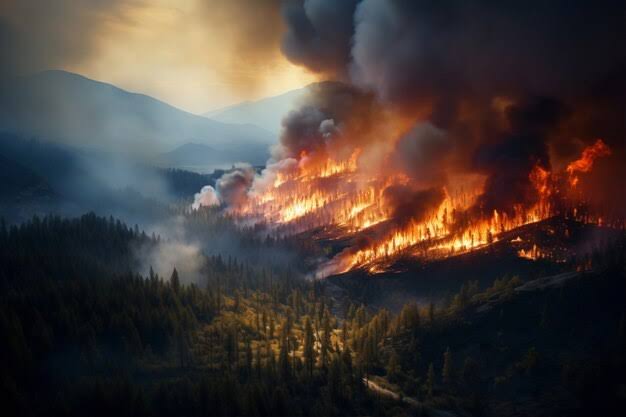 Image generated with Ai
Canada is experiencing one of its most severe wildfire seasons in recent memory, with devastating fires sweeping across vast areas of the country. As of August 11, 2025, a total of 725 wildfires are active, according to the Canadian Interagency Forest Fire Center. The fires have spread across various provinces, including Manitoba, Saskatchewan, and Alberta, wreaking havoc on both the environment and the health of the population. These fires, fueled by unusually dry conditions and extreme heat, are significantly impacting air quality, triggering health warnings, and raising concerns about the long-term effects on both the Canadian and U.S. populations.
The wildfires have not only affected the local Canadian communities but have also had significant repercussions in neighboring regions, especially across the United States. The thick smoke from the fires has traveled far beyond Canadian borders, leading to air quality warnings in states such as Minnesota and North Dakota. As these fires continue to rage, there is increasing concern over the long-term environmental and public health impacts, with experts pointing to the role of climate change in exacerbating the frequency and intensity of these fires.
Advertisement
Advertisement
Wildfire Hotspots: Where the Fires Are Burning in Canada
Canada is home to some of the world’s largest forests, and unfortunately, these vast natural landscapes are often the primary sites for wildfires. As of August 2025, Canada has already witnessed significant damage from wildfires, particularly in its northern provinces. Manitoba, for example, has declared a state of emergency for the second time this year, as wildfires have consumed approximately 4.3 million acres of land. The province’s challenging conditions, including dry weather and high temperatures, have created ideal conditions for these fires to spread uncontrollably.
Saskatchewan has also seen widespread devastation, with the northern part of the province facing evacuations for about 3,200 residents, mainly from rural and Indigenous communities. This year, Saskatchewan has experienced the largest area burned in Canada, totaling 6.7 million acres, further emphasizing the severity of the wildfire season. Alberta and British Columbia, which were the epicenters of last year’s record-breaking wildfires, have seen fewer fires this season. However, several communities in these provinces still remain under evacuation orders, and the risks associated with these fires are far from over.
Advertisement
Advertisement
In Newfoundland, a province that has rarely been affected by such widespread fires, the situation has escalated quickly. The government has enlisted the help of the armed forces and the Coast Guard to manage the growing fires, which have forced the evacuation of 900 people. These fires in Newfoundland mark a significant shift, showing that wildfires are no longer confined to the western provinces and are becoming an increasingly widespread threat across Canada.
While Quebec has seen fewer fires this year compared to previous seasons, the province has still felt the impact, with smoke drifting southward into parts of the United States. Quebec’s wildfires are primarily attributed to human activities, marking a stark contrast to other regions where lightning strikes are the main cause. In response to the increased wildfire activity, Quebec’s provincial government launched a comprehensive public awareness campaign last year to address the dangers and encourage better prevention measures.
Advertisement
Advertisement
The Health Effects of Wildfire Smoke: A Growing Concern
The wildfires themselves are not the only issue; the smoke they generate is becoming a major health concern for both Canadians and U.S. residents. Wildfire smoke contains fine particulate matter, specifically PM 2.5, which can penetrate deep into the lungs and enter the bloodstream. Short-term exposure to these particles can cause respiratory issues such as bronchitis, asthma exacerbation, and other serious health problems.
Health officials have been warning vulnerable populations, including children, the elderly, pregnant individuals, and those with pre-existing health conditions like heart or lung disease, to avoid outdoor activities during times of heavy smoke. The situation has grown dire, especially for people with chronic conditions such as diabetes and kidney disease, who are at an even greater risk of health complications due to prolonged exposure to wildfire smoke.
Advertisement
Advertisement
Both the Canadian and U.S. governments have issued air quality warnings, and local authorities have advised residents to stay indoors or limit their outdoor activities. For those who are forced to go outside, the use of N95 masks is being recommended to filter out harmful particles in the air. The Air Quality Index (AQI) has become a key tool for residents, helping them determine when it is safe to venture outside and when to take precautions.
Wildfires and the Role of Climate Change
As wildfires become an annual crisis in Canada, the role of climate change in exacerbating these events has been brought into focus. Experts argue that rising temperatures and prolonged periods of dry conditions are making forests more susceptible to wildfires. The hotter and drier the environment, the easier it is for fires to ignite and spread.
Michael Waddington, a professor at McMaster University in Hamilton, Ontario, has pointed out that the increasing intensity of wildfires in Canada can be attributed to a warming climate. He described the situation as a “tinderbox” where the conditions are ripe for wildfires to rage uncontrollably. This growing threat has been compounded by the increasing global temperatures, much of which can be traced back to the actions of major carbon emitters, particularly the United States.
Climate change has led to shifts in weather patterns, with longer dry spells and more intense heatwaves, creating a perfect storm for wildfires. This, coupled with human-driven environmental degradation and poor forest management, has led to an alarming rise in wildfire activity across the country. The unpredictability and severity of these fires have sparked a debate over how governments should prepare and adapt for the future.
Advertisement
Advertisement
The Response and Cooperation Between Canada and the United States
In the wake of these widespread wildfires, both Canada and the United States have strengthened their cooperation to combat the crisis. The smoke from Canadian wildfires has heavily affected air quality in many parts of the United States, particularly in the Midwest, leading to increased concern from both governments. In July, six U.S. members of Congress sent a letter to Canada’s ambassador, asking for clarification on the country’s efforts to address the wildfire crisis.
In response, Canada has worked closely with the U.S. government, sharing resources and coordinating efforts to manage the ongoing fires. The two countries have joined forces in wildfire mitigation strategies, which include air and ground firefighting efforts, resource sharing, and public health interventions aimed at minimizing the effects of the smoke. International operations like Operation Seagull, a collaboration between Canada, China, Cambodia, Laos, Myanmar, and Vietnam, have also contributed to the fight against the fires, leading to numerous arrests and rescues.
While the joint efforts have yielded positive results, much more needs to be done to address the root causes of these fires and prevent further damage. The cooperation between the two nations reflects the growing need for a unified approach to combatting climate change and mitigating its impact on both the environment and public health.
Looking Ahead: What Needs to Be Done
As wildfires continue to ravage forests and affect air quality, there is a pressing need for more effective policies and solutions. Experts argue that forest management techniques, such as prescribed burns and thinning, must be implemented to reduce the severity of these fires. However, many of the affected areas are so remote that such measures are difficult to carry out. The Canadian government must focus on improving its firefighting infrastructure, increasing the resources available for wildfire suppression, and developing strategies for better forest management.
There is also a need for stronger international cooperation and policy changes to address the growing threat of climate change and its impact on wildfire activity. Global efforts to reduce greenhouse gas emissions and limit global warming are essential in preventing future environmental crises.
Conclusion: The Growing Wildfire Crisis in Canada
The wildfires sweeping across Canada have had devastating effects on both the environment and the health of the population. With the influence of climate change worsening the conditions for these fires, there is a critical need for both local and international efforts to mitigate their impact. Governments must prioritize forest management, increase firefighting resources, and implement long-term strategies to combat climate change.
The increasing frequency and intensity of wildfires in Canada highlight the urgent need for global action. While progress has been made in responding to the immediate crisis, the future of Canada’s forests and the health of its citizens depend on the ability to address the deeper, underlying causes of these fires.
Advertisement
