
Riyadh Season 2026 Raises Saudi Arabia’s Profile As A Global Sports And Entertainment Destination
Published
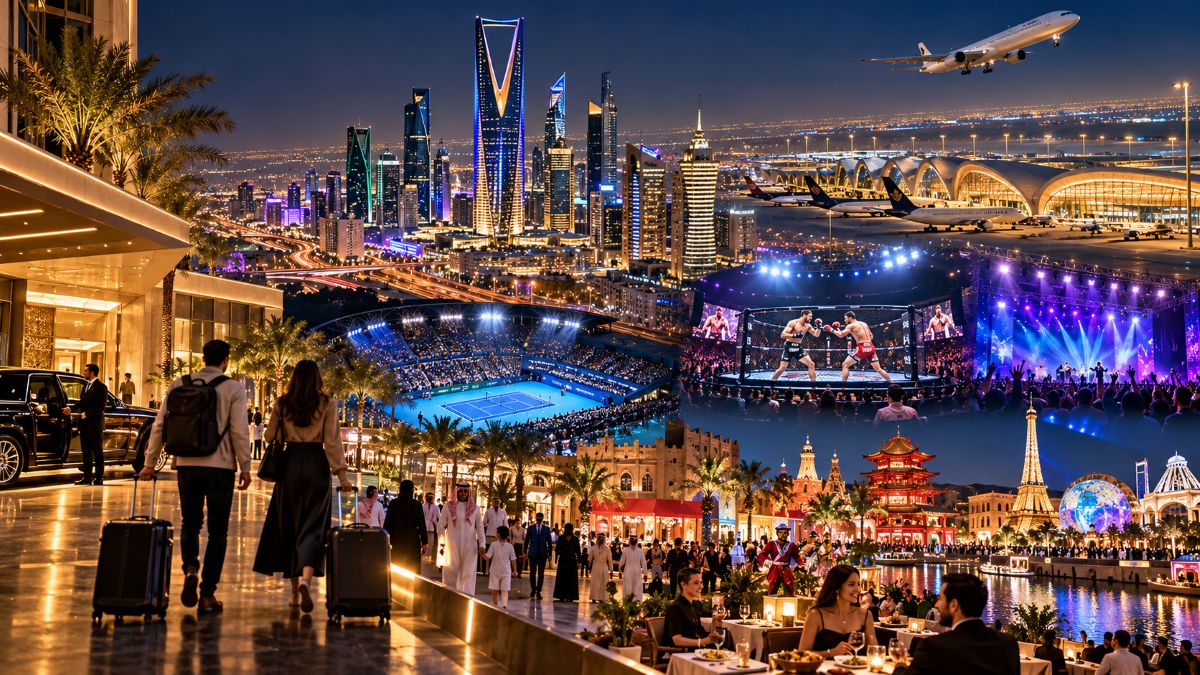
Image generated with Ai
Riyadh is preparing for another major winter tourism cycle as Riyadh Season 2026 opens on 21 October for a 10-week programme. The seventh edition will combine UFC, boxing, wrestling, Six Kings Slam tennis, concerts, comedy, theatre and family attractions. The event arrives after the previous edition attracted 17 million visitors, according to Saudi Arabia’s General Entertainment Authority. Meanwhile, Riyadh recorded 15.41 million tourists in 2024, up from 12.24 million in 2022. The figures reveal a rapidly expanding visitor economy, although seasonal visitor counts and annual tourist totals measure different things. For travellers, the bigger story is Riyadh’s emergence as an event-led destination where sport, hospitality, aviation, dining and entertainment increasingly operate as one tourism ecosystem.
Riyadh Builds a New Tourism Engine
The significance of the upcoming season lies beyond its headline attractions. Riyadh is increasingly using major events to create reasons for travellers to visit during specific periods, rather than relying solely on business travel, religious journeys or traditional sightseeing.
The latest edition begins with a remarkably dense calendar. Its programme includes world-class boxing and wrestling, UFC bouts and Six Kings Slam, alongside concerts, theatre, comedy and family entertainment. Boulevard World, Boulevard City, Wonder Garden, The Groves, Farmers’ Market and Ana Arabia will add further layers to the visitor experience.
This model gives Riyadh a different tourism proposition. A traveller can now combine a sporting event with restaurants, shopping, cultural experiences and entertainment without leaving the metropolitan area.
Advertisement
Advertisement
That matters because destination economics increasingly depend on how many reasons a visitor has to stay, rather than simply how many attractions exist.
The Numbers Behind Riyadh’s Rise
The underlying tourism statistics show that the capital was already growing before the latest entertainment push. GASTAT data records 15,414,495 tourists in Riyadh during 2024, compared with 15,116,674 in 2023 and 12,236,302 in 2022. That represents almost 26% growth over two years.
Advertisement
Advertisement
Riyadh’s 2024 figure also represented roughly 13.3% of Saudi Arabia’s 115.88 million tourists recorded nationally that year. The national total rose from 94.47 million in 2022 to 109.34 million in 2023 before reaching 115.88 million in 2024.
| Riyadh Tourism | 2022 | 2023 | 2024 |
|---|---|---|---|
| Tourists | 12.24m | 15.12m | 15.41m |
| Two-year growth | — | — | 25.97% |
| Saudi national total | 94.47m | 109.34m | 115.88m |
| Riyadh’s 2024 national share | — | — | 13.3% |
However, one distinction is crucial for readers. 17 million Riyadh Season visitors cannot be directly compared with 15.41 million annual tourists, because event visitor counts can include repeat visits and use different statistical definitions.
That distinction makes the 17-million figure impressive, but it should not be interpreted as 17 million unique tourists. The more useful insight is that Riyadh’s entertainment ecosystem can generate visitation on a scale comparable with the city’s wider annual tourism flow.
Why the 17-Million Benchmark Matters
The sixth edition concluded with 17 million recorded visitors, following its launch in October 2025. The programme combined entertainment zones, theatrical productions, boxing, tennis, snooker, concerts and interactive experiences.
The latest season therefore begins with an established demand base rather than an untested concept. Its challenge is now different: can Riyadh convert event popularity into deeper tourism spending and longer stays?
That question is more important than another attendance record. A successful event economy should feed hotels, restaurants, transport operators, attractions, retail businesses and aviation.
Advertisement
Advertisement
The available hospitality data already indicates significant structural expansion.
Hotels Are Expanding Around Demand
Saudi Arabia had 5,622 licensed tourism hospitality facilities in Q3 2025, compared with 3,998 a year earlier. That represents a striking 40.6% increase in licensed facilities.
Hotels accounted for 2,667 facilities, while serviced apartments and other hospitality establishments represented 2,955. The growth suggests that accommodation supply is expanding alongside the Kingdom’s wider tourism strategy.
| Saudi Hospitality Indicator | Q3 2024 | Q3 2025 | Change |
|---|---|---|---|
| Licensed facilities | 3,998 | 5,622 | +40.6% |
| Hotel occupancy | 46.1% | 49.1% | +3 percentage points |
| Hotel average daily rate | SAR 354 | SAR 341 | -3.6% |
| Hotel average stay | 4.2 nights | 4.1 nights | -1% |
| Tourism employment | 948,629 | 1,009,691 | +6.4% |
The numbers offer a useful counterpoint to the assumption that tourism growth automatically means sharply higher hotel prices. In Q3 2025, hotel occupancy improved to 49.1%, while the average daily rate fell 3.6% to SAR 341.
That does not mean major-event dates will remain inexpensive. Instead, it shows that national accommodation supply has been expanding sufficiently to alter the broader pricing picture.
The Length-Of-Stay Question
For travellers, the most revealing statistic may be the average hotel stay.
Advertisement
Advertisement
Hotel guests recorded an average stay of 4.1 nights in Q3 2025, slightly below 4.2 nights a year earlier. Serviced-apartment guests averaged 2.1 nights.
The figures suggest that Saudi Arabia has room to increase the value generated by each visitor. Riyadh’s event calendar could help address that challenge if major events encourage travellers to add leisure days around their primary reason for visiting.
Consider a sports traveller attending a two-day tournament. A destination with limited complementary attractions might generate a short visit, while a dense entertainment district can encourage additional dining, shopping and sightseeing.
That is where event-led lengthening of stays becomes commercially important.
Sports Are Becoming Tourism Infrastructure
Six Kings Slam illustrates this shift particularly clearly. The 2026 tournament will take place on 21, 22 and 24 October, bringing Jannik Sinner, Carlos Alcaraz, Novak Djokovic, Alexander Zverev, Taylor Fritz and Alex de Minaur to Riyadh. Netflix will stream the tournament globally.
The tournament debuted in 2024 and has quickly become one of the season’s recognisable international properties. The 2025 edition featured six leading players whose combined careers represented more than 30 Grand Slam singles titles.
Advertisement
Advertisement
For destination marketing, this creates an unusual advantage. Riyadh is not merely selling tickets to local spectators; it is placing the city inside a global sports-media narrative.
The same principle applies to UFC, boxing and wrestling. Sport becomes a travel trigger, while the surrounding entertainment infrastructure provides reasons to extend the trip.
Boulevard World Offers a Different Proposition
Boulevard World deserves particular attention because it represents a distinctive form of destination design. Rather than sending visitors across multiple countries, it brings international cultural themes together within one entertainment environment.
The 2026 programme places Boulevard World among the season’s principal zones, alongside Boulevard City and Wonder Garden. The concept allows visitors to encounter international food, entertainment and cultural environments within a single Riyadh itinerary.
For international travellers, this can work as an easy introduction to the capital’s entertainment economy. For domestic visitors, it creates a repeat-visit proposition because the programme can change without requiring a completely new destination.
That programmable tourism model is one of Riyadh’s most interesting innovations.
Advertisement
Advertisement
Aviation Will Determine the Next Phase
Entertainment alone cannot create an international tourism hub. Riyadh needs the aviation infrastructure to absorb growing demand.
The planned King Salman International Airport provides the longer-term capacity story. Its master plan covers 57 square kilometres and six parallel runways, with capacity targeted at 100 million passengers annually by 2030 and 185 million by 2050.
The airport project also reflects Riyadh’s geographical advantage. The capital sits between major markets across Europe, Asia and Africa, giving it a strong foundation for international connectivity.
For event tourism, that geography matters because a major tournament can draw visitors from several source markets simultaneously. Better connectivity can therefore amplify the commercial effect of every major event.
Riyadh Versus Other Event Cities
Riyadh’s emerging model invites comparisons with Las Vegas, Dubai and Singapore, but the structure is not identical.
Las Vegas built its tourism economy around casinos, conventions, shows and hospitality. Dubai combines aviation connectivity, shopping, luxury hospitality, business travel and mega-events. Singapore has developed a tightly integrated model around business events, culture, entertainment and high-value tourism.
Advertisement
Advertisement
Riyadh is pursuing a more calendar-driven destination model, where recurring seasons and major sporting properties create concentrated waves of demand.
| Destination | Core Event-Tourism Strength | Riyadh’s Distinction |
|---|---|---|
| Las Vegas | Entertainment and conventions | Less dependent on gambling |
| Dubai | Aviation, shopping and luxury | More event-calendar driven |
| Singapore | Business events and culture | Larger entertainment-zone model |
| Riyadh | Sport, entertainment and culture | Rapidly expanding integrated ecosystem |
The comparison also explains why Riyadh Season should not be viewed as merely a festival. It functions as a demand-generation mechanism for a much broader destination economy.
What Travellers Should Watch
Visitors planning a trip should treat the event calendar as an important part of itinerary planning. Major sports dates can alter accommodation demand, while quieter periods may provide better availability and more predictable pricing.
The opening period is particularly significant because Six Kings Slam begins on the same day as the season itself. Travellers interested in several attractions should therefore compare event dates before selecting flights and accommodation.
A four-night trip can also produce a substantially different experience from a one-event weekend. Travellers can combine entertainment zones with dining, shopping and cultural attractions instead of treating Riyadh as a single-event stop.
The wider accommodation market provides another useful signal. With national hotel occupancy at 49.1% in Q3 2025 and supply expanding rapidly, travellers should compare several accommodation categories rather than assuming traditional hotels offer the only practical option.
Advertisement
Advertisement
Saudi Tourism Has Entered a Bigger Phase
Riyadh’s entertainment expansion forms part of a much larger national transformation. Saudi Arabia exceeded its earlier 100-million-tourist target ahead of schedule and subsequently raised its ambition to 150 million annual visitors by 2030.
That broader ambition explains why entertainment, aviation and hospitality are developing simultaneously. The objective is not simply to fill venues during a winter season.
Instead, Saudi Arabia is building a destination ecosystem in which events generate visitation, visitation supports hospitality, connectivity expands access and attractions encourage longer stays.
Riyadh Season 2026 therefore matters because it provides a live test of that model. If the capital can turn millions of event visits into longer stays, wider spending and repeat international travel, its entertainment calendar could become a durable tourism asset rather than a seasonal attraction.
The Capital’s Next Tourism Test
The real measure of Riyadh’s transformation will not be another spectacular attendance figure. It will be whether major events translate into higher-value tourism behaviour, including longer stays, broader spending and stronger international repeat demand.
The ingredients are increasingly visible. Riyadh’s tourist base has expanded sharply since 2022, hospitality supply is growing, employment has crossed one million nationally and airport infrastructure is being designed for much larger passenger volumes.
The seventh edition now arrives with a proven 17-million-visitor benchmark and an unusually diverse programme. For travellers, that means Riyadh is becoming less of a stopover and more of a destination planned around experiences. The next chapter will depend on whether the city can turn that event intensity into lasting tourism depth.
Advertisement
