
CAPA Summit Asia Pacific 2025, Discussion Future of Aviation and Sustainability in Cairns: All You Need To Know

Published
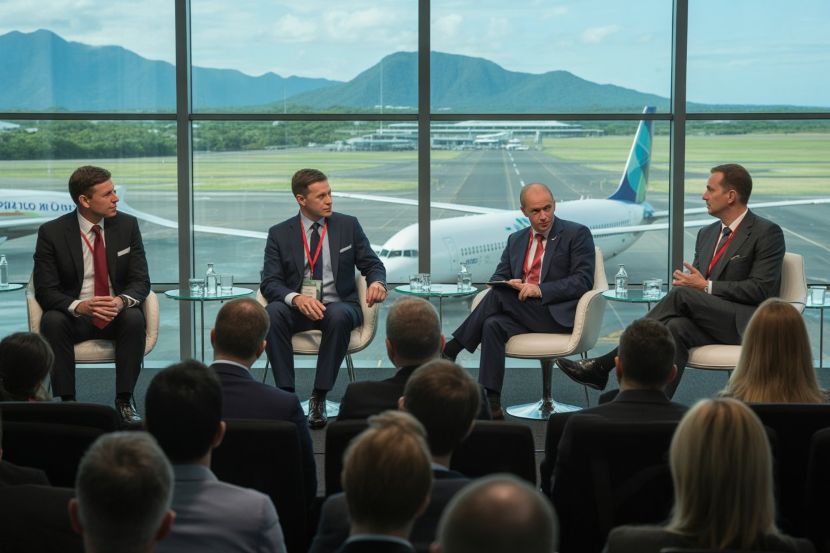 Image generated with Ai
The CAPA Summit Asia Pacific 2025 in Cairns has been a pivotal event in the aviation industry, attracting top leaders, airline executives, and industry professionals from across the globe. Hosted at Cairns Convention Centre, this summit brought together major figures in the aviation sector to share insights, strategies, and future plans for the industry.
Virgin Australia’s New Growth Path and Fleet Expansion
In his keynote speech, Dave Emerson, Virgin Australia’s CEO, accentuated the value segment enhancement. Virgin was aiming its marketing at small business, corporate value, and premium leisure travellers. Emerson explained how Virgin Australia is attempting to capture about one-third of the domestic market share, a figure the airlines is focused on increasing in the airline’s customer base in these segments to flex further.
Advertisement
Advertisement
Recently, the airline achieved significant milestones, including its successful IPO, which attracted a 25% investment from Qatar Airways. This strategic partnership also resulted in launching new international flights from Australia to Doha. Emerson added that Virgin Australia’s future plans include fleet expansion with 16 new aircraft, including the Boeing 737 MAX and Embraer E-Jets E2, slated for delivery in the coming fiscal year.
The airline’s fleet renewal program aims to modernize its aircraft while remaining financially efficient, relying on cash flow rather than raising additional capital. The company has grown from a post-administration fleet of 58 aircraft to over 100 in operation today. Additionally, Virgin Australia is introducing pet-friendly flights as part of its customer experience enhancement efforts.
Advertisement
Advertisement
Managing Risks in a Volatile Global Environment
Austrian Capital Territory’s Chief Minister Andrew Barr, ACCC’s Matthew Schroder, and Cairns Airport’s CEO Richard Barker participated in a panel discussion focusing on an important topic of concern in the world today; the need to manage risks considering the current global climate.
As the aviation industry faces numerous challenges, including geopolitical instability, fuel price volatility, and the fast-paced advancements in AI technology, the panelists discussed strategies to ensure sustainable airline operations and competitive pricing.
Advertisement
Advertisement
Matthew Schroder mentioned that the ACCC had approved the Qatar Airways-Virgin Australia strategic partnership, highlighting its potential to boost competition and offer significant benefits to Australian consumers, including better access to international routes, including a daily flight from Canberra to Doha starting December 2025.
Sustainable Aviation Fuel (SAF) and Net-Zero Emissions Goals
The summit placed a strong emphasis on aviation sustainability. With the Australian aviation sector facing increased pressure to meet net-zero emissions goals, panelists from Air New Zealand, Qantas, and Boeing discussed the challenges and opportunities in adopting Sustainable Aviation Fuel (SAF).
Kimberly Camrass, Boeing’s Sustainability Lead for the South Pacific, outlined the critical role SAF will play in decarbonizing the aviation industry. However, she pointed out that SAF adoption has been slow due to the limited local production and high costs, as it currently remains three to four times more expensive than conventional jet fuel.
The Group Sustainability Officer of Qantas Messent Fiona underscored that shifting to SAF will require collaboration throughout the entire aviation ecosystem. Corporate collaborations along with government action were noted by Fiona to be crucial for achieving the carbon reduction targets in 2030.
The Australian Aviation Market: Recovery and Growth
According to Simon Elsegood, CAPA’s Head of Research, the Australian aviation industry is on a strong recovery path post-COVID. However, several challenges remain, including workforce shortages, supply chain disruptions in aircraft production, and increasing maintenance costs.
In terms of market trends, international passenger traffic is rebounding faster than domestic travel, with Southeast Asia and emerging European markets seeing the most significant growth. However, the industry faces constraints in aircraft availability, which affects route development and overall capacity growth.
Advertisement
Advertisement
One of the biggest changes in recent years has been the decline in business travel, which has been significantly impacted by the rise of video conferencing and changing corporate policies post-pandemic.
Qantas’ Ambitious Fleet and Sustainability Plans
During a discussion with Qantas Domestic CEO Markus Svensson, I learned about the airline’s exciting plans for fleet renewal, which includes the new A321XLR aircraft. The first delivery is expected by Christmas 2025, with a total of 10 aircraft slated for delivery by mid-2026.
This fleet renewal program is part of Project Sunrise, an ambitious initiative to introduce non-stop long-haul flights to any destination globally, starting with Sydney-London routes by 2027. Additionally, Qantas is focusing heavily on SAF and reducing its carbon footprint through sustainable aviation technology.
Conclusion: The Future of Aviation
The CAPA Airline Leader Summit 2025 held in Cairns demonstrated the aviation sector’s resolve to tackle problems and capture possibilities. Through fleet expansions and strategic partnerships to the implementation of Sustainable Aviation practices, the Summit emphasized toward the aviation industry’s future will be much collaboration and innovation.
With increasing pressures for sustainability and economic recovery, aviation leaders continue to work toward net-zero emissions, while navigating the challenges presented by geopolitical instability and industry disruptions.
Advertisement
