
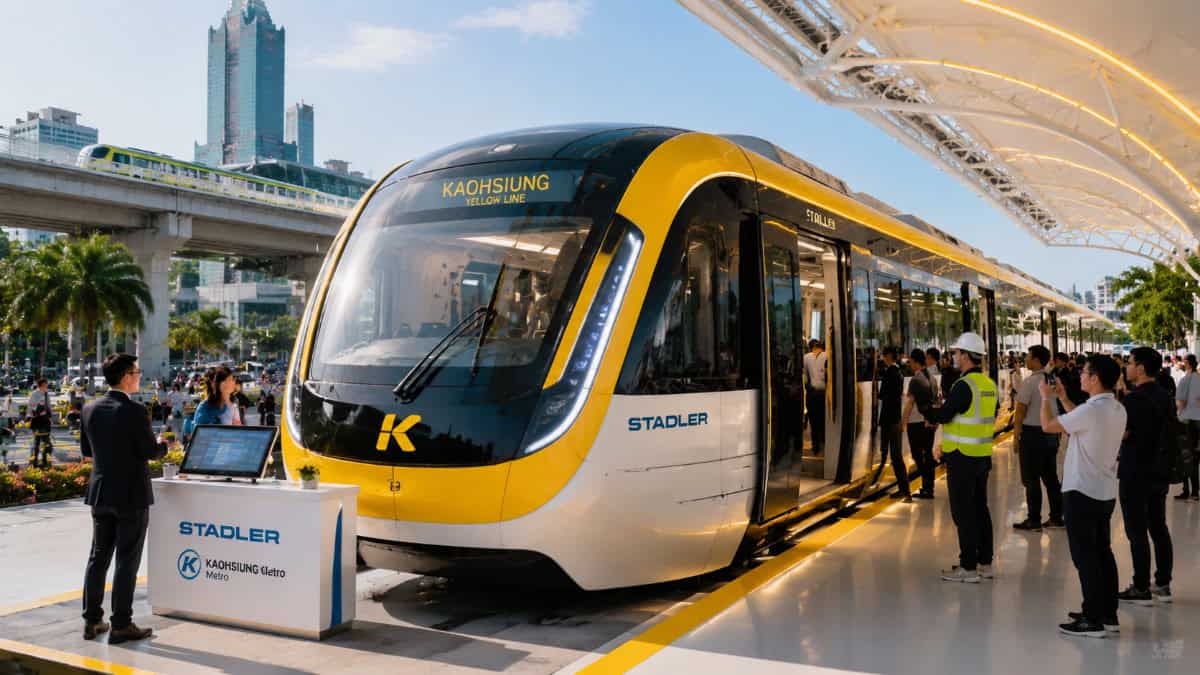
Image generated with Ai
The future metro train of the Kaohsiung Yellow Line of Taiwan has taken one important step closer to reality after the company Stadler presented its prototype of the new automated metro train. This project is Stadler’s first metro train development in Asia and will bring new automated rail technology to southern Taiwan upon completion. The new train will be part of a NT$43.4 billion railway systems contract, providing for the substantial development of the urban transport network of Kaohsiung.
As per the Kaohsiung City Mass Rapid Transit Bureau, there are going to be 25 three-car train sets on the new Yellow Line, which is now being built. The development of the train takes place through cooperation of the international group consisting of Stadler, ST Engineering and Siemens Mobility. The trains will unite the rail manufacturing capabilities of Switzerland with the innovative signalling system technology.
Advertisement
For commuters, the future Yellow Line will provide better connections within Kaohsiung between neighbourhoods, transport hubs, business districts, and touristic attractions. The new line is also an element of the bigger tendency of developing smart, automated, and sustainable urban transport system in Asia.
Public transport is becoming increasingly important for cities that attract large numbers of visitors. Efficient metro networks allow travellers to explore destinations more easily while reducing dependence on private vehicles and road-based transport.
Advertisement
Advertisement
Kaohsiung is Taiwan’s second-largest city and an important centre for tourism, business, culture, and industry. The Yellow Line is expected to strengthen the city’s transport system by improving connections across areas that currently depend heavily on existing rail and road networks.
The Yellow Line is expected to provide travellers with:
For international visitors, better metro connectivity can make exploring a city simpler, especially for travellers unfamiliar with local transport systems.
The latest development follows Stadler’s unveiling of the full-scale train mock-up for the future Yellow Line. The presentation marks an important stage in the project as Taiwan prepares to introduce a new generation of automated metro technology.
The trains are being designed specifically for Kaohsiung’s climate and operational requirements.
The Yellow Line metro project includes:
Under the agreement, Stadler is responsible for manufacturing the trains at its St Margrethen facility in Switzerland, while Siemens Mobility is supplying the communications-based train control (CBTC) signalling system.
The cooperation brings together international expertise to create a modern automated metro solution for Kaohsiung.
The new trains are designed as medium-capacity metro vehicles equipped with advanced automation technology.
Unlike traditional metro trains that require drivers, the Kaohsiung Yellow Line trains will be capable of GoA4 unattended automatic operation.
The new metro vehicles will feature:
The lightweight aluminium structure helps improve energy efficiency while supporting long-term operational performance.
The trains are being developed to handle the specific environmental conditions of southern Taiwan, where high humidity and warm temperatures are common.
Automation is becoming a major focus in urban transport development worldwide. As cities grow, governments are looking for solutions that can improve efficiency, reliability, and passenger capacity.
The Kaohsiung Yellow Line represents Taiwan’s move toward more advanced public transport infrastructure.
The technology could support:
GoA4 systems use advanced digital controls to manage train movement, allowing operators to focus on monitoring and system management rather than manual driving.
The Yellow Line is planned as a major addition to Kaohsiung’s metropolitan transport network. The route is designed in a Y-shaped configuration, improving connections across the city.
The project aims to link areas that currently require longer road journeys.
The completed line will include:
The combination of elevated and underground sections allows the line to integrate into Kaohsiung’s existing urban environment while providing efficient passenger movement.
Improved public transport can have a major influence on tourism development. When visitors can easily move between attractions, accommodation areas, and transport hubs, destinations become more accessible.
Kaohsiung has become increasingly popular among visitors due to its waterfront areas, cultural attractions, markets, and urban experiences.
The Yellow Line may contribute to:
For travellers, a modern metro network can transform how they experience a city.
The Kaohsiung Yellow Line is still under construction, and passengers cannot use the service yet. The trains are scheduled to be delivered by 2028, but the opening timeline for the railway has changed.
The project was originally targeted for completion in 2028. However, recent planning authorisation information indicates that the line could open in phases between 2032 and 2034.
Travellers should know:
Visitors planning future trips should check official transport updates before relying on the Yellow Line for travel.
The Kaohsiung Yellow Line project represents a significant milestone for Stadler because it marks the company’s first metro train project in Asia.
The development highlights increasing demand for advanced urban rail systems across the region.
The project demonstrates:
As Asian cities continue growing, metro systems are becoming essential infrastructure for managing future mobility needs.
The Kaohsiung Yellow Line is a future metro route being developed in Kaohsiung, Taiwan, to improve urban transportation.
Stadler is supplying the trains, while Siemens Mobility provides the CBTC signalling system.
Kaohsiung has ordered 25 three-car trainsets for the project.
The trains are designed for GoA4 unattended automatic operation, allowing automated operation without onboard drivers.
The line was originally planned for 2028, but updated planning information indicates phased opening could take place between 2032 and 2034.
The completed route will extend 22.9 kilometres with 23 stations.
Introduction of the first metro train by Stadler for the Yellow Line of Kaohsiung is an important landmark towards future transport development in Taiwan. This project brings together the elements of automation, environmental design, and international rail experience to offer a new era of urban transport.Upon its completion, the Yellow Line will make the movement easier within Kaohsiung, boost tourism in the area and allow tourists and locals to explore the city faster and in a convenient way.While this project proceeds further, it demonstrates the transformation which is currently occurring throughout Asia with respect to public transport.
Advertisement
Tags: automated rail systems, Kaohsiung tourism transport, Kaohsiung Yellow Line metro train, Stadler metro technology, Taiwan railway development
Advertisement
Advertisement













Friday, September 4, 2026

Friday, September 4, 2026

Friday, September 4, 2026

Friday, September 4, 2026

Thursday, September 3, 2026

Wednesday, September 2, 2026

Friday, September 4, 2026

Friday, September 4, 2026


