
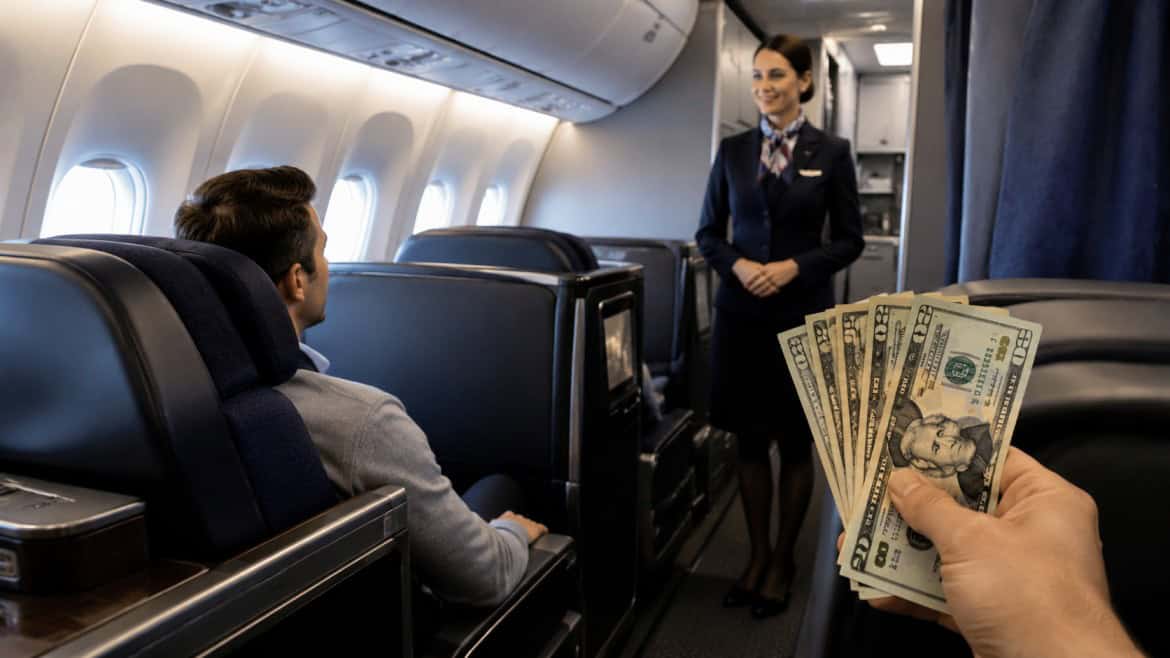
Image generated with Ai
American Airlines is under scrutiny right now after reports of first class domestic upgrades being offered for just $35. This is happening across key US airports, including Chicago O’Hare, and it is reshaping expectations for elite travellers. The development matters immediately because it directly affects frequent flyers relying on complimentary upgrades under loyalty programmes. The group most impacted is AAdvantage elite members who are seeing paid upgrades offered while premium seats remain unassigned.
The timing is critical because this pricing behaviour is emerging during peak domestic travel cycles in the United States, when airlines typically balance revenue optimisation against loyalty commitments. What is unfolding is a visible shift in how premium cabin inventory is being managed, and it is forcing passengers to reconsider what elite status actually guarantees.
Advertisement
The controversy centres on reports that American Airlines is offering domestic first class upgrades for as little as $35, even when elite passengers are still awaiting complimentary clearance.
Travellers departing from major hubs such as Chicago O’Hare International Airport have reported receiving buy-up notifications nearly a day before departure. In some cases, first class seats were still available, yet instead of clearing elite upgrades, the system prioritised discounted paid offers.
Advertisement
Advertisement
Key reported patterns include:
For many frequent flyers, the shock is not just the price. It is the perception that loyalty-based benefits are being quietly replaced with dynamic paid access.
The airline industry has been moving for years toward a more aggressive revenue model for premium cabins. What is happening now is an acceleration of that shift.
Instead of releasing unsold first class seats early to loyalty members, carriers increasingly treat them as “late monetisation inventory”. That means seats are held back until the final hours before departure to capture last-minute paying demand.
Industry behaviour shows three structural drivers:
This approach is not unique to one airline. However, the visibility of extremely low pricing has intensified debate about fairness in upgrade distribution.
For carriers like American Airlines, the strategy is financially logical. For passengers, it is psychologically disruptive.
The most immediate impact is being felt by frequent flyers who invest heavily in status qualification. Many are now questioning whether elite tiers still guarantee meaningful benefits.
Traditionally, elite status within programmes such as AAdvantage was built on three core incentives:
However, the growing trend of paid micro-upgrades is changing that balance.
Elite passengers are reporting:
This has created a behavioural shift. Some frequent flyers are now prioritising lowest fares and alternative airlines rather than consolidating loyalty with a single carrier.
The erosion is subtle but significant: loyalty is becoming conditional rather than guaranteed.
What is happening at American Airlines reflects a broader transformation across global aviation economics.
Airlines are no longer simply selling tickets. They are operating algorithm-driven revenue ecosystems where every seat is dynamically priced until departure.
The new model includes:
Even competitors across the US market are adopting similar structures. The result is a gradual replacement of loyalty-driven upgrades with market-driven microtransactions.
This shift is subtle but powerful. It redefines the relationship between airline and passenger from “reward-based loyalty” to “transactional optimisation”.
In this environment, even a $35 upgrade is not a discount—it is a calculated price floor designed to capture marginal revenue before departure.
For passengers, the practical implications are immediate and measurable.
At the same time, occasional travellers may benefit from these pricing shifts. Low-cost upgrade offers can provide premium cabin access at historically reduced rates, especially on less crowded routes.
However, frequent flyers are facing a different reality: loyalty benefits are becoming probabilistic rather than assured.
The deeper transformation is the emergence of what can be described as an upgrade marketplace economy. Instead of fixed loyalty rewards, airlines are building fluid pricing environments where seat upgrades behave like auctioned inventory.
In this system:
This is the structural story behind the $35 upgrade phenomenon. It is not an isolated pricing anomaly. It is a redesigned marketplace logic embedded into airline revenue systems.
For airlines like American Airlines, this model maximises seat value extraction. For passengers, it introduces unpredictability into one of the most valued aspects of air travel loyalty.
The tension now sits at the centre of modern aviation: profitability versus predictability.
The emergence of $35 first class upgrade offers from American Airlines is more than a pricing story. It is a signal of how rapidly airline loyalty systems are evolving under revenue pressure and algorithmic pricing models.
For elite travellers, the message is clear: status alone no longer guarantees premium access in the way it once did. For occasional flyers, new opportunities exist—but they are inconsistent and time-sensitive.
As airlines continue refining dynamic pricing systems, the concept of a fixed loyalty reward is being replaced by a fluid, demand-driven marketplace. Travellers who understand this shift early will be better positioned to navigate it.
The question now is not whether upgrades still exist—but who gets to decide their value in real time.
Advertisement
Advertisement
Advertisement













Friday, September 4, 2026

Friday, September 4, 2026

Friday, September 4, 2026

Thursday, September 3, 2026

Wednesday, September 2, 2026

Friday, September 4, 2026
Friday, September 4, 2026