
Yangon Streets Reveal the Myanmar Tourists Rarely See: 10 Routes Through Its Living Heritage

Published
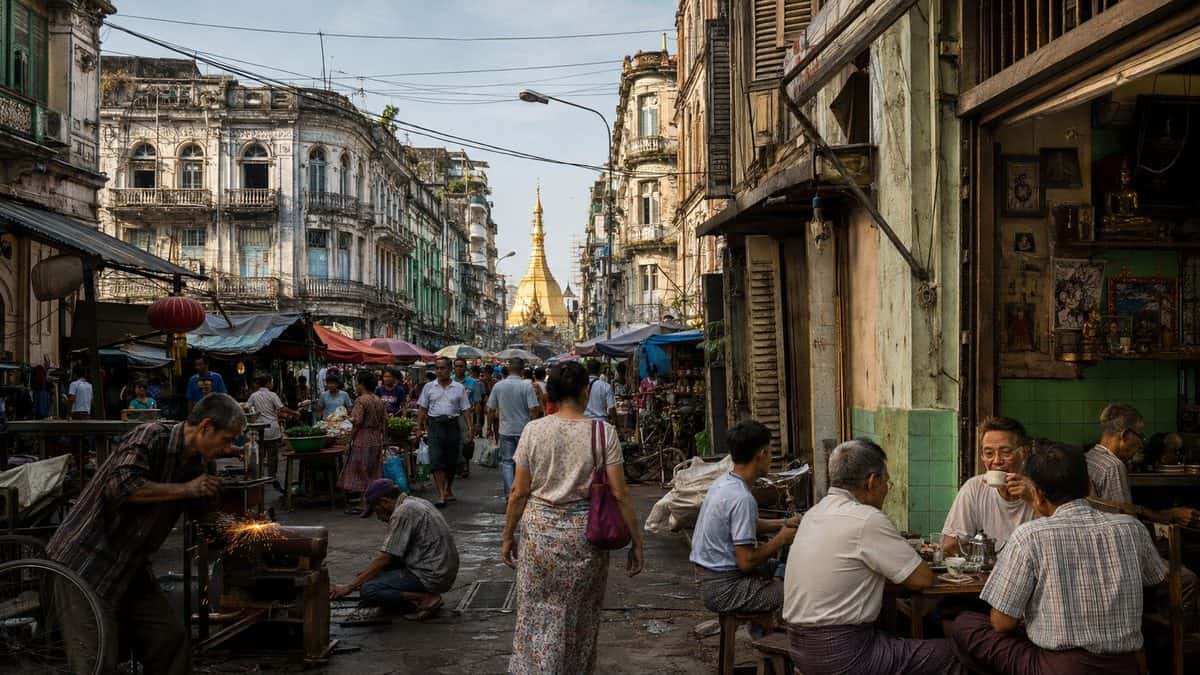
Yangon lets travelers see an Asian metropolis through its unassuming streets. The ex-national capital has a large historic urban center that留a lot of colonial architecture. It has religious sites, markets, and businesses. The city also retains a large historic center, unlike most cities countries. Myanmar recorded 1,063,072 international arrivals in 2024, down 17% from 2023, and Yangon International Airport handled 242,722 international arrivals. That makes the city an important gateway obstructed by Myanmar’s other challenges to tourism. However, for travelers, the greatest discoveries may lie outside the most famous attractions. The city’s streets show the tea shop culture and migrant histories along with architectural survival. Travel along Yangon’s streets offers travelers a chance to see how the city actually lives rather than another spot to check off the list.
Why Yangon Streets Matter More Than Checklists
Yangon changed profoundly after the national capital moved to Naypyidaw in 2006. It remained Myanmar’s commercial capital, however, and its historic centre continued to function as a dense business and residential district. The Ministry of Hotels and Tourism describes Yangon as a city with a distinctive colonial urban core, tree-lined streets, markets and street vendors. The area around Sule Pagoda also has a history extending more than 2,000 years.
Advertisement
Advertisement
That layering makes the city particularly rewarding for slow exploration. A traveller can encounter a colonial courthouse, a Buddhist shrine, a Chinese shop-house, an Indian-influenced commercial quarter and a roadside tea shop within the same walk. The attraction is the continuity between these elements, rather than any single monument.
Yangon’s historic centre also contains an unusually concentrated architectural inheritance. A Yangon Heritage Trust inventory project identified 2,122 heritage structures within a proposed downtown conservation area covering Lanmadaw, Latha, Pabedan, Kyauktada, Botahtaung and Pazundaung townships. The figure demonstrates why the city’s streets deserve to be treated as a connected cultural landscape.
Advertisement
Advertisement
| Yangon street experience | What travellers can understand |
|---|---|
| Historic shop-houses | Commerce, migration and urban history |
| Tea shops | Everyday social life |
| Markets | Food supply and neighbourhood economies |
| Religious streets | Myanmar’s plural urban culture |
| Workshops | Traditional skills and livelihoods |
| Colonial avenues | The city’s imperial-era transformation |
| Railway corridors | Yangon beyond the central business district |
| Riverside streets | Trade, transport and port history |
Pansodan Street Turns Architecture Into a Living Archive
Few Yangon streets illustrate the city’s architectural inheritance more clearly than Pansodan Street. Its lower section contains a remarkable concentration of historic commercial and government buildings. The former Yangon Region High Court, for example, was constructed between 1905 and 1911. It measures almost 300 feet by 288 feet and cost 2.45 million rupees at the time. Restoration planning for the building was inspected by senior officials in August 2025.
The traveller does not need to enter every building to appreciate the street. Look instead at façades, arcades, balconies, staircases and old commercial proportions. Pansodan demonstrates how Yangon once operated as a cosmopolitan imperial port, where administrative power and commercial ambition shaped the streetscape.
Advertisement
Advertisement
The street also illustrates a more important preservation question. Heritage survives only when buildings remain useful, not merely when façades are photographed. Historic properties can become homes, offices, galleries, restaurants or other active spaces. That adaptive use gives travellers a better understanding of preservation as an economic and social process.
Bogalay Zay Street Shows Heritage With a Pulse
Bogalay Zay Street offers a different version of historic Yangon. Research into its streetscape describes it as particularly significant because of its relationship with the former Secretariat and its concentration of colonial shop-house architecture. The buildings traditionally combined commercial ground floors with residential accommodation above.
Advertisement
Advertisement
That arrangement matters for travellers because it reveals how urban life once worked. The street was not designed as a museum district. Shops generated income below, while families or workers occupied the floors above. That mixed-use pattern helped keep commercial streets active throughout the day.
Bogalay Zay also demonstrates how conservation can coexist with contemporary activity. Some historic buildings have accommodated newer cafés, galleries and other uses without completely erasing their streetscape. For visitors, this creates an unusually accessible form of heritage tourism: history can be observed while the neighbourhood continues functioning.
Latha Road Carries Chinatown Beyond the Postcard
Yangon’s Chinatown is often reduced to food photographs and lantern-lit streets. Latha Road offers a deeper way to understand the district. Historic conservation research selected Latha Road as one of several representative downtown areas because of its distinctive social and cultural character. The same study identified the area as part of Yangon’s Chinese quarter.
Travellers should therefore look beyond restaurant signs. Shop-house proportions, Chinese religious influences, family businesses and market activity reveal a neighbourhood shaped by migration and commerce. The strongest experience comes from walking slowly and noticing how different generations of businesses occupy the same urban fabric.
Advertisement
Advertisement
The wider lesson is significant for tourism. Chinatown is not simply a themed attraction. It is part of Yangon’s living commercial history, and its value increases when visitors treat it as a functioning neighbourhood.
19th Street Becomes Yangon After Sunset
When daylight fades, 19th Street develops an entirely different rhythm. The Chinatown side street is known for rows of barbecue stalls, roadside dining and an evening food scene that attracts both residents and visitors. The pavement becomes an informal dining landscape, with grills, tables and food stalls competing for limited space.
For travellers, this is more than a meal stop. The street demonstrates how food becomes urban infrastructure in Yangon. A narrow road can become a social venue once traffic gives way to diners and vendors.
The experience also rewards curiosity. Skewers commonly include meat, tofu, seafood and vegetables, while nearby establishments offer broader Chinese and Myanmar dishes. Visitors should follow normal food-safety judgement, choose busy stalls with good turnover and avoid assuming that every dish suits their dietary needs.
26th Street Reveals a Multicultural Commercial Yangon
A walk along 26th Street can reveal another dimension of the city’s social geography. Earlier heritage research selected the street as a representative downtown area because of its predominantly Indian-origin community. The same project examined it alongside Latha Road and Bogalay Zay Street to capture different cultural and architectural identities within the historic centre.
That makes 26th Street particularly useful for travellers interested in Yangon’s migration history. The city’s historic centre was never culturally uniform. Indian, Chinese, Burmese and other communities contributed to its commercial life, religious landscape and food culture.
Advertisement
Advertisement
This is also why a conventional monument-based itinerary can miss so much. A building tells one story. A functioning street reveals several generations of movement, trade and adaptation.
Maha Bandula Road Connects Monumental Yangon With Daily Life
Maha Bandula Road provides a useful counterpoint to quieter heritage lanes. It runs through the historic centre and connects major civic spaces with commercial neighbourhoods. The surrounding architecture demonstrates how Yangon combined grand public institutions with tightly packed commercial streets.
Travellers should resist the temptation to photograph only the most imposing structures. Watch the pavements instead. Vendors, commuters, shopkeepers and pedestrians create the everyday rhythm that allows the historic district to remain a city rather than a preserved stage set.
The nearby High Court and other civic buildings also show how colonial administrative planning shaped the city. Yet the contemporary street activity demonstrates that the urban landscape has outlived the political system that created much of it.
Shwe Bon Thar Road Explains the City Through Commerce
Shwe Bon Thar Road is another useful corridor for understanding downtown Yangon through trade. Its importance lies less in one spectacular landmark and more in the dense commercial ecosystem surrounding the historic centre.
This is where travellers should adopt a different visual habit. Instead of asking “What attraction is here?”, ask “What does this street sell, who buys it and where does it come from?” Markets and specialist shops can reveal far more about a city’s economy than a polished visitor attraction.
Advertisement
Advertisement
That approach also supports more responsible tourism. Spending modestly with independent vendors, eating at local establishments and buying useful goods can distribute visitor spending beyond conventional tourist businesses.
Thein Phyu Street Leads Towards Working Yangon
As travellers move east from the historic core, the urban character changes. Thein Phyu Street and adjoining neighbourhoods offer a useful transition between central Yangon and the city’s broader residential and commercial fabric.
This is where the story of Yangon becomes less architectural and more human. Small businesses, workshops, transport activity and residential buildings reveal a city whose economy extends well beyond the postcard centre.
For photographers, the attraction lies in texture and movement. Yangon becomes most compelling when nothing is staged. A craftsman working behind a shopfront or a vendor preparing breakfast can reveal more about contemporary life than another picture of a landmark.
The Circular Railway Shows Yangon Beyond Downtown
The city’s railway network offers one of the most practical ways to widen the traveller’s perspective. Myanma Railways publishes suburban services connecting Yangon with places including Insein and Hlawga. Its published timetable includes multiple Yangon–Insein services across morning, midday and afternoon periods.
The railway matters because it changes the traveller’s relationship with the city. Instead of moving directly between attractions, visitors can observe residential districts, markets and commuter patterns from a slower transport system.
Advertisement
Advertisement
It should not be romanticised as a tourist spectacle, however. It is working public transport first. Travellers should behave accordingly, avoid obstructing passengers and follow current railway instructions.
Tea Shops Offer the City’s Quietest Introduction
Among all Yangon experiences, the humble tea shop may provide the clearest introduction to everyday urban culture. These establishments function as informal meeting points where food, tea, conversation and business intersect.
For visitors, the important skill is observation. Watch how customers order, share tables and move through the space. Notice the breakfast dishes, tea preparation and rhythm of service. A short stop can reveal a social landscape that organised sightseeing rarely captures.
This also creates an important distinction between authenticity and performance. Travellers do not need a staged cultural encounter. They can simply enter an ordinary establishment respectfully, order something suitable and allow the surroundings to speak for themselves.
Shwedagon Remains Essential, But It Is Not the Whole City
None of this diminishes Shwedagon Pagoda. It remains Yangon’s defining religious landmark and one of Myanmar’s most significant sacred sites. The official Shwedagon authority records the pagoda’s height at 326 feet, or 99.36 metres, with the complex occupying 114 acres.
The pagoda’s history also demonstrates why Yangon cannot be reduced to its colonial inheritance. Its story stretches across centuries and includes repeated restoration after earthquakes, storms and other disasters. The official history records major structural interventions following earthquakes, including extensive reinforcement under King Hsinbyushin.
Advertisement
Advertisement
The smarter itinerary therefore includes Shwedagon while moving beyond it. The pagoda explains Yangon’s spiritual identity; its streets explain its social identity.
A Traveller’s Street-Level Yangon Guide
| Experience | Ideal approach | What to observe |
|---|---|---|
| Pansodan | Slow daytime walk | Historic civic and commercial buildings |
| Bogalay Zay | Architecture walk | Shop-houses and adaptive reuse |
| Latha Road | Day and evening | Chinese-Burmese commercial life |
| 19th Street | Evening | Barbecue and street dining |
| 26th Street | Daytime | Indian-influenced commercial character |
| Maha Bandula Road | Daytime | Civic buildings and street activity |
| Shwe Bon Thar Road | Daytime | Specialist commerce |
| Thein Phyu area | Daytime | Working neighbourhoods |
| Circular Railway | Daylight | Commuter and suburban life |
| Tea shops | Morning | Food, conversation and daily routines |
Travellers should check local conditions before setting out. Operating hours, transport schedules and access arrangements can change, so official information should take precedence over older travel guides.
The country’s official tourism statistics show why such practical flexibility matters. Myanmar’s international arrivals reached only 24% of the 2019 level in 2024, according to the government’s inbound tourism survey. About 79% of surveyed international visitors travelled independently, while 76% stayed overnight.
Those figures suggest an important opportunity for destination storytelling. Independent travellers often need neighbourhood-level information that conventional package itineraries do not provide. Yangon can answer that demand through walkable cultural narratives rather than attraction-heavy itineraries.
Heritage Is Also an Economic Question
Yangon’s heritage debate extends beyond architecture. Conservation affects property owners, tenants, businesses, craftspeople, residents and future tourism investment.
Historic buildings can become economic assets when they accommodate appropriate new uses. Yet poorly planned redevelopment can remove the very urban character that makes a destination distinctive. Earlier conservation research highlighted the importance of integrating heritage protection with wider urban planning rather than treating individual buildings in isolation.
Advertisement
Advertisement
The lesson for travellers is straightforward. Spend where heritage and local livelihoods intersect. A meal in a neighbourhood restaurant, a purchase from an independent shop or a locally guided walk can support the economic life that keeps historic districts functioning.
How to Walk Without Turning Life Into a Spectacle
Responsible street tourism requires restraint. Residential lanes are homes, not open-air museums, and people working in markets or shops are not automatically subjects for photography.
Ask before photographing individuals. Avoid blocking doorways or shop entrances. Dress appropriately around religious buildings and follow local instructions about footwear and access. When eating, observe local customs rather than assuming every street-food ritual works the same way.
Travellers should also remain alert to changing local circumstances. Myanmar’s operating environment can vary considerably, so visitors should consult current official travel guidance before travelling and reassess local conditions during their stay.
Yangon Rewards the Unplanned Detour
The strongest reason to explore Yangon streets is not that they offer hidden attractions. It is that they reveal the machinery of an actual city.
Pansodan exposes layers of institutional history. Bogalay Zay demonstrates architectural continuity. Latha Road carries the memory of Chinese commercial networks. 19th Street transforms food into nightlife. Other corridors reveal Indian influences, neighbourhood commerce, transport and working life.
Advertisement
Advertisement
Together, they challenge the idea that meaningful travel requires a spectacular sight. Yangon’s greatest travel story is the relationship between its landmarks and the ordinary life surrounding them.
For readers planning a visit, the practical message is equally important. Allow time to walk, pause, observe and return to places at different times of day. Use official transport information when relying on trains, and verify current travel conditions before departure.
Yangon becomes more legible when travellers stop rushing between famous addresses. Its historic streets still carry the imprint of empire, migration, religion and commerce, but they also carry something more immediate: daily life. That is the Yangon tourists often miss, and the Yangon worth taking time to understand.
Advertisement
