
Argentina Cruise Growth Tests Ushuaia Operations as Buenos Aires Supports Antarctic Travel Access

Published
Argentina has confirmed than 590 calls from passenger vessels at Ushuaia for the 2026–27 season 100 more than the previous season.. A date-by-date look at the official timetable from 17 September shows a more immediate problem in the cruise industry. On 28 December 11 vessels are scheduled to arrive. Nine of them have call windows that overlap for much of the day. On 6 January eight new ships are due to arrive. They will meet five ships that were carried over from 5 January. At the time 78.8% of the passengers who left from Ushuaia Airport through July 2026 were going to Buenos Aires airports. This makes air-transfer planning very important, for Antarctic cruise operations.
Ushuaia’s 590 Cruise Calls Hide a More Important Peak Day Story
According to the National Ports and Navigation Agency’s official 14 September announcement, more than 590 passenger-vessel calls are confirmed for Ushuaia during the 2026–27 season. That represents an increase of 100 calls over the preceding season.
For cruise operators, destination management companies and travel agents, however, the annual total does not reveal the full operational picture. The more consequential metric can be how many ships need Ushuaia within the same hours.
The official schedule updated on 17 September 2026 identifies clusters where arrivals, departures and vessels remaining from the previous day overlap. These should not be described as confirmed congestion. Nor does the timetable establish that every call represents a full passenger turnaround.
Advertisement
Advertisement
What it does establish is a series of unusually dense operating windows that can concentrate requirements for berth management, passenger transfers, hotel nights, coaches, provisioning and luggage movements within a comparatively short period.
28 December Emerges as the Key Date to Watch
The clearest example is 28 December 2026.
Advertisement
Advertisement
Eleven vessels have scheduled arrival times that day. Discoverer, Seaventure and Ocean Victory are listed for 06:00. World Voyager, Vestland Adventurer, Ocean Explorer and Ultramarine follow at 07:00. Scenic Eclipse and SH Diana arrive at 18:00, Seabourn Venture at 19:00 and Plancius at 22:00.
That is only part of the operational picture. Island Sky is scheduled from 27 December at 05:00 until 28 December at 18:00, while L’Austral runs from 27 December at 19:00 until 28 December at 19:00. Combining those carry-over vessels with the morning arrivals means nine scheduled call windows overlap between 07:00 and 18:00. This is a calculation from the official timetable rather than an official prediction of port congestion.
Advertisement
Advertisement
The following dates illustrate why agents should examine individual sailing days rather than relying solely on the 590-call headline.
| Selected date | New scheduled arrivals | Vessels carried into date | Maximum overlapping call windows identified | Operational significance |
|---|---|---|---|---|
| 16 Nov 2026 | 7 | 1 | 7 | Five arrivals are concentrated around 07:00–08:00 alongside existing activity. |
| 25 Nov 2026 | 5 | 2 | 7 | Five new calls combine with Octopus and Ortelius already within their scheduled port windows. |
| 28 Dec 2026 | 11 | 2 | 9 | Seven arrivals are scheduled by 07:00, producing the strongest morning overlap found in the reviewed timetable. |
| 29 Dec 2026 | 3 | 5 | 8 | The previous day’s concentration carries into another intensive morning rather than clearing overnight. |
| 6 Jan 2027 | 8 | 5 | 9 | Five ships from 5 January remain while four more have arrived by 10:00. |
These figures count scheduled call windows, not confirmed simultaneous berth occupancy. That distinction matters because vessels can have different operational arrangements, and the published schedule does not justify claiming all ships will physically occupy the quay together.
Buenos Aires Becomes Critical to Ushuaia Cruise Reliability
The second part of the story lies hundreds of kilometres north.
According to official Ushuaia International Airport operating statistics, 150,614 passengers departed for Buenos Aires Aeroparque and 108,337 for Ezeiza between January and July 2026. Combined, the two Buenos Aires airports accounted for 258,951 passengers.
Advertisement
Advertisement
Across all destinations listed in the airport’s 2026 table through July, the recorded total was 328,569 passengers. Therefore, Buenos Aires represented approximately 78.8% of those outbound passenger movements, based on a calculation from the airport dataset.
Ushuaia Municipality provides another useful peak-season benchmark. During January 2026, 554 flights arrived in the city and 427 originated in Buenos Aires, equivalent to about 77.1% of the monthly total. The same month recorded 107 cruise calls and 43,720 cruise passengers.
| Land-side indicator | Official benchmark | Cruise-planning relevance |
|---|---|---|
| Ushuaia arriving flights, Jan 2026 | 554 | Shows the scale of peak-season aviation movements. |
| Arrivals from Buenos Aires | 427 or 77.1% | Demonstrates the gateway’s dominant role in Ushuaia access. |
| Cruise calls, Jan 2026 | 107 | Indicates substantial simultaneous seasonal port demand. |
| Cruise passengers, Jan 2026 | 43,720 | Establishes the size of the passenger flow handled during one peak month. |
| Estimated hotel occupancy, Jan 2026 | 80% | Suggests less accommodation flexibility during high-demand periods. |
| Ushuaia passengers departing for AEP and EZE, Jan–Jul 2026 | 258,951 | Confirms the strength of the Buenos Aires air corridor. |
| Recorded establishments, Nov 2025 hotel survey | 89 | Provides an official accommodation-supply benchmark. |
| Room occupancy, Nov 2025 | 72% | Shows accommodation was already operating at substantial utilisation before the latest record season. |
Buenos Aires is therefore directly relevant to the headline rather than being included merely for geographical reach. Argentina’s national port authority also lists Buenos Aires, Puerto Madryn and Ushuaia within principal southbound cruise itineraries continuing towards Chile and Antarctica.
Hotel Capacity Could Matter More on Ship Cluster Days
Accommodation availability deserves particular attention because Antarctic expedition itineraries frequently involve pre- or post-cruise stays and tightly controlled embarkation movements.
Official municipal data estimated 80% hotel occupancy in Ushuaia during January 2026, when 43,720 cruise passengers moved through the city.
Separately, the latest comparable INFUETUR hotel survey identified 89 establishments in November 2025. It recorded a 72% room-occupancy rate and a 58.9% bed-space occupancy rate. The report records 61,710 available room-nights and 168,150 available bed-nights for the month; those monthly figures should not be confused with the number of physical hotel rooms or beds in the city.
Advertisement
Advertisement
This makes the 28 December and early-January clusters commercially relevant. Even when port operations remain fluid, concentrated embarkation and disembarkation can increase competition for suitable pre-cruise rooms, transfer departure slots and baggage-handling capacity.
New Port Rules Put Real Operational Capacity at the Centre
The timing of Argentina’s latest port regulation strengthens this analysis.
According to Resolution 51 of 2026 published by Argentina’s National Ports and Navigation Agency, a new framework governs vessel entry and berth allocation at Ushuaia. It was published on 14 September 2026 and took effect the following day.
The regulation explicitly connects berth and entry management with the port’s real operational capacity, available infrastructure, safety conditions, manoeuvre planning and continuity of services. That does not indicate that congestion is expected. It does, however, demonstrate that physical capacity and vessel sequencing are active management considerations immediately before a season exceeding 590 calls.
The port itself is multipurpose. Its principal pier measures 550 metres long and 28 metres wide, while passenger logistics are handled alongside fishing and other port operations. The national authority says the terminal normally processes around 250,000 visitors and more than 500 international cruise calls per season.
Infrastructure work is continuing. A project awarded in July involves 75 replacement fenders at an investment exceeding US$2.5 million. Water and electrical services and fire-protection infrastructure are also being improved as part of the port programme.
Advertisement
Advertisement
Antarctic Cruise Data Explain Why December and January Matter
Historical evidence shows why late December and January deserve closer attention.
INFUETUR’s official analysis of the 2024–25 Ushuaia cruise season recorded 565 cruise trips, 157,082 passengers and 94,169 crew, producing 251,251 passenger-and-crew movements across all cruise categories.
Antarctic operations alone accounted for 422 voyages and 105,221 passengers, representing 74.7% of trips and 67% of all cruise passengers that season. December recorded 98 Antarctic voyages carrying 26,318 passengers. January followed with 97 voyages and 30,826 passengers, while February produced 94 voyages and 25,538 passengers.
That historic concentration helps explain why an eleven-arrival day in late December should matter more to the trade than the season-wide total alone.
The Hidden Risk Is Operational Compression Rather Than Overall Volume
The information gain from the 2026–27 timetable lies in compression.
A port can absorb a large annual cruise programme when activity is distributed across hundreds of days. The commercial challenge changes when several arrivals, departures and overnight stays are compressed into the same morning.
Advertisement
Advertisement
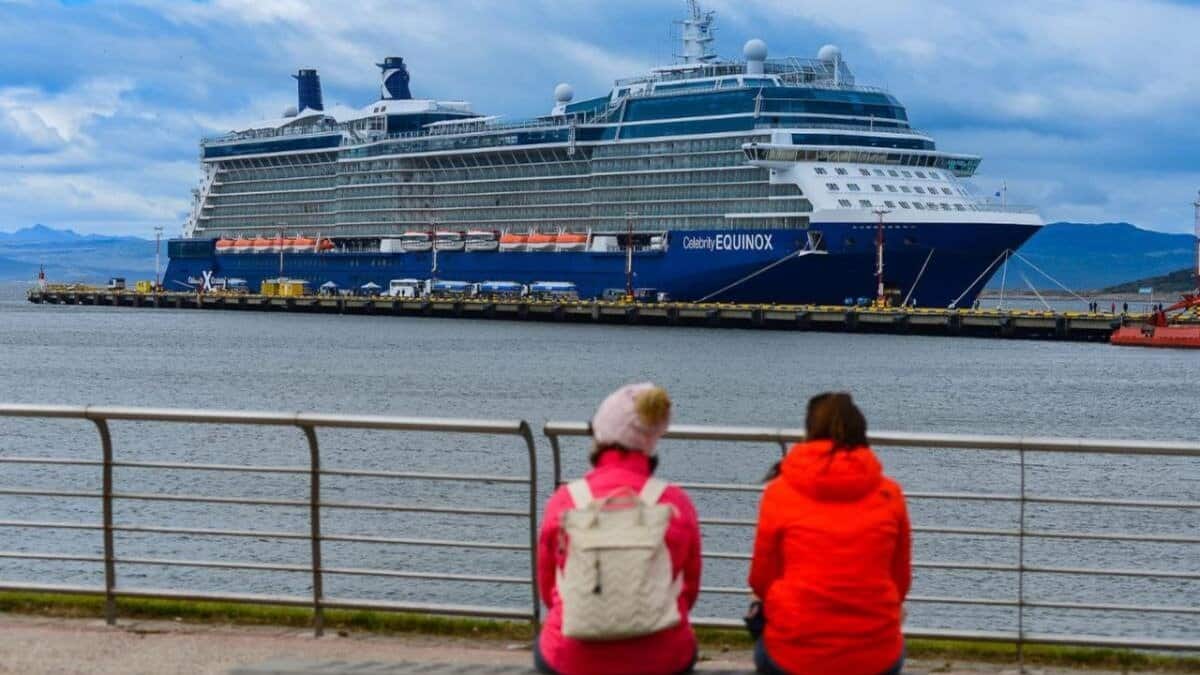
On 28 December, the official schedule places nine vessel call windows together for much of the day. On 6 January, the same maximum is reached through a different pattern: five vessels remain from the previous evening while three ships arrive at 07:00 and Celebrity Equinox follows at 10:00.
For cruise sellers, this shifts risk assessment away from the quay alone. A delayed aircraft, a late coach movement or unavailable hotel rooms can affect an expedition itinerary even when maritime operations themselves remain on schedule.
The relevant question for travel companies is therefore not simply whether Ushuaia can handle more than 590 calls across a season. It is how effectively every component of the passenger chain performs during the comparatively small number of highly compressed operating days.
What Travel Agents and Tour Operators Should Monitor
- Track 28 and 29 December particularly closely. The official timetable shows exceptional call concentration across consecutive days, meaning pressure may carry overnight rather than disappear after one peak.
- Watch 6 January as a second major operational window. Five vessels are scheduled to remain from 5 January before another eight arrivals occur during the day.
- Protect Buenos Aires connections. Its two airports account for nearly four-fifths of recorded outbound Ushuaia passengers through July 2026, making connection disruption a material cruise risk.
- Avoid unnecessarily tight self-connections. Where itinerary design permits, additional time between international flights, Buenos Aires domestic sectors and expedition embarkation reduces exposure to knock-on disruption.
- Secure pre- and post-cruise accommodation early. January 2026 already produced an estimated 80% hotel occupancy rate.
- Reconfirm coach and baggage arrangements on cluster dates. Concentrated ship windows can produce simultaneous requirements for passenger collection, baggage staging and terminal transfers even without port congestion.
- Recheck the official Ushuaia vessel timetable before departure. Forward maritime schedules remain operational planning documents, so agents should work from the latest published version rather than the original booking-date schedule.
Argentina’s Cruise Growth Now Faces a More Sophisticated Test
Argentina’s record 2026–27 Ushuaia cruise season is fundamentally a growth story. More than 590 calls demonstrate the scale of the southern cruise market and Ushuaia’s established role as an Antarctic gateway. But the deeper B2B story lies in what happens when that growth becomes concentrated into individual operating days.
The combination of eleven arrivals on 28 December, nine overlapping call windows, another intensive sequence on 6 January, strong Buenos Aires aviation dependence and already elevated peak-season accommodation demand turns turnaround coordination into a crucial part of the season.
For the international cruise trade, Ushuaia’s next competitive test may therefore be measured less by how many ships visit Argentina and more by how smoothly port sequencing, airport transfers, Buenos Aires connections, hotels, coaches and baggage systems work together when the Antarctic season reaches its busiest hours.
Advertisement
