
Egypt to Receive New Velaro High-Speed Train in August 2025, Connecting Ain Sokhna, Alamein, and Marsa Matrouh as Part of 2,000-Kilometre National Rail Network

Published
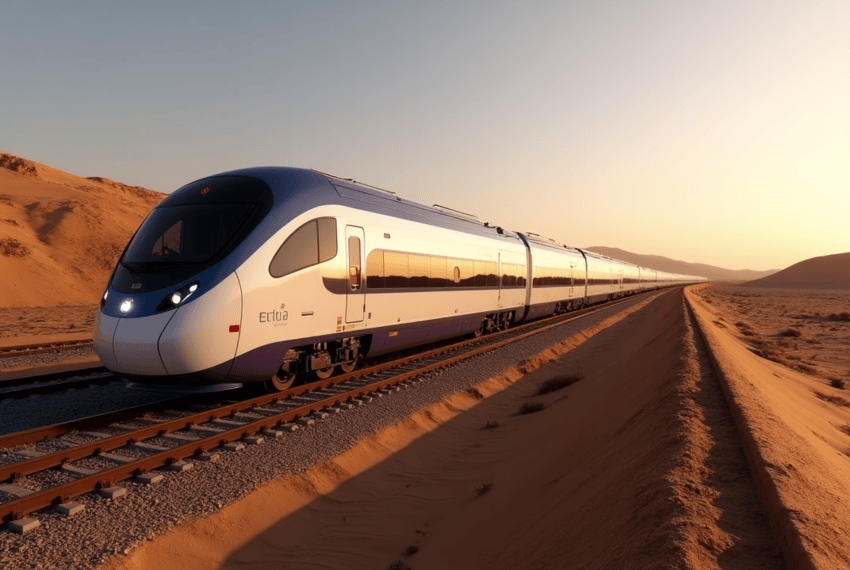 Image generated with Ai
Egypt is preparing to enter a new era of transport with the anticipated arrival of its first Velaro high-speed electric train in August 2025. This milestone marks the beginning of operations for the Ain Sokhna–Alamein–Marsa Matrouh line, a central corridor within Egypt’s 2,000-kilometre national high-speed rail network—the first of its kind in the country.
During a site visit, Kamel Al-Wazir, Deputy Prime Minister for Industrial Development and Minister of Industry and Transport, reviewed progress along the corridor and reaffirmed the government’s commitment to creating a modern, integrated rail system. The project is being executed in cooperation with Siemens Mobility, the German rail technology leader behind the Velaro train model, one of the world’s most advanced high-speed trains.
The project is not only a national achievement but also a pivotal development in Africa’s transport evolution. For travelers, logistics companies, tourism operators, and regional planners, the implications are substantial, both within Egypt and across a broader regional context.
A High-Speed Link Between Key Economic Zones
Advertisement
Advertisement
The Ain Sokhna–Alamein–Marsa Matrouh route represents the first phase of Egypt’s high-speed rail network, which will eventually span 2,000 kilometers. The line is being positioned as a core artery for connecting Egypt’s Red Sea coast with the Mediterranean, linking major cities, economic zones, and agricultural regions.
The broader network is set to be anchored by 60 passenger stations, two main depots, and five maintenance hubs, providing robust support for a fully integrated transportation system. Once complete, the network will operate:
Advertisement
Advertisement
- 41 Velaro high-speed trains for long-distance passenger services.
- 94 regional trains for intercity travel.
- 41 freight locomotives dedicated to goods transport.
This tripartite structure ensures that the network is not just a commuter solution, but also a logistical backbone for national and international trade.
The Velaro Advantage: What Makes This Train Different
Advertisement
Advertisement
The Velaro train, manufactured by Siemens Mobility, is regarded as one of the fastest, most efficient, and most environmentally conscious high-speed rail models in the world. Already in service in Germany, Spain, Turkey, and China, the Velaro’s deployment in Egypt places the country among the global elite of high-speed rail adopters.
For travelers, the Velaro promises:
- Top speeds exceeding 300 km/h, dramatically reducing travel time between Egyptian cities.
- State-of-the-art passenger amenities, including onboard Wi-Fi, spacious seating, accessibility features, and climate-controlled environments.
- Energy efficiency, helping Egypt reduce its transport-related carbon footprint.
This upgrade in comfort and speed positions Egypt to rival other regional transit hubs, making train travel a compelling alternative to domestic flights and road journeys.
What It Means for Domestic Travelers
Advertisement
Advertisement
Egyptian citizens and residents will be the primary beneficiaries of the high-speed rail network, which is designed to enhance daily mobility, create job opportunities, and provide equitable access to transport in both urban and rural areas.
The corridor linking Ain Sokhna, Alamein, and Marsa Matrouh will allow for rapid movement across Egypt’s densely populated and economically diverse regions. Cities such as Ganat Misr, West Minya, Toshka, and East Oweinat—many of which are undergoing massive development—will now become more accessible, integrating them more fully into the national economy.
For domestic tourists, the trains will offer fast, reliable access to Egypt’s historic and natural treasures, from beachfront resorts on the Mediterranean to Red Sea diving destinations. Travel that once required hours by bus or car will now be possible in a fraction of the time, with greater comfort and reduced risk.
Impacts on International Tourism
For international travelers arriving in Cairo or coastal gateway cities, the high-speed rail network opens new possibilities for multi-city itineraries that were previously cumbersome or time-consuming. The rail line will allow smoother connections between tourist hotspots like Luxor, Aswan, Alexandria, and Egypt’s emerging Red Sea Riviera destinations.
Travel agencies can now develop rail-inclusive tour packages, similar to those in Europe and East Asia, where visitors travel seamlessly between historic, cultural, and leisure destinations by high-speed train.
Advertisement
Advertisement
This modernization aligns with Egypt’s broader goal of attracting 30 million tourists annually by 2028, an ambition that will rely heavily on diversified transport offerings and greater connectivity between international airports and in-country destinations.
Economic and Logistical Significance
From a logistics and trade perspective, the Velaro-equipped rail system is about more than passenger mobility. The inclusion of 41 dedicated freight locomotives means Egypt is building an integrated corridor for cargo transport, particularly important for agricultural exports and industrial goods.
The ability to move goods swiftly between industrial centers, agricultural belts, and maritime ports will dramatically cut transport times and costs. For example, agricultural products from inland farms in Mostakbal Misr and New Delta can be shipped to Red Sea or Mediterranean ports for export, while raw materials and imports can reach interior production zones with new efficiency.
In this sense, Egypt’s high-speed rail project functions not just as a transport network but as a national logistics corridor, poised to play a key role in regional trade and North Africa’s integration with global markets.
What This Means for the Travel Industry
Advertisement
Advertisement
For airlines, bus operators, and domestic travel services, the advent of high-speed rail presents both competition and opportunity. While air travel may remain dominant for longer routes or international connections, high-speed rail will likely draw market share from domestic carriers and intercity bus services.
To stay competitive, these industries may:
- Adjust pricing models to reflect the faster and more efficient alternative offered by rail.
- Integrate with rail services by offering first-mile/last-mile transport solutions.
- Focus on niche or remote routes not yet serviced by rail.
Hotels, especially those near new or upgraded stations, are likely to benefit from increased footfall. Tourism boards and regional governments can now promote lesser-known destinations that are newly accessible via the high-speed network.
A Regional Benchmark for African Infrastructure
Egypt’s progress with this high-speed rail project also holds implications beyond its borders. As the first African country to implement a Velaro high-speed system, Egypt is positioning itself as a model for transport infrastructure modernization in emerging markets.
The success of this project could inspire similar initiatives in Morocco, Algeria, Ethiopia, and Kenya, where demand for modern transport continues to rise. In this way, Egypt is not just expanding its own economy and improving mobility—it is helping to set the pace for a continent on the move.
Advertisement
Advertisement
What Travelers Should Know and Plan For
With the first Velaro train set to arrive in August 2025, travelers planning future trips to or within Egypt should begin to consider how the network will influence their travel logistics.
Key points for consideration:
- Booking options: Rail travel may soon be available through online portals, tour agencies, and integrated booking systems with airlines.
- Timetable alignment: Travel itineraries that once relied solely on air or road may soon be supplemented with high-speed connections.
- New destination access: Travelers may wish to explore towns and regions that were previously logistically difficult to reach but now become practical with high-speed rail.
Looking Ahead: August 2025 and Beyond
When Egypt receives its first Velaro train in August 2025, it won’t just be taking delivery of rolling stock—it will be accepting the future of transport. From that point onward, the focus will shift to full-scale deployment, service trials, and gradual network expansion.
By 2030, Egypt envisions a nationally integrated high-speed system that connects not only Ain Sokhna, Alamein, and Marsa Matrouh, but extends deeper into the country’s interior and outward toward the broader Mediterranean and African transport grids.
Advertisement
Advertisement
For travelers, this means a future of faster, greener, and more comfortable journeys. For the world, it signals that North Africa is stepping confidently into the next generation of mobility.
In just a few years, hopping from one end of Egypt to another may become as routine as a suburban commute—changing not just how people travel, but how they experience the nation.
Advertisement
