
Gabon Tourism Caravan Advances Destination Growth Through Lambaréné and Franceville Travel Circuits

Published
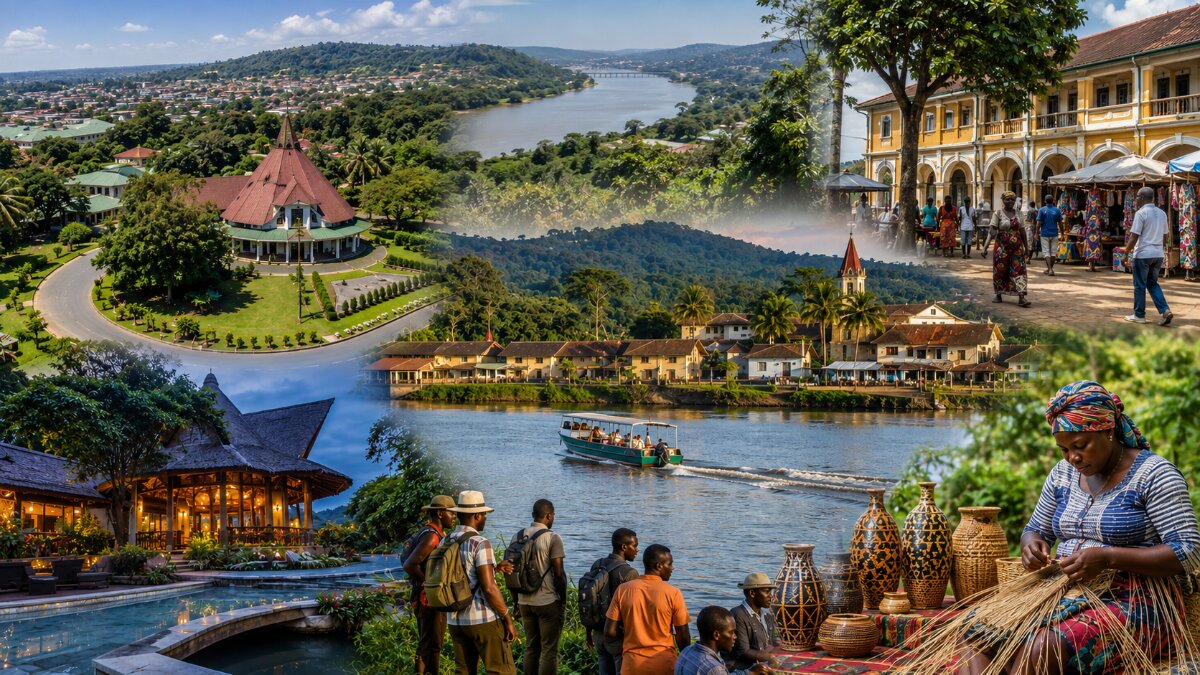
Gabon’s Caravane Touristique 2026 is doing something more consequential than promoting summer excursions. Running until 6 September, the programme is putting packaged provincial travel through a practical market test, with transport, accommodation, meals and activities combined into four-day circuits. Lambaréné and Franceville have emerged as particularly important indicators because both sit inside wider government infrastructure plans, while Lambaréné also hosted national sustainable-tourism strategy work during the caravan itself. The experiment could help determine which destinations outside Libreville are genuinely ready for stronger domestic and eventually international visitor flows.
Gabon tourism caravan is evolving into a test of whether provincial hubs can function commercially
The most important development surrounding Gabon tourism in August is not simply that the third Caravane Touristique is under way. It is the convergence of several government programmes around the same provincial destinations.
Advertisement
Advertisement
According to the Government of Gabon, the Caravane Touristique 2026 runs from 17 July to 6 September and is designed to stimulate domestic tourism, strengthen destination attractiveness and organise travel through provincial circuits. Its published packages bundle transport, accommodation, full-board catering and scheduled activities rather than relying on visitors to assemble each element independently.
That structure effectively allows Gabon to test a basic requirement of destination development: whether an interior city can operate as a tourism distribution hub from which travellers can reach surrounding attractions reliably, affordably and with sufficient service quality.
Advertisement
Advertisement
The interpretation is analytical rather than an officially declared government test. However, it is supported by the Ministry of Tourism’s explicit adoption of a hub-oriented approach, its emphasis on better-structured visitor experiences, and wider government objectives covering product definition, service standards, infrastructure, tourism governance and international promotion.
Why the timing matters as Gabon faces weaker aviation momentum
The domestic experiment has acquired greater strategic relevance because Gabon enters the second half of 2026 with international aviation momentum under pressure.
Advertisement
Advertisement
According to the World Bank Group’s June 2026 Tourism Watch, aviation passenger arrivals used as a proxy for tourism flows in Gabon declined 15% year on year during the first quarter of 2026. That was weaker than the overall Western and Central African pattern, where several markets recorded double-digit increases. The measure is an aviation-arrival indicator rather than a direct count of international tourists, so the distinction is important.
For Gabon, this creates a practical argument for developing the product before intensifying overseas demand generation. Sending more international visitors into provincial circuits will deliver limited economic value if ground transport, accommodation, guiding, attraction access and service standards cannot operate consistently.
Advertisement
Advertisement
The caravan therefore provides something tourism campaigns often lack: real travellers moving through actual destinations under defined itineraries and prices.
Official tourism ambitions make that validation increasingly important
According to a June assessment published by the Government of Gabon, the Tourism Ministry reported tourism at about 4% of national GDP, approximately 2,500 direct jobs, around 1,000 tourists annually under the ministry’s stated measure, and a longer-term ambition of reaching 10,000 visitors. These figures are ministry-reported sector indicators and should not be confused with broader border or aviation passenger counts.
A tenfold visitor ambition changes the operational question. Gabon does not only need attractive landscapes. It needs destinations capable of absorbing additional demand without creating severe gaps between promotional expectations and the on-ground experience.
| Strategic indicator | Latest official/institutional position used here | Why it matters for the caravan |
|---|---|---|
| Caravane Touristique 2026 | 17 July–6 September 2026 | Creates a multi-week live operating window |
| Standard circuit duration | 4 days / 3 nights | Tests multi-day destination retention |
| Q1 2026 aviation passenger-arrival proxy | -15% year on year | Adds urgency to improving destination competitiveness |
| Tourism contribution reported by ministry | About 4% of GDP | Shows diversification relevance |
| Direct tourism employment reported by ministry | About 2,500 | Links provincial demand with employment potential |
| Ministry-stated visitor ambition | Around 1,000 to 10,000 | Makes scalable infrastructure and products essential |
Sources: Government of Gabon and World Bank Group.
Advertisement
Advertisement
Lambaréné provides the clearest evidence of the wider policy experiment
Lambaréné tourism is particularly important to the new angle because the city is simultaneously a caravan base, an infrastructure-development location and a centre for national tourism-policy work.
The official caravan programme uses Lambaréné as the base for a four-day, three-night circuit encompassing a city tour and excursions involving regional lakes, Sindara, Tsamba and Magotsi. The package costs 292,000 CFA francs for a solo traveller, 496,000 CFA francs for a couple and 190,000 CFA francs for a child aged three to 12.
Then, on 5 August, while the caravan was still operating, the government launched work in Lambaréné on the National Strategy for Sustainable Tourism Development and the Revitalisation of Handicrafts. A nine-day process was established to examine development levers, the natural and cultural offer, competitiveness and tourism’s contribution to local economic growth.
That overlap is significant. Lambaréné is not simply being marketed as a place to visit. It is simultaneously providing a setting in which the country is considering how its tourism economy should be structured.
Franceville creates a tougher test of price, distance and itinerary depth
Franceville travel offers a different commercial test.
Its official four-day package is priced at 506,000 CFA francs for one person, 892,000 CFA francs for a couple and 396,000 CFA francs for a child. The itinerary extends to Poubara, Mbinda, Bakoumba, Parc de la Lékédi, Djakimadjiba and SUCAF.
Advertisement
Advertisement
The solo Franceville package is therefore approximately 73% more expensive than Lambaréné, based on the government’s published prices. For couples, the effective per-person price rises from 248,000 CFA francs in Lambaréné to 446,000 CFA francs in Franceville, a difference of almost 80%.
That price gap makes Franceville commercially revealing. If travellers accept a substantially higher package price for a deeper provincial itinerary, it may demonstrate scope for differentiated higher-value domestic products. If demand proves weaker, the result would highlight how transport costs, distance and accommodation economics could restrict future international packaging.
| 2026 circuit | Solo price | Couple price | Child price | Included programme characteristics |
| Lambaréné | 292,000 CFA | 496,000 CFA | 190,000 CFA | City experience, regional lakes, Sindara, Tsamba, Magotsi |
| Franceville | 506,000 CFA | 892,000 CFA | 396,000 CFA | Poubara, Mbinda, Bakoumba, Lékédi, Djakimadjiba, SUCAF |
| Bitam | 508,000 CFA | 1,132,000 CFA | 414,000 CFA | Mont Koum, Kyé-Ossi, three-border zone, Minvoul and surrounding attractions |
All three published packages run for four days and three nights and include transport, accommodation, meals and programmed activities, with drinks excluded.
Infrastructure plans could determine whether caravan hubs survive beyond September
A tourism hub becomes economically useful only when the surrounding city can handle repeated visitor movement.
Here another piece of Gabon’s 2026 policy architecture becomes relevant. According to the Government of Gabon’s Programme d’Aménagement et de Développement des Infrastructures du Gabon, or PADIG, both Lambaréné and Franceville are among seven interior cities targeted by an integrated urban-development programme.
PADIG covers four areas with direct implications for destination readiness: urban-road construction and rehabilitation, connecting roads, drainage and flood resilience, public facilities and improvements to existing built infrastructure. The programme is not a tourism project, but its geographical overlap with caravan hubs could materially influence tourism accessibility and visitor experience.
Advertisement
Advertisement
This is where the 2026 caravan potentially becomes more valuable to planners and the travel trade. It can expose operational problems before tourism promotion scales up: difficult transfers, excessive journey times, insufficient rooms, weak site management or an itinerary that cannot reliably deliver what is advertised.
Gabon is already preparing to market the destination internationally
Domestic product testing is occurring alongside a separate internationalisation push.
According to the Government of Gabon, the country prepared an Official Travel Guide 2026 and a Tourism Investment Guide, with copies transferred to the Ministry of Foreign Affairs for distribution through Gabonese diplomatic and consular missions overseas. The stated purpose is to strengthen promotion among potential visitors, partners and investors.
The Tourism Ministry’s 100-day roadmap also links destination development with product definition, better reception and service quality, tourism infrastructure, the creation of tourism offices, regulatory reform and international promotional material. Five national parks — Pongara, Loango, Lopé, Ivindo and Moukalaba-Doudou — have additionally been identified as pilots for ecotourism investment within the national growth and development framework.
Taken together, those policies suggest a sequence with considerable B2B relevance: build provincial products, test movement through them, strengthen infrastructure and governance, then improve international visibility.
The real result will come after the last caravan departs
As of 18 August 2026, the official programme still has 19 days remaining before its scheduled conclusion on 6 September. The most valuable information for tour operators will therefore not be whether the caravan produced publicity, but whether its component parts can continue operating afterwards.
Advertisement
Advertisement
For destination management, the key indicators would include occupancy generated by the packages, repeat bookings, average visitor expenditure, transport reliability, attraction capacity, guide availability, satisfaction, cancellation rates and the proportion of tourism spending retained locally.
The official sources reviewed for this report had not published a comprehensive final 2026 caravan performance dataset by 18 August. Until such evidence appears, it would be premature to describe Lambaréné, Franceville or the wider network as proven tourism hubs.
That distinction matters for international travel sellers. A successful promotional event is not automatically a viable year-round circuit.
Critical takeaways for travel agents and tour operators
- Treat the caravan as product validation, not proof of permanent capacity. Confirm that accommodation, guides, transfers and attraction access remain available after 6 September before contracting future programmes.
- Price Lambaréné and Franceville separately. Their official package costs already show materially different economics, making a uniform Gabon provincial package inappropriate.
- Build contingency time into interior itineraries. Provincial tourism depends heavily on ground mobility, and infrastructure improvements remain part of ongoing government programmes.
- Verify inclusions carefully. The official caravan packages combine transport, lodging, meals and activities, but future commercial products may not reproduce the same bundled conditions.
- Watch for post-caravan data. Visitor numbers, accommodation use, service-quality findings and repeat demand would provide stronger evidence for B2B contracting decisions.
- Follow infrastructure delivery in Lambaréné and Franceville. PADIG-related mobility and urban improvements could gradually strengthen their suitability as regional bases.
- Separate aviation trends from tourism counts. The World Bank’s 15% Q1 decline relates to an aviation passenger-arrival proxy, not a direct measurement of tourist arrivals.
- Monitor Gabon’s international promotion strategy. Distribution of official travel and investment guides abroad means overseas demand generation could begin moving faster than provincial supply development.
What Gabon’s provincial experiment could mean for international tourism
The strategic importance of Caravane Touristique 2026 lies in what happens after the buses with organised excursions and bundled packages disappear. If Lambaréné, Franceville and other provincial bases retain functioning itineraries with dependable suppliers and commercially viable demand Gabon would have something more useful than a national tourism campaign including a network of tested products that international tour operators could potentially adapt.
That would give the country a more credible path towards dispersing visitors beyond Libreville, linking tourism spending with interior communities and using ecological and cultural assets as part of economic diversification. Failure would also produce useful information. It would expose where infrastructure, service standards, pricing or distribution need further work before international marketing accelerates.
For the travel industry, that makes the remaining weeks of the caravan unusually important. Gabon is not merely showing travellers what exists beyond its capital. It is finding out whether those places can function as destinations when tourism becomes a business rather than an event.
Advertisement
