
New York and Nashville Lock Horns With Many Others in the Christmas Lights Showdown as Spectacular Displays and Hotel Demand Reshape US Holiday Travel

Published
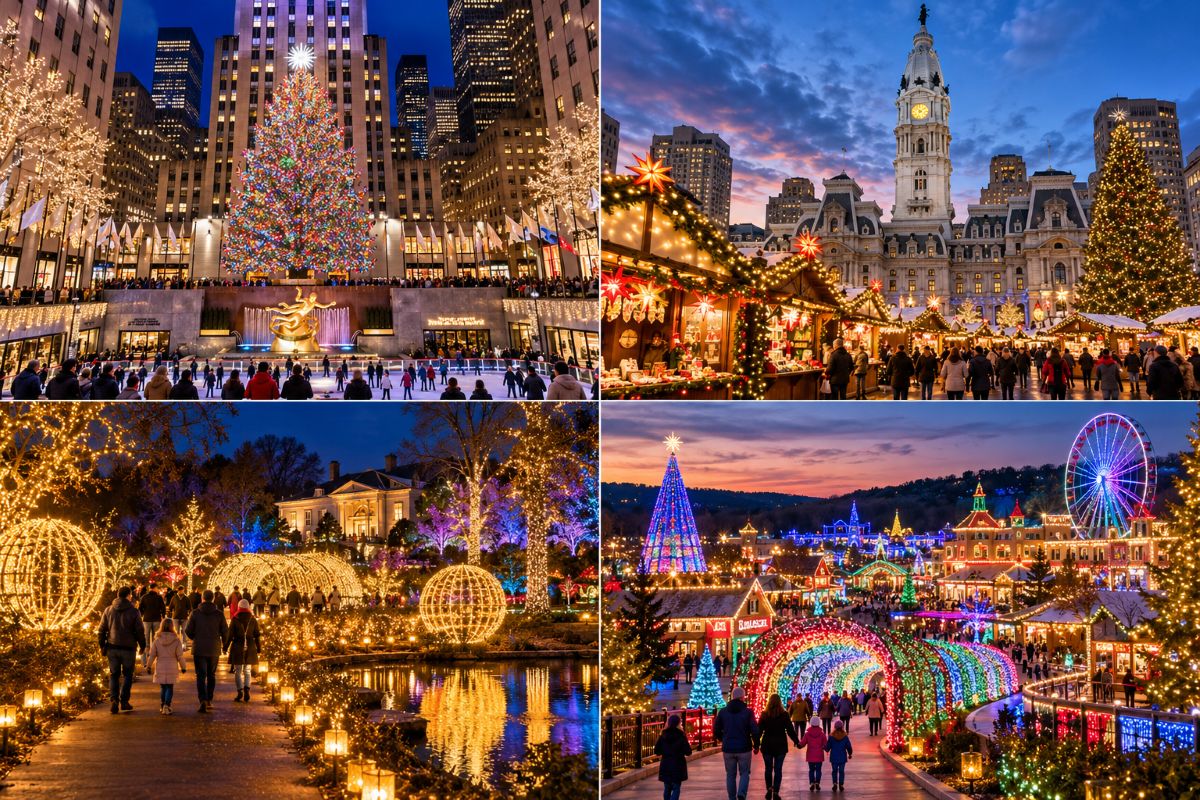
America’s Christmas lights showdown is intensifying as New York, Philadelphia, Nashville and Branson prepare distinct festive experiences for the 2026 holiday season. Their competing attractions span Manhattan’s celebrated Christmas tree, Philadelphia’s European-style market, Nashville’s illuminated botanical gardens and Branson’s sprawling theme-park spectacle. Silver Dollar City alone promises more than 6.5 million lights from 7 November 2026 to 2 January 2027. Meanwhile, Cheekwood’s Holiday LIGHTS runs from 20 November to 3 January, offering an immersive garden experience. Travellers must now weigh ticket prices, hotel demand, seasonal opening dates and family entertainment to determine which destination delivers the strongest overall value.
Four Destinations Offer Four Distinct Christmas Experiences
The competition reflects four different approaches to seasonal tourism. New York relies on iconic landmarks and citywide illuminations, while Philadelphia combines historic streets with festive shopping. Nashville builds its appeal around carefully designed garden installations, whereas Branson packages lights with rides, performances and dedicated Christmas attractions.
This distinction matters because advertised light counts cannot measure an entire holiday experience. Families may prefer interactive entertainment, couples might favour atmospheric city streets, and budget-conscious visitors could prioritise free displays. Therefore, the strongest destination depends on the balance between spectacle, convenience, accommodation and spending.
| Destination | Principal Christmas attraction | Confirmed 2026 dates | Main competitive advantage |
|---|---|---|---|
| New York City | Rockefeller Center Christmas tree and citywide displays | Tree arrives 7 November; lighting ceremony 2 December | Iconic landmarks and urban variety |
| Philadelphia | Christmas Village at LOVE Park and City Hall | 21 November–27 December | Free market admission and historic surroundings |
| Nashville | Cheekwood Holiday LIGHTS | 20 November–3 January | Immersive illuminated garden |
| Branson | Silver Dollar City’s An Old Time Christmas | 7 November–2 January | More than 6.5 million lights and live entertainment |
The calendars establish a useful planning window, but published opening dates do not guarantee daily admission. Visitors should check individual operating schedules, particularly around Thanksgiving, Christmas Day and New Year’s Day.
Advertisement
Advertisement
Branson Leads With Monumental Light Displays
Branson’s strongest advantage is the concentration of Christmas entertainment within a dedicated tourism destination. Silver Dollar City’s An Old Time Christmas opens on 7 November 2026 and continues through 2 January 2027. The park advertises more than 6.5 million lights, an eight-storey animated Christmas tree, illuminated structures and live seasonal productions.
Its Christmas in Midtown display alone features 1.5 million lights arranged across towering installations and light tunnels. The 2026 programme also introduces the Stars, Lights & Christmas Nights parade, adding another attraction beyond static illuminations. Visitors can combine these experiences with festive food, craft shopping and theatrical performances.
Advertisement
Advertisement
Branson’s wider Christmas offer also extends beyond one ticketed venue. Community displays, themed attractions and other seasonal experiences encourage visitors to spread spending across several businesses. However, that breadth can increase the total trip cost if families purchase multiple admissions, meals and transport.
The destination’s tourism strategy provides an unusually clear example of seasonal economic development. The Branson Christmas Coalition reports that nearly 21% of annual visitation occurs during November and December, compared with 18% for its competitive set. Its research also estimates that Christmas-related destination promotion generates more than $20 million in incremental visitor spending annually. These figures are coalition estimates, not independently verified 2026 spending totals.
Advertisement
Advertisement
Nashville Turns Botanical Gardens Into Light Theatre
Nashville offers a more contained, immersive alternative through Cheekwood Estate & Gardens. Its Holiday LIGHTS programme runs from 20 November 2026 to 3 January 2027, transforming the landscaped estate into a seasonal walking experience. More than one million lights illuminate a route designed around gardens, installations and the historic mansion.
The attraction’s published schedule runs from 4.30pm to 10pm, with timed entry slots available every 30 minutes. However, Cheekwood closes on Thanksgiving Day, Christmas Day and New Year’s Day, making calendar checks essential. Its extended season gives visitors opportunities to travel before Christmas or after the main holiday.
Admission prices provide a clearer picture of the experience’s cost. Gardens-only adult tickets start at $26 on non-peak nights and rise to $29 on peak nights. Gardens-and-mansion admission costs $29 and $32 respectively, while youth tickets range from $20 to $26. Children aged two and under enter free, although service charges and a $5 vehicle parking fee can increase the bill.
For families, the distinction between garden-only and mansion-inclusive admission matters. The cheaper option may suit visitors focused on outdoor illuminations, while the higher-priced ticket offers a broader estate experience. Nevertheless, the walking format requires consideration of temperatures, mobility needs and children’s tolerance for outdoor evening visits.
Advertisement
Advertisement
Nashville’s wider tourism economy also strengthens its Christmas proposition. Visitors generated a record $11.6 billion in Davidson County spending during 2025, according to tourism-industry data released in August 2026. That represented a 3.5% annual increase and an average of $31.8 million in daily visitor spending, although the figures cover the entire year rather than Christmas alone.
New York Commands a Premium Urban Christmas
New York’s competitive advantage is the breadth of its seasonal experience rather than a single attraction’s light count. Rockefeller Center anchors the itinerary, while decorated shopping streets, winter entertainment and neighbourhood displays allow visitors to build a multi-day festive break. The Christmas tree arrives on 7 November, ahead of its scheduled lighting ceremony on 2 December 2026.
The wider city experience can appeal to travellers who want to combine Christmas sightseeing with museums, restaurants, Broadway performances and shopping. However, these additions also create separate expenses, making an urban itinerary harder to price through one admission ticket. Families should distinguish free public displays from paid attractions and reserve timed experiences where required.
Accommodation remains a major consideration. New York City hotels recorded an average daily room rate of $333.71 in 2025, with occupancy reaching 84.1%. Visitors spent $55.6 billion across the city that year, including $13.9 billion on hotels, according to the New York State Comptroller’s analysis. These figures demonstrate the scale of the visitor economy, but they do not isolate Christmas-period demand.
The practical implication is straightforward: families should compare the complete cost of staying near major attractions against accommodation farther away. A cheaper room can lose its advantage if transport fares, journey times and additional meals increase the overall budget. Conversely, visitors staying centrally may save time and combine several free displays in one evening.
Philadelphia Makes Free Festive Access Its Advantage
Philadelphia presents a different proposition through Christmas Village at LOVE Park and City Hall. The 2026 market operates from 21 November to 27 December, bringing wooden stalls, seasonal food, gifts and festive entertainment into the city centre. Its free admission gives visitors access to the market atmosphere without an initial ticket charge.
Advertisement
Advertisement
The market typically features more than 100 vendors selling ornaments, accessories, winter clothing, crafts and food. Nearby City Hall adds further seasonal attractions, including a Ferris wheel and carousel. This arrangement encourages visitors to combine shopping, sightseeing and meals within a compact urban area, potentially reducing the need for a car.
Free entry, however, should not be mistaken for a free holiday. Food, gifts, rides, parking and accommodation remain chargeable, and festive shopping can quickly expand discretionary spending. Families can control costs by setting a shopping allowance, using public transport and choosing paid activities selectively.
Philadelphia’s wider visitor economy underlines the market’s commercial importance. The city welcomed 26.6 million visitors in 2024, while Greater Philadelphia recorded 43.9 million. City visitor spending reached a record $4.5 billion, and regional spending reached $7.8 billion. These annual figures include business, leisure and other travel, rather than Christmas Village alone.
The market also supports local enterprise. Philadelphia’s Department of Commerce continued its Christmas Village Market Grant programme in 2026, helping participating organisations connect local and emerging businesses with market opportunities. That provides a useful reminder that festive attractions generate value beyond visitor entertainment, supporting vendors and the surrounding hospitality economy.
Hotel Rates Reveal Four Different Value Propositions
Accommodation costs may ultimately shape the destination choice more than headline ticket prices. Annual hotel figures offer a useful starting point, although the latest available observations do not cover identical years. They also cannot substitute for live quotations for December 2026.
| Destination | Average daily hotel rate | Occupancy | Data period |
|---|---|---|---|
| New York City | $333.71 | 84.1% | 2025 |
| Philadelphia | $199 | Not included here | 2024 |
| Nashville / Davidson County | $199.20 | 67.0% | 2025 |
| Branson | Comparable figure not established | Comparable figure not established | Further verification required |
Sources for the underlying statistics include the New York State Comptroller, Visit Philadelphia and Visit Nashville’s research reports. The table deliberately avoids assigning Branson an unverified rate or presenting the figures as a like-for-like Christmas price comparison.
Advertisement
Advertisement
New York’s room rate stands substantially above the historical Philadelphia and Nashville benchmarks. Yet travellers should not assume that Philadelphia or Nashville will always be cheaper on peak dates. Christmas weekends, major events, room occupancy and booking conditions can change the actual price significantly.
For a reliable comparison, travellers should check the same three-night dates, identical room occupancy, comparable hotel categories and equivalent cancellation policies. They should also examine taxes, resort or destination fees, parking charges and breakfast inclusions before deciding which room offers better value.
Branson needs particular attention because families may spend more time at ticketed attractions and less time exploring a large city. A hotel close to the principal park may reduce driving, while a property farther away might offer a lower nightly rate. The final choice depends on transport costs and the number of attractions included in the itinerary.
A Family Budget Needs More Than Ticket Prices
The most useful way to compare the destinations is to separate fixed admission expenses from variable travel spending. Nashville provides published attraction prices, Philadelphia offers a free-entry market, and Branson’s flagship attraction combines numerous activities within one park. New York, meanwhile, mixes free public sightseeing with separately priced entertainment.
| Cost component | New York | Philadelphia | Nashville | Branson |
|---|---|---|---|---|
| Main festive experience | Several free and paid options | Christmas Village admission is free | Ticketed garden experience | Ticketed theme-park experience |
| Published adult price | Depends on chosen attractions | $0 market admission | $26–$32 at Cheekwood | Check selected date and ticket type |
| Child pricing | Depends on attraction | $0 market admission | $20–$26; under three free | Check selected date and ticket type |
| Parking | Depends on location | Paid parking available nearby | $5 per vehicle at Cheekwood | Check park and hotel arrangements |
| Main additional costs | Hotels, transport, shows and dining | Shopping, rides, food and lodging | Fees, transport and accommodation | Admission, meals, accommodation and transport |
These figures are attraction-level reference points, not complete holiday quotations. Cheekwood’s ticket prices exclude applicable service fees, while Branson’s wider attractions may require separate purchases. Philadelphia’s free market admission covers neither shopping nor rides.
A useful editorial benchmark would compare a two-night stay for two adults and two children, followed by a three-night version for travellers wanting more attractions. Each estimate should use actual accommodation quotations and include admission, local transport, parking and a consistent food allowance. Airfares should remain a separate variable because departure cities differ.
Advertisement
Advertisement
This approach would reveal whether a higher-priced attraction reduces spending elsewhere or simply adds to the total. It would also help readers distinguish the cheapest entry point from the most economical complete holiday.
Seasonal Demand Changes the Tourism Equation
The four destinations demonstrate how Christmas tourism can extend the travel calendar and distribute visitor spending across different businesses. Branson’s model concentrates entertainment into a recognised seasonal programme, while Nashville uses a ticketed garden experience to attract evening visitors. Philadelphia combines market trading with nearby attractions, and New York distributes festive activity across hotels, restaurants, retail districts and entertainment venues.
Branson’s visitor research is particularly revealing because it measures the role of Christmas in destination choice. The Christmas Coalition reports that 47% of November and December visitors consider its Christmas positioning very or extremely important when deciding to visit. It also estimates that 11% would not have visited without that appeal. These findings suggest that distinctive seasonal programming can influence travel decisions, although the research should not be treated as a direct comparison with the other three destinations.
Nashville’s tourism statistics show a different kind of economic scale. Its $11.6 billion in visitor spending during 2025 reflects a broad market, with Christmas contributing to a wider year-round hospitality economy. Philadelphia’s $4.5 billion in city visitor spending during 2024 similarly includes numerous travel purposes. Neither figure measures the direct economic contribution of an individual festive attraction.
New York provides another important contrast. Its $55.6 billion in annual visitor spending and $13.9 billion in hotel spending show the scale of the city’s tourism infrastructure. However, the data cannot establish how much revenue the Christmas tree, seasonal displays or holiday shopping generate independently. Reliable seasonal analysis requires dedicated event research or clearly defined estimates.
For travel businesses, the commercial lesson is that festive attractions can act as demand generators rather than isolated entertainment products. Visitors may extend stays, dine locally, shop for gifts and book additional experiences. Nevertheless, the value of those activities depends on visitor behaviour, the length of the trip and the extent to which spending remains within the destination.
Advertisement
Advertisement
Plan Around Dates, Transport and Crowds
Travellers should select dates according to their priorities rather than assuming every display operates throughout the full season. New York’s tree arrives well before its lighting ceremony, so early-November visitors can see the installation process and surrounding decorations but cannot attend the December ceremony. Philadelphia’s market closes on 27 December, while Nashville and Branson continue into January.
Transport can materially alter the experience. Philadelphia’s central market is accessible by public transport, making it practical for visitors who prefer not to drive. New York also supports car-free sightseeing, although crowded streets and long walking distances can challenge families with young children. Nashville’s garden attraction requires a separate journey from the city centre, while Branson visitors should plan transfers between their accommodation and individual attractions.
Weather preparation is equally important. Outdoor gardens and street markets expose visitors to winter temperatures, rain and potentially slippery paths. Families should check current forecasts, wear suitable footwear and confirm accessibility arrangements before travelling. Timed admission also means that late arrivals can disrupt a tightly planned evening.
Booking early can improve choice, but it does not guarantee the lowest rate. Travellers should compare refundable and non-refundable hotel offers, monitor attraction ticket releases and check parking policies. Before paying, they should also verify whether their chosen venue closes on a public holiday or requires advance reservations.
Which Destination Wins the Christmas Lights Showdown?
The Christmas lights showdown produces no universal winner because each destination serves a different travel preference. Branson stands out for the advertised scale of its illuminations and the breadth of its theme-park entertainment. Nashville offers an immersive, ticketed garden experience, while Philadelphia combines a free-entry market with historic surroundings and convenient public transport. New York delivers the most varied citywide itinerary, but its hotel costs require careful budgeting.
For families, the smartest decision is to compare the complete cost of the holiday rather than one attraction’s admission price. The most valuable trip may be the destination that combines memorable displays, suitable activities and manageable travel costs. As 2026 bookings develop, live hotel quotations and confirmed operating schedules will provide the final evidence needed to determine which festive escape delivers the strongest value.
Advertisement
