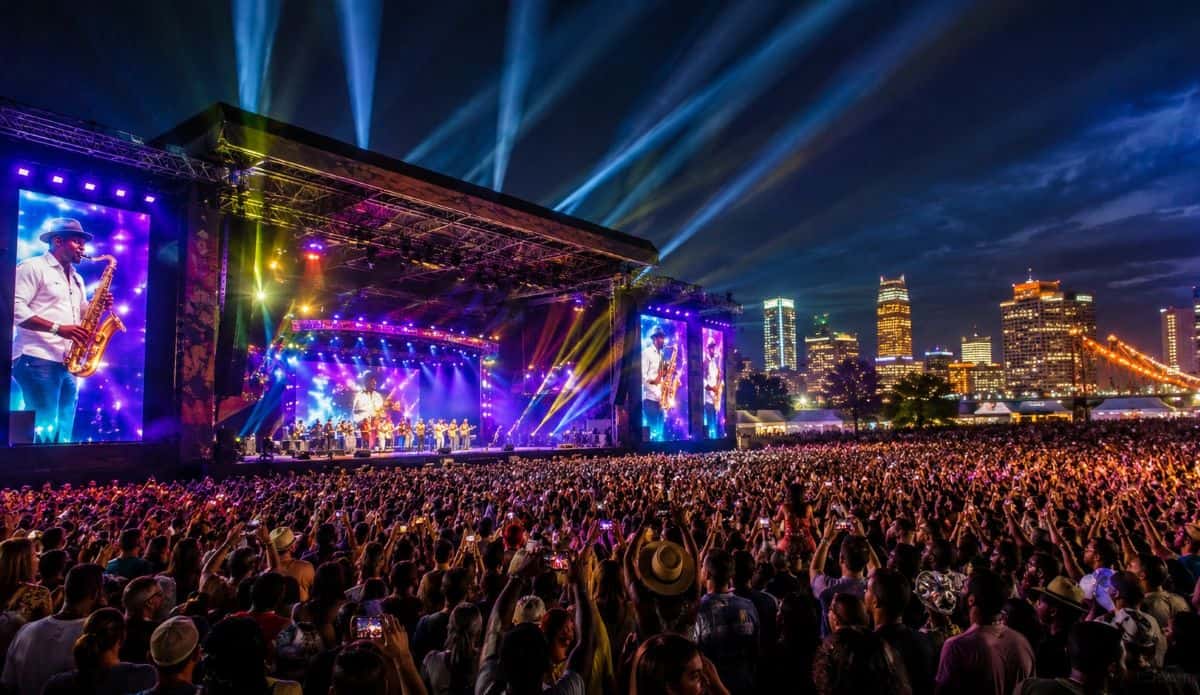
Image generated with Ai
The air changing during New Orleans autumns is almost palpable. After enduring hot summer days with no break, the evenings cool down into warm indigo tones, and are now even more energized with the anticipation of a thrilling night out. Though it was the fall of 2021, New Orleans was still beating with its own drum, just adjusting to the reduced threat of the music halls that usually light up the streets. With their passion and drive to fight for survival, New Orleans & Co would later be roused by the local venue owners who organized NOLAxNOLA. Bright as 1000 suns, NOLAxNOLA will take over every nook and cranny of the city from September 24 to October 4, 2026. It is the soul of Louisiana.
It is the jazz clubs of Tipitina’s, the echoing Preservation Hall bricks, and the sweaty street brass that fills the air throughout Frenchmen Street. NOLAxNOLA is a love letter to New Orleans culture aides and will keep the spirit of New Orleans alive. It is more than a performance as audience. It is being the heartbeat to keep New Orleans forever victorious.
Why Is NOLAxNOLA Reshaping Autumn Tourism Across New Orleans, Louisiana?
NOLAxNOLA stands as a revolutionary decentralized municipal music coalition that fundamentally transforms how visitors experience autumn travel across New Orleans, Louisiana. Conceived through a direct partnership between destination leaders at New Orleans & Company and independent venue operators, this showcase runs from September 24 to October 4, 2026. Rather than gathering crowds in a single fenced field, the festival activates 35 to 40 historic halls across iconic districts like the French Quarter, Tremé, Uptown, Marigny, Bywater, and Mid-City.
Advertisement
Advertisement
This innovative model preserves local heritage while channelling tourist spending straight into neighborhood ecosystems. Visitors wander between world-famous establishments like Tipitina’s, Preservation Hall, and The Maple Leaf Bar while absorbing authentic music. By shifting the focus away from traditional mega-festivals, New Orleans successfully elevates grassroots culture bearers and protects independent venues from economic pressures. The resulting surge in fall travel turns the shoulder season into a highly lucrative cultural pilgrimage for music lovers worldwide.
How Did A Crisis In Fall 2021 Create This Revolutionary Cultural Model In New Orleans, Louisiana?
The origin of NOLAxNOLA traces directly back to the public health challenges of Fall 2021, when sudden cancellations of major outdoor gatherings left local creators vulnerable. Facing the catastrophic loss of signature autumn events like Jazz Fest and Voodoo Fest, municipal organizers at New Orleans & Company joined forces with grassroots venue owners across New Orleans, Louisiana to prevent widespread financial ruin.
Rather than surrendering to economic hardship, this coalition created a decentralized framework that replaced single mega-stages with neighborhood-wide concert routes. By encouraging travelers to explore historic music corridors across the French Quarter and Tremé, the city established a resilient model that keeps independent music halls solvent while consistently revitalizing autumn hotel bookings.
Advertisement
Advertisement
How Does Decentralised Concert Programming Power High Visitor Arrivals In New Orleans, Louisiana?
Distributing live performances across dozens of historic neighborhood stages yields extraordinary economic advantages for local hospitality workers throughout New Orleans, Louisiana. Official tourism benchmarks indicate that the city welcomes between 17.94 Million and 19.46 Million visitors annually, translating to roughly 53,000 daily arrivals who contribute $9.0 Billion to $10.05 Billion to the regional economy.
During the September 24 to October 4 period, NOLAxNOLA elevates fall hotel occupancy to an impressive 65% to 72% average. This sustained visitor influx provides reliable revenue for 80,000 to 100,000 hospitality workers while ensuring ticket, food, and beverage spending directly enriches local venue operators and musical performers.
What Makes NOLAxNOLA Talks Vital For Music Preservation And Industry Policy In New Orleans, Louisiana?
Beyond evening concerts spanning jazz, brass, funk, blues, bounce, hip-hop, R&B, and indie rock, NOLAxNOLA hosts informative public forums known as NOLAxNOLA Talks. Hosted at the New Orleans Jazz Museum within New Orleans, Louisiana, these free daytime sessions gather artists, venue proprietors, and journalists to discuss pressing cultural issues.
Panelists address vital topics such as venue sustainability, creator rights, and local economic policy to safeguard the city’s artistic identity. By pairing live musical showcases with serious policy dialogue, New Orleans ensures that its expanding tourism sector actively funds and protects its legendary musical lineage.
How Does NOLAxNOLA Boost Occupancy and RevPAR Rates Across Downtown and Uptown New Orleans?
The strategic placement of NOLAxNOLA across late September and early October fundamentally shifts the financial performance of lodging assets across Orleans Parish. Historically, early September represents an off-peak period for the regional hospitality market, with baseline hotel occupancy hovering between 45% and 52%. By dispersing multi-day musical showcases across 35 to 40 independent venues, the initiative elevates autumn occupancy rates to a robust 65% to 72% across downtown, mid-city, and uptown corridors.
This occupancy growth directly drives key operational yield metrics for hoteliers, notably Average Daily Rate (ADR) and Revenue Per Available Room (RevPAR). During peak concert weekends, daily room rates across premium districts such as the French Quarter, the Arts/Warehouse District, and Uptown transition from average baseline rates of $160 per night to elevated figures ranging between $230 and $280 per night. Consequently, RevPAR benchmarks across participating accommodation providers experience direct growth increases of 25% to 35%, stabilizing property revenues while providing consistent employment during a shoulder season.
Can Decentralised Venue Concerts Solve the Musician Pay Disparity in Tremé and the Marigny?
Decentralized concert models offer a distinct financial architecture compared to centralized, field-based mega-festivals, directly benefiting local culture bearers in neighborhoods like Tremé and the Faubourg Marigny. Under standard corporate staging frameworks, local artists frequently receive flat-rate gig compensation ranging between $100 and $125 per player. NOLAxNOLA transforms this structure by routing performances directly through grassroots clubs, enabling musicians to participate in direct door-charge and ticket-share arrangements that yield average earnings of $350 to $600 or more per performance.
Beyond individual gig compensation, the decentralized framework guarantees local capital retention across the municipal economy. Traditional multi-stage festivals often result in significant capital extraction by out-of-state production firms and national ticket brokers. In contrast, the neighborhood venue model ensures that 85% to 90% of total ticket sales revenue remains inside local parish businesses. This direct cash injection protects independent music halls from commercial pressures while sustaining operational payroll for the region’s 80,000 to 100,000 hospitality and cultural workers.
How Does Spreading Concert Foot Traffic Prevent Bottlenecks Across Frenchmen Street and Magazine Street?
Pedestrian logistics and crowd distribution represent critical factors in maintaining urban livability during multi-day metropolitan events. By spreading concert programming across 35 to 40 licensed cultural venues rather than restricting access to a single enclosed venue grounds, NOLAxNOLA prevents severe foot-traffic bottlenecks along narrow commercial veins such as Frenchmen Street, Oak Street, and Magazine Street.
This spatial distribution generates a sustained pedestrian flow multiplier across surrounding commercial corridors. Economic analyses reveal a 1.69x local multiplier effect, meaning every $1.00 spent on venue admission generates an additional $0.69 in auxiliary spending at nearby neighborhood establishments. Small businesses operating within adjacent radii—including independent restaurants, late-night bars, and boutique retail shops along Oak Street, Frenchmen Street, and St. Claude Avenue report immediate food, beverage, and retail sales increases of 30% to 45% throughout the 11-day festival timeframe.
What Role Do NOLAxNOLA Talks Play in Protecting Grassroots Music Ecosystems in Mid-City New Orleans?
Beyond evening musical showcases, the inclusion of daytime educational programming provides a structural foundation for long-term cultural preservation. Hosted primarily at the New Orleans Jazz Museum in historic Mid-City, NOLAxNOLA Talks convenes community artists, venue proprietors, urban planners, and municipal policymakers. These free public forums host more than 10 dedicated panel sessions addressing night-time economy management, zoning protections, creator intellectual property rights, and specialized healthcare initiatives tailored for culture bearers.
The initiative directly addresses challenges recorded within the local Venue Sustainability Index. Municipal data demonstrates that while 83% of local musicians possess over a decade of professional industry experience, a substantial majority face severe cost burdens related to rising housing prices and operational overhead for performance spaces. By integrating policy discussions alongside live performance schedules, municipal destination leaders construct actionable policy pathways to protect grassroots venue infrastructure from commercial displacement.
How Does the New Orleans Office of Nighttime Economy Manage Infrastructure and Transportation Logistics?
Executing a multi-neighborhood showcase requires rigorous municipal coordination, overseen primarily by the New Orleans Office of Nighttime Economy in tandem with transit authorities and emergency services. Public transit agencies, including the Regional Transit Authority (RTA), implement strategic adjustments to streetcar and bus transit schedules. Frequency rates along major arteries like the St. Charles, Canal Street, and Rampart-St. Claude streetcar lines are increased to accommodate a steady influx of approximately 53,000 daily visitors moving between performance hubs.
In addition to transit management, municipal agencies implement targeted regulatory adjustments regarding noise ordinances, public safety patrols, and operational licensing. Special event permits extend standard operating hours for licensed music halls across the French Quarter and Marigny, allowing spaces to host live performances past standard midnight thresholds without incurring municipal code penalties. Sound mitigation protocols and dedicated rideshare loading zones are simultaneously deployed to minimize residential disruption while maintaining smooth traffic flow across dense urban zones.
How Does Live Music Drive Dining Expenditures in the French Quarter and Bywater Neighborhoods?
The intersection of late-night entertainment and culinary tourism creates a powerful economic engine for neighborhood dining establishments. Destination spending metrics indicate that visitors to New Orleans expend an average of $545 per day across lodging, dining, and live entertainment combined. During the 11-day NOLAxNOLA calendar, culinary and beverage outlays represent between 32% and 38% of total visitor outlays, underlining the role of food service in driving overall tourism revenues.
Because performances are hosted inside established commercial corridors, dining expenditures naturally align with concert schedules. Neighborhood eateries, bistros, and food trucks situated within a three-block radius of active venues in the French Quarter, Bywater, and Tremé experience late-night sales surges of 40% or more. This synchronized expenditure model ensures that the economic benefits of music tourism extend beyond performance stages into the broader food and beverage service economy.
Why Indoor Venue Coalitions Provide a Resilient Alternative to Outdoor Autumn Festivals in Louisiana?
Late September and early October fall within the peak window of the Gulf Coast hurricane season, presenting substantial climate and weather disruption risks for outdoor event organizers. In the regional event sector, approximately 41% of outdoor festival operators report experiencing significant weather delays, partial shutdowns, or complete event cancellations due to tropical storms and heavy rain events.
By utilizing an indoor venue coalition framework, NOLAxNOLA effectively neutralizes weather interruptions. Operating within permanent urban infrastructure drastically reduces capital risk by eliminating the need for temporary outdoor staging, temporary electrical grid installations, and field turf protection systems. Participating venues feature permanent structures, professional sound systems, and backup power capabilities, ensuring event continuity while insulating artists, venue operators, and travel planners from multi-million-dollar weather cancellation losses.
Can Walkable Neighborhood Corridors Support Low-Carbon Tourism Across Historic New Orleans Districts?
Decentralized urban festivals offer an inherently sustainable environmental footprint when compared to greenfield or suburban outdoor events that rely heavily on personal automobile transport. Historic New Orleans neighborhoods, such as the French Quarter and Faubourg Marigny, feature urban grid designs boasting high Walk Scores of 90 to 95 out of 100. These high-density, mixed-use corridors allow festival attendees to travel seamlessly between performance venues on foot, dramatically reducing urban carbon emissions.
During festival dates, active transit usage experiences significant expansion across all participating districts. Data indicates a 50% or greater increase in pedestrian corridor usage, streetcar ridership, and micro-mobility bike-share rentals connecting performance clusters. By leveraging existing municipal transit infrastructure and high-walkability urban planning, NOLAxNOLA demonstrates how decentralized cultural tourism can operate efficiently while lowering transit-related environmental impacts across historic urban spaces.
The Final Horizon
The spirit of NOLAxNOLA will keep enduring well after the last ride of the streetcars on Saint Charles Avenue. This is the opportunity to shield the legacy of New Orleans from further loss and erosion. It is preservation at its finest, and you have an opportunity to do your part. From September 24 until October 4, 2026, you have the opportunity to support the artists of New Orleans on the Triangle Music District. Think about buying your favorite artist a drink before the show. Consider the recovery of talented artists at your subscription (that’s right, a subscription). These artists are the heartbeat of the community and the most significant part of New Orleans’ cultural heritage. Your support may bring back the famous rocking Jazz Clarinet. The music of New Orleans will re-ignite your musical passion and spirit, and carry you back to your home to call the woodwind soul of the Continents.
Frequently Asked Questions
NOLAxNOLA runs from September 24 to October 4, 2026, across New Orleans, Louisiana.
Performances take place in 35 to 40 independent venues across the French Quarter, Uptown, Marigny/Bywater, Tremé, and Mid-City, including Tipitina’s, Preservation Hall, and The Maple Leaf Bar.
The festival drives fall tourism, raising hotel occupancy to 65%–72% while channelling ticket, food, and beverage spend directly to local venue owners, artists, and hospitality workers.
Advertisement
Tags: louisiana, music event, New Orleans, Travel News, United States
Advertisement
Advertisement











Tuesday, September 1, 2026

Tuesday, September 1, 2026

Tuesday, September 1, 2026

Tuesday, September 1, 2026
Tuesday, September 1, 2026

Tuesday, September 1, 2026

Tuesday, September 1, 2026

Tuesday, September 1, 2026