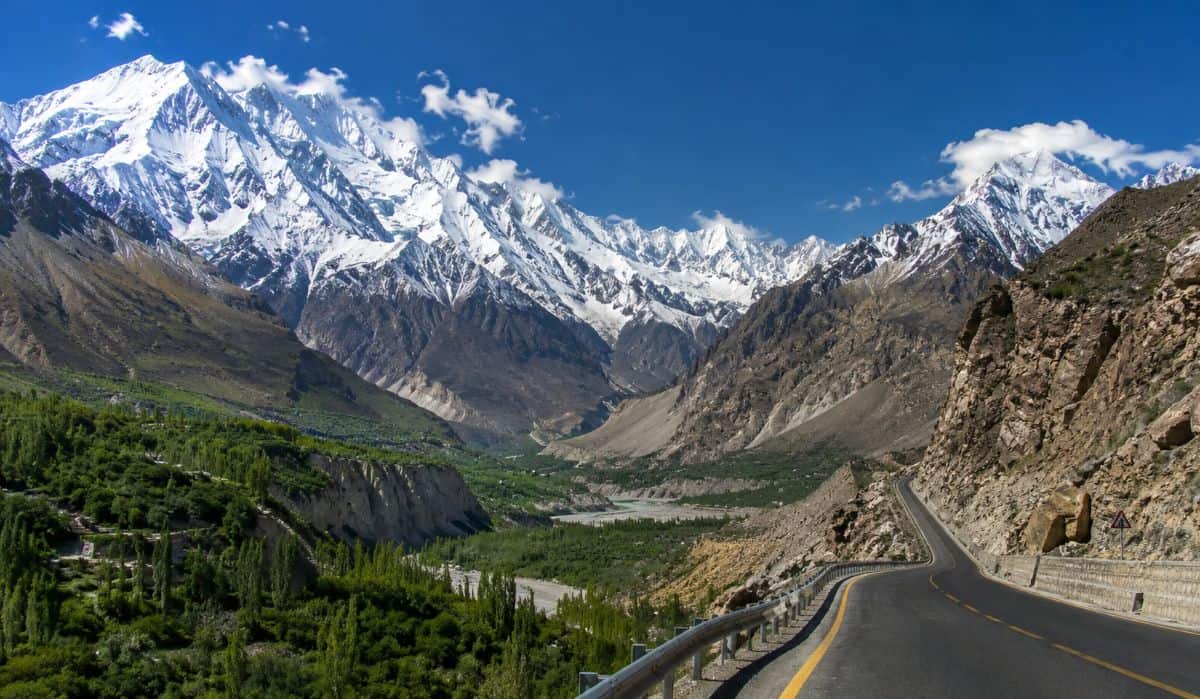
Image generated with Ai
Mornings on the Karakoram will always hold significance. The distractions you’ve brought with you will literally melt away. As much as Northern Pakistan attracts travelers, it also demands them. For more than half the year, 2,200 foreign travelers go to Gilgit-Baltistan and Kashmir to face and scale the omnipresent challenges of K2. Standing next to these, but no less legendary peaks, in the silence of Nanga Parbat are Broad Peak, Gasherbrum I, Gasherbrum II. Amidst the faster, but also busier, world travel and the expenses and bureaucracy of travel, these men and women have gone to take the mountain route. It is true that they are re-balancing the energy that the mountainside communities are longing for. Northern Pakistan is finally reaching over 10,000 foreign travelers for the first time in years. They aren’t just opening their borders, they are giving the chance to truly experience the wilderness.
Unprecedented Surge in International Mountaineering and High-Altitude Alpine Adventures
Advertisement
The high-altitude tourism sector in Gilgit-Baltistan experienced a remarkable revival between April and August, welcoming over 2,200 foreign mountaineers and trekkers. Consequently, these intrepid global travelers journeyed to northern Pakistan to conquer some of the planet’s highest and most hazardous mountains, including K2, Nanga Parbat, Broad Peak, Gasherbrum-I, and Gasherbrum-II. This impressive arrival rate demonstrates how international adventure enthusiasts are increasingly drawn to extreme alpine destinations. Furthermore, this trend persists despite ongoing regional geopolitical uncertainties, fluctuating fuel costs, global travel advisories, and bureaucratic delays in permit processing. Official projections indicate that overall foreign tourist arrivals across both open and restricted areas in Gilgit-Baltistan will surpass 10,000 visitors by the end of the year, representing a substantial year-over-year increase.
Therefore, this influx of global travelers is fundamentally altering international tourism trends and operational dynamics for extreme expedition operators worldwide. As demand for raw, uncrowded, and challenging destinations grows, alpine enthusiasts are shifting their focus toward northern Pakistan. This proves that high-altitude travel remains resilient even amidst broader geopolitical volatility. Furthermore, tourism authorities expect more than 4,000 foreign climbers and trekkers to visit the territory next year, driven by efforts to streamline complex permit procedures and modernize regional administrative processes. While the primary mountaineering season officially drew to a close at the end of summer, high-altitude trekking activities particularly along the world-famous K2 Base Camp trek route are expected to persist straight through October.
Advertisement
Advertisement
Substantial Local Economic Resurgence and Broader Financial Footprint Across the Region
The economic ripple effects of this foreign tourism surge extend far beyond the initial administrative procedures, providing vital financial sustenance to communities throughout Gilgit-Baltistan. Official revenue data revealed that climbing and trekking permit fees generated approximately PKR 350 million (representing roughly $1.2 million) for the regional government by the end of June. Beyond these direct state permit collections, foreign visitors injected critical liquidity directly into the grassroots mountain economy, directly sustaining local porters, hotels, transport providers, shopkeepers, and various small support businesses. This financial influx highlights how niche, high-value adventure tourism can effectively serve as a primary catalyst for regional economic development and community stability.
Looking at the broader international picture, this financial direct-injection model offers a sustainable blueprint for remote mountain regions globally. Travelers who engage in high-altitude expeditions generally spend significantly more money per trip than average leisure tourists, supporting extended supply chains and specialized local workers over long durations. Consequently, the rising popularity of peaks such as K2 and Nanga Parbat demonstrates that global travelers are willing to invest heavily in authentic, remote experiences, ultimately influencing how adventure itineraries are structured and priced across the global travel industry.
Transformative Global Effects on Travelers and Future Industry Dynamics Worldwide
From a worldwide perspective, the ongoing boom in northern Pakistan reflects a profound shift in global traveler behavior and long-haul expedition logistics. Modern international tourists are increasingly seeking out off-the-beaten-path journeys, actively accepting logistical challenges in exchange for unique, untouched natural landscapes. As global travel itineraries expand into previously isolated territories, safety protocols, international flight connectivity, and multi-country trip planning are adapting to accommodate high-altitude destinations. The steady rise in international arrivals proves that dedicated global adventurers will navigate complex travel advisories and rising transport expenses to achieve their bucket-list alpine goals.
Additionally, this sustained growth forces global travel providers, gear suppliers, and international insurance agencies to tailor their offerings specifically for long-duration, high-risk treks in Gilgit-Baltistan. As high-altitude trekking along routes like K2 Base Camp continues through October, the overall travel calendar is stretching longer into the autumn months. Ultimately, the expanding footprint of high-altitude adventure tourism in northern Pakistan highlights a growing, global demand for immersive wilderness exploration that directly transforms both local livelihoods and international travel markets.
Comprehensive Operational Analysis of High-Altitude Alpine Tourism Infrastructure and Economic Dynamics Across Northern Pakistan
The high-altitude landscape of Gilgit-Baltistan stands as an extraordinary geographical sanctuary, hosting five of the world’s fourteen legendary eight-thousand-meter summits. High-altitude expeditions converge on K2, which towers at 8,611 meters (28,251 feet), alongside Nanga Parbat at 8,126 meters (26,660 feet), Gasherbrum-I at 8,080 meters (26,509 feet), Broad Peak at 8,051 meters (26,414 feet), and Gasherbrum-II at 8,034 meters (26,358 feet). Each formidable peak presents distinct physical hazards and technical difficulties. For instance, K2 demands supreme technical proficiency due to dangerous choke points like the Bottleneck and the notorious Abruzzi Spur. Meanwhile, Nanga Parbat features the colossal Rupal Face, a vertical wall rising over 4,600 meters from base to summit, establishing it as the sheerest mountain precipice on Earth.
These severe topographic profiles dictate global expedition logistics and commercial pricing models throughout the adventure travel sector. Because conquering these giant mountains involves exceptional operational hazards, fully guided commercial logistics for K2 command premium rates ranging from $30,000 to $60,000 per climber. Conversely, lower seven-thousand-meter peaks attract budget-conscious alpine teams seeking technical challenges without astronomical outlays. By understanding these elevation tiers, global tour operators can structure tiered expedition packages that cater to elite mountaineers and intermediate alpine trekkers alike, expanding northern Pakistan’s international market reach.
Tiered Seasonal Permit Regulations and Financial Eco-Tax Deposit Structures
Administrative governing bodies in Gilgit-Baltistan enforce structured, seasonal permit fee systems to manage international climber volumes effectively. During the peak summer window running from April through September, standard permit fees for K2 are set at $5,000 per foreign climber. To encourage off-peak visitation, these charges decrease sharply to $2,500 in the autumn season and drop further to $1,500 during winter. Similarly, foreign trekking permits for restricted border corridors are fixed at $300 per person in summer, $200 in autumn, and $100 during winter. Additionally, authorities impose a mandatory $500 eco-tax deposit per expedition group, which is refunded only after teams present documented verification of complete waste removal from high-camp routes.
This strategic price differentiation plays a crucial role in regulating environmental pressure across fragile alpine zones. Lower off-season rates incentivize commercial outfits to schedule expeditions outside congested summer months, effectively spreading environmental footprints and search-and-rescue resources across a multi-season timeline. Furthermore, the enforced eco-tax system penalizes abandoned oxygen canisters and discarded gear along high routes, establishing a self-sustaining financial mechanism that protects pristine environments while setting a clear benchmark for sustainable alpine management.
Extended Autumn Operational Calendars Across Key Karakoram Trekking Corridors
While peak summit attempts generally conclude by late August, high-altitude trekking along the iconic K2 Base Camp route remains highly active straight into October. Navigating through key geological landmarks such as the Baltoro Glacier and the panoramic amphitheater of Concordia, autumn trekking stretches the historical three-month summer sprint into a robust 180-day operational calendar. This expanded operational timeframe fundamental transforms the regional hospitality and logistics ecosystem.
Extending the active trekking calendar ensures sustained financial viability for regional transport providers, gear rental outfits, and guesthouse establishments across northern Pakistan. Continuous autumn operations mitigate extreme seasonal unemployment, granting skilled mountain guides and support crews reliable, long-term employment. For global adventure agencies, this extended window translates into reliable late-season itineraries that satisfy the expanding worldwide demand for wilderness exploration without compounding peak-season overcrowding.
Grassroots Micro-Economic Revenue Distribution and Local Workforce Compensation Metrics
The economic impact of high-altitude international tourism extends deep into the rural valleys of Gilgit-Baltistan, generating direct household revenue far beyond initial administrative state fees. While direct climbing and trekking permits generated approximately PKR 350 million (roughly $1.2 million) for government coffers by the end of June, foreign expeditions also employed over 5,000 local porters, high-altitude cooks, and specialized liaison officers. Daily wages for local porters average between $25 and $35 per day, supplemented by mandatory cold-weather gear stipends and daily food allowances mandated by regional regulations.
This decentralized financial distribution model serves as the primary economic engine for remote mountain communities in Skardu, Shigar, Hunza, and Diamer. A single summit expedition frequently mandates between 50 and 100 porters to haul equipment across the Baltoro Glacier, directly injecting crucial capital into local village economies. This high-value, niche tourism model proves that regulated mountain travel can lift remote populations by converting international adventure interest into localized financial resilience.
High-Altitude Emergency Protocols, Search-and-Rescue Logistics, and Risk Mitigation Standards
Operating above seven thousand meters in sub-zero alpine conditions necessitates stringent emergency protocols and sophisticated safety infrastructure. Authorities require all foreign expedition members to secure comprehensive insurance coverage that explicitly includes emergency high-altitude helicopter evacuations up to $50,000 to $70,000. Complex search-and-rescue missions are coordinated through specialized military rotorcraft squadrons stationed at strategic airbases in Skardu and Gilgit, ensuring rapid response capabilities across remote mountain ranges.
Standardizing mandatory rescue insurance provides essential risk protection for international trip operators, underwriters, and travelers. Streamlined medical evacuation logistics safeguard human lives during severe altitude sickness or unpredictable avalanches, while simultaneously insulating commercial travel providers against catastrophic liability costs. This institutionalized safety umbrella enhances international confidence, positioning northern Pakistan as a mature, professionally managed destination for high-risk adventure travel.
Administrative Modernization and Digital Visa Clearance Initiatives
Historically, complex paper-based permit procedures and administrative delays presented significant barriers for international expeditions planning trips to Gilgit-Baltistan. In response, authorities implemented streamlined digital visa portals and online clearance channels. Processing times for non-restricted zone entry visas have dropped to under 48 to 72 hours, while target administrative clearances for restricted alpine zones now aim for completion in less than 14 business days, dramatically improving upon historic 60-day processing delays.
This digital administrative shift removes substantial operational friction for worldwide travel organizers. International outfitters can now finalize complex multi-country logistics, flight bookings, and client reservations months in advance with high operational certainty. By eliminating bureaucratic bottlenecks, the region effectively positions itself as a highly accessible, transparent alternative to increasingly over-regulated alpine destinations worldwide.
Environmental Sustainability Regulations and High-Altitude Glacier Conservation Mandates
To preserve fragile high-altitude ecosystems, regulatory frameworks cap expedition sizes at a maximum of 20 members per permit. Authorities strictly enforce waste accounting systems along heavily traveled routes like the Abruzzi Spur and Concordia, requiring meticulous tracking of human waste, used fuel canisters, and oxygen equipment. These mandates focus on protecting delicate ecological zones, including the Baltoro Glacier, which spans over 63 kilometers (39 miles) as one of the world’s longest non-polar glaciers.
Strict environmental governance prevents ecological degradation caused by over-tourism, maintaining the pristine natural beauty that draws global travelers. Enforcing rigorous environmental accountability protects local water catchments and alpine flora, safeguarding the region’s long-term commercial viability. International eco-adventure agencies can comfortably market these destinations to environmentally conscious clients, knowing that strict conservation protocols are actively enforced.
Long-Term Market Projections and Infrastructure Investment Horizons Through 2026
The long-term economic outlook for northern Pakistan’s high-altitude travel sector points toward sustained, robust growth. Total foreign visitor arrivals across both open and restricted territories in Gilgit-Baltistan are projected to exceed 10,000 total visitors by the end of the current year. Furthermore, foreign mountaineers and high-altitude trekkers alone are forecasted to expand from over 2,200 foreign adventurers this past season to more than 4,000 foreign climbers and trekkers next year.
This rapid visitor growth necessitates matching investments in regional transportation and hospitality infrastructure. Upgrading air transit capabilities at Skardu International Airport, expanding hotel bed capacity, enhancing regional mobile connectivity, and maintaining critical transport arteries like the Karakoram Highway are vital steps. Meeting these infrastructure demands ensures that Gilgit-Baltistan solidifies its status as a top-tier global hub for international adventure tourism.
The Final Verdict
When all of the expeditions have cleared the campsite with the last of the winter dusting having settled, Gilgit-Baltistan adds something more meaningful than just a tangible return from permits and numbers recorded from tourism. It is recorded in cups of sweet tea and giggles from tents, in the pride of the local porters for guiding adventurers through perilous terrain and the connection each traveler forms with the ancient and mighty mountains. While the Baltoro Glacier freezes over, the warmth of this country remains etched on the adventurers who traversed these paths.
As Pakistan’s northern frontier looks to an even more promising future this season, the increase in high altitude adventures is so much more than just stats or peaks that have finally been tamed. It illustrates a confidence, an unbreakable spirit that inspires us to appreciate the great beauty of this world, and connect us to distant places of this world as we are undauntedly driven to travel.
Advertisement
Advertisement
Advertisement











Tuesday, September 1, 2026
Tuesday, September 1, 2026

Tuesday, September 1, 2026
Tuesday, September 1, 2026
Tuesday, September 1, 2026

Tuesday, September 1, 2026

Tuesday, September 1, 2026

Tuesday, September 1, 2026



