
World Cup Travel Boom Fades as International Visitor Spending Slips in US

Published
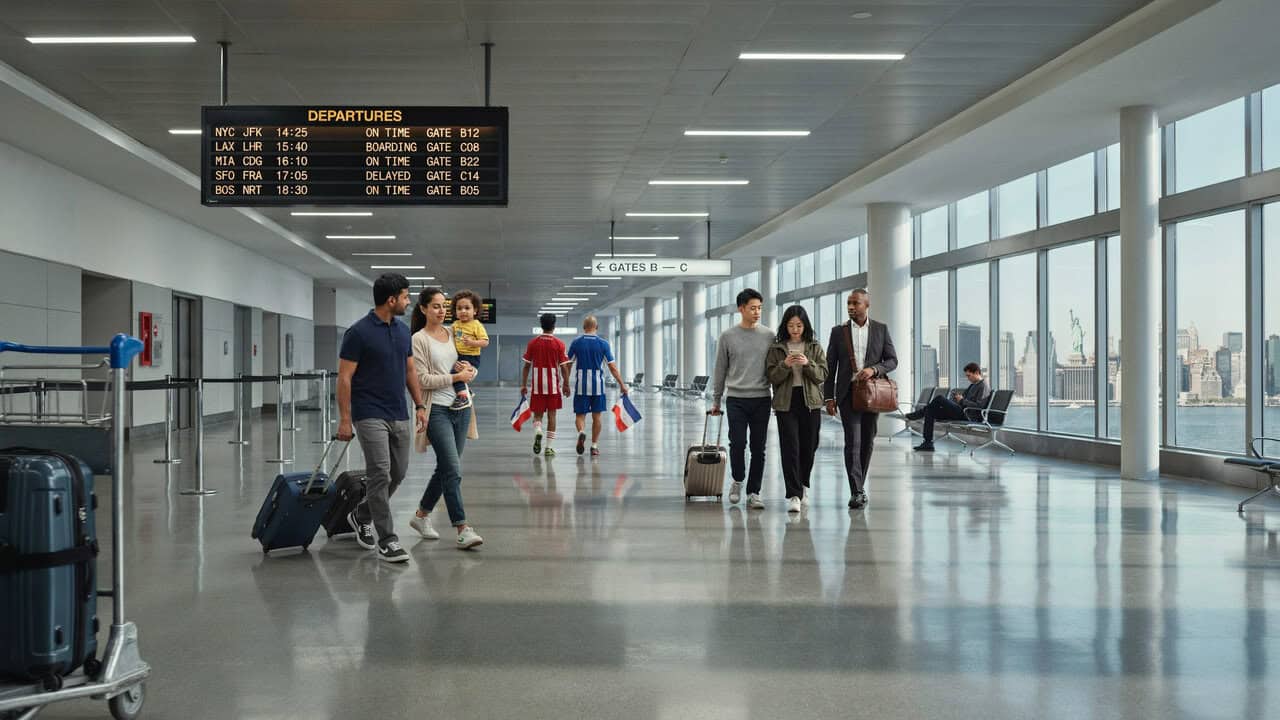
For travelers arriving in the United States, the summer of 2026 offered an unusually exciting reason to cross the Atlantic, Pacific or the northern and southern borders. The FIFA World Cup turned cities across the country into international meeting points, filling stadiums, hotels, restaurants and tourist attractions. But as the football crowds began heading home, the latest U.S. government figures showed that the wider international tourism recovery was struggling to maintain that momentum.
International visitor spending retreats in July
International visitors spent approximately $20.4 billion in the United States in July 2026, according to the National Travel and Tourism Office (NTTO), part of the U.S. Department of Commerce.
The figure represented a decline of about 1% compared with July 2025, following a stronger June when international travel and tourism spending exceeded $21 billion. The July performance therefore offers an early indication that the extraordinary demand created by the World Cup did not automatically translate into a sustained increase in international tourism.
The NTTO’s travel receipts data measures spending by international visitors on travel and tourism-related goods and services in the country, making it an important indicator of the economic contribution generated by overseas travelers.
Advertisement
Advertisement
World Cup creates an extraordinary travel surge
The decline comes shortly after one of the biggest sporting events ever staged in North America.
The 2026 FIFA World Cup began on June 11 and concluded on July 19, with matches held across the United States, Canada and Mexico. FIFA reported that 6,810,966 fans attended the tournament’s 104 matches, setting an all-time World Cup attendance record. U.S. venues alone welcomed millions of spectators across 11 host cities.
Advertisement
Advertisement
For the U.S. travel industry, the tournament represented far more than ticket sales. International fans needed flights, hotels, restaurants, local transportation and entertainment, while many visitors were expected to extend their trips to explore other American destinations.
Research from the U.S. Travel Association had found that international World Cup visitors expected to spend more than $5,000 per person, considerably more than visitors on typical international trips to the country. More than 80% of prospective visitors also indicated that they were open to traveling beyond the major gateway cities.
Advertisement
Advertisement
Overseas arrivals remain under pressure
The latest travel data suggests that the World Cup’s influence was powerful but temporary.
U.S. Travel Association data shows that overseas arrivals in July were 7% below July 2025, while year-to-date overseas arrivals were down 4.7%. Overall air passenger volume also weakened during the month.
That is particularly important for the tourism sector because visitor numbers ultimately determine how much demand reaches hotels, attractions, restaurants, retailers and local transportation providers.
The weakness is not uniform across every international market, however. Some destinations continue to perform strongly. U.S. Travel Association data showed that arrivals from India were running at 132% of 2019 levels, while Mexico and Colombia were also above their pre-pandemic benchmarks.
Advertisement
Advertisement
Domestic travelers are helping fill the gap
One of the more interesting developments in the latest numbers is that the U.S. travel industry itself is not experiencing an across-the-board slowdown.
Total U.S. travel spending reached $122.8 billion in July, up 5.8% from the same month a year earlier, according to the U.S. Travel Association. Hotel room demand increased 2.8%, while revenue per available room rose 8.2%.
The contrast suggests that domestic travelers are helping compensate for weaker international demand.
For hotels and destinations, that distinction matters. A busy hotel does not necessarily mean international tourism is healthy. A significant portion of the current demand may be coming from Americans traveling within their own country.
U.S. tourism recovery still has hurdles
The latest figures also highlight the challenge facing the U.S. beyond the World Cup.
The Department of Commerce’s official forecast expects international visitation to increase from 68.3 million visitors in 2025 to 70.5 million in 2026, with arrivals projected to reach 85.2 million by 2030.
Advertisement
Advertisement
That longer-term outlook remains positive, but the recovery is expected to take time.
The U.S. Travel Association has identified several factors that could affect international demand, including visa wait times, inflation, energy prices, geopolitical uncertainty and perceptions of the United States among potential visitors.
These issues become particularly important when travelers have numerous competing destinations to choose from.
What the post-World Cup period means for travelers
The end of the World Cup does not mean the United States is losing its appeal as a holiday destination. Instead, the latest figures show that the country cannot depend on major global events alone to maintain international tourism growth.
The tournament demonstrated how quickly international demand can surge when travelers have a compelling reason to visit. The next challenge is converting that temporary attention into ordinary vacations, longer stays and repeat visits.
For travelers, that means the U.S. remains a major destination with strong demand across cities, national attractions and entertainment hubs—but the post-World Cup period will provide a much clearer picture of whether international tourism can regain steady momentum without another global sporting spectacle.
And perhaps that is the real lesson from the summer: millions came to America for football, but the bigger test for U.S. tourism begins now, when travelers have to choose the country simply because they want to visit it.
Advertisement
