
Massachusetts Emerges As Autumn Tourism Hub As The Big E Attracts Millions Across New England in 2026

Published
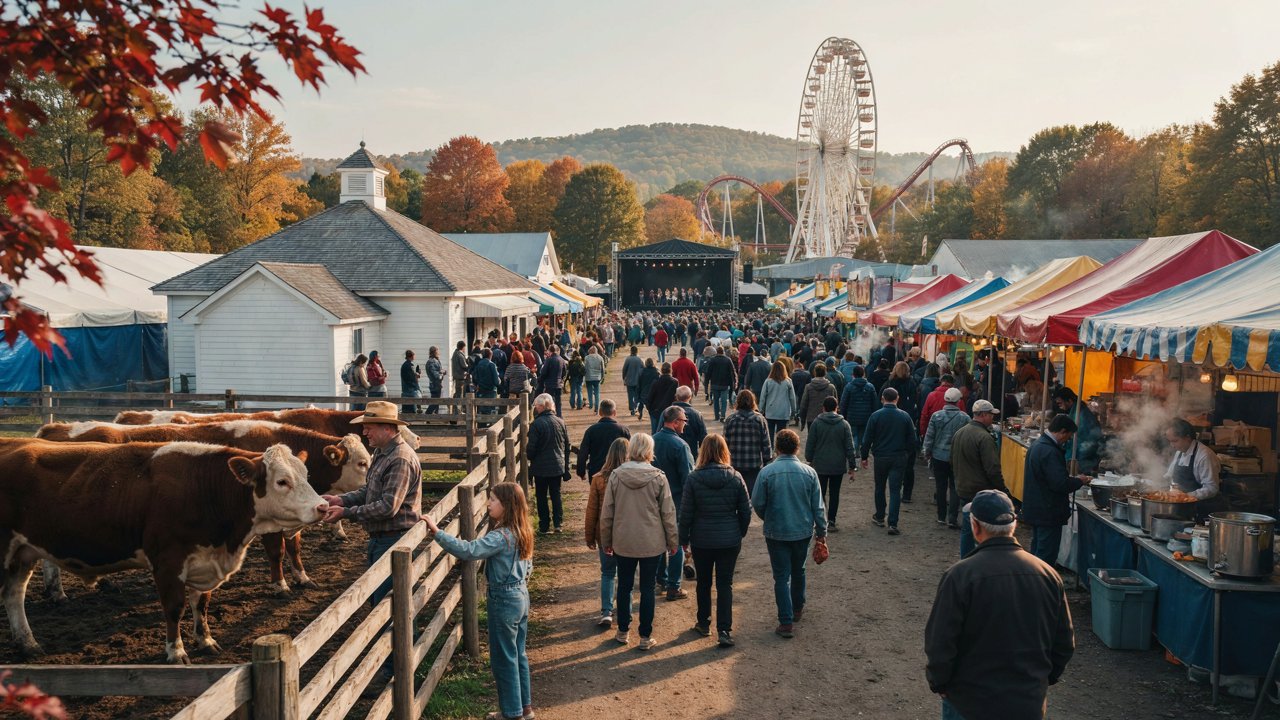
Image generated with Ai
Grounds crews, agricultural exhibitors, and concessionaires across the 175-acre Eastern States Exposition campus are operating at peak capacity this week as The Big E navigates the climactic stretch of its 17-day 2026 run, scheduled from September 18 through October 4. Recognized as the largest agricultural event on the Eastern Seaboard and the fourth-largest fair in North America, the multi-state exposition brings together more than 1.5 million visitors annually to Western Massachusetts’ Pioneer Valley.
Conceived in 1916 by visionary agricultural leader Joshua L. Brooks to revitalize northeastern farming practices, the event has expanded into a multi-sector economic powerhouse. The modern exposition combines cutting-edge livestock genetics competitions, multi-genre arena concerts, craft beverage showcases, and a cultural marketplace that unifies all six New England state economies onto a single fairground.
Advertisement
Advertisement
Location, Campus Staging, and Participating Stakeholders
The exposition unfolds across the Eastern States Exposition grounds located at 1305 Memorial Avenue in West Springfield, Massachusetts, directly along the banks of the Westfield River.
Unlike traditional single-state agricultural fairs, The Big E operates an interstate cooperative showcase:
Advertisement
Advertisement
- The Avenue of States: The centerpiece of the fairgrounds, where all six New England states—Connecticut, Maine, Massachusetts, New Hampshire, Rhode Island, and Vermont—own and maintain permanent, full-scale replicas of their original state capitols or historic landmarks. Inside, each sovereign state operates dedicated cultural pavilions showcasing regional commerce, from Maine baked potatoes and Vermont maple syrup to Rhode Island clam chowder and New Hampshire craft ciders.
- Agricultural and Livestock Units: Over 25 breeds of dairy and beef cattle, sheep, swine, and draft horses compete in the Mallary Agricultural Complex, drawing breeders and exhibitors from 26 states and Canadian provinces.
- Civic, Educational, and Youth Leadership: National 4-H programs, Future Farmers of America (FFA) chapters, and collegiate agricultural programs stage extensive youth development demonstrations.
- Commercial Vendors and Entertainment: The fair features over 500 commercial exhibitors across the Better Living Center, the open-air Midway operated by North American Midway Entertainment, the 7,000-capacity Big E Arena, and historical craft demonstrations in the Storrowton Village Museum.
Audited Five-Year Attendance Trajectory (2021–2025)
The Big E has demonstrated consistent post-pandemic foot-traffic expansion, driven by upgraded public transport partnerships like the Pioneer Valley Transit Authority (PVTA) “Big E Express” shuttles and fine-tuned ticketing strategies.
| Year | Edition | Total Fair Attendance | Peak Single-Day Attendance | Audited Catalysts & Operational Dynamics |
| 2021 | 104th | 1,498,774 | 177,238 (Sat, Oct. 2) | Full return of physical gates following 2020 disruption; high regional demand. |
| 2022 | 105th | 1,603,354 | 177,789 (Sat, Sept. 24) | Expansion of artisanal specialty food corridors; ideal early-autumn weather. |
| 2023 | 106th | 1,427,234 | ~145,000 | Multiple severe rainstorms across key peak weekends softened gross gate entries. |
| 2024 | 107th | 1,633,935 | 178,608 (Sat, Sept. 21) | All-time historical attendance record; Carnival Warehouse ranked 4th in North America. |
| 2025 | 108th | 1,538,463 | ~171,000 | Third-largest edition in history; verified entries across all 50 U.S. states and overseas hubs. |
Official data benchmarked against Eastern States Exposition audited gate filings, regional transit logs, and Carnival Warehouse industry evaluations.
Advertisement
Advertisement
Global Equivalents: Do Other Countries Host This Event?
The Eastern States Exposition itself is singular to West Springfield, Massachusetts; no duplicate “Big E” or affiliated franchise operates abroad. However, several sovereign nations stage culturally and structurally equivalent multi-provincial agricultural and commercial expositions:
- Canada (The Royal Agricultural Winter Fair, Toronto): The world’s largest combined indoor agricultural fair and international equestrian competition, bringing together livestock breeders and artisanal food producers from across Canadian provinces and international agricultural networks.
- France (Salon International de l’Agriculture, Paris): Europe’s flagship multi-regional agricultural gathering, where all French regions and overseas territories showcase artisanal gastronomy, heritage livestock breeds, and national agricultural policy.
- United Kingdom (The Royal Welsh Show & Royal Highland Show): Elite four-day agricultural celebrations in Wales and Scotland featuring competitive livestock judging, forestry showcases, rural business trade, and regional culinary pavilions.
- Australia (Sydney Royal Easter Show, New South Wales): Australia’s premier agricultural celebration, blending rural livestock contests, forestry, crop showcases, and grand midway entertainment over a two-week run.
Inbound Travel Feeder Corridors: Which Regions Visit Most?
Mobility analytics and gate origin tracking conducted by regional tourism authorities illustrate distinct feeder pipelines:
Advertisement
Advertisement
- The New England Regional Core (Mass., Conn., R.I.): Generating over 70% of total fairgoers, these visitors arrive primarily via the Interstate 91 and Interstate 90 (Mass Pike) intersection, with Connecticut and Massachusetts residents dominating weekday and weekend day-tripper volume.
- Northern New England & Mid-Atlantic Corridors: Travelers from New Hampshire, Vermont, Maine, and New York commute 2 to 4 hours, heavily driving three-day weekend travel and group coach tour packages.
- Cross-Border and International Arrivals: Inbound international tourism is dominated by Canada (specifically the neighboring provinces of Quebec and Ontario), followed by visitors from the United Kingdom, Ireland, and Mexico drawn to New England’s early-autumn foliage corridor.
Macro-Economic Impact and Primary Beneficiary
The United States—and specifically the Commonwealth of Massachusetts, Hampden County, and the Pioneer Valley—stands as the primary beneficiary of the exposition’s financial footprint:
- Direct Regional Economic Output: Independent municipal impact studies indicate that the Eastern States Exposition generates nearly $1.2 billion in annual economic activity across its calendar, with the 17-day Big E fair serving as the central engine generating over $700 million in direct and indirect consumer transactions.
- Hospitality and Accommodations: Hotel occupancy in Springfield, West Springfield, Holyoke, and Windsor Locks (Conn.) regularly hits 92% to 96% throughout late September, elevating regional Average Daily Rates (ADR) and yielding substantial state meals and room-occupancy tax revenue.
- Interstate Small-Business Trade: For hundreds of artisanal food producers, dairy farms, maple sugarmakers, and rural craftsmen participating in the Avenue of States, the 17-day fair accounts for 25% to 40% of their total annual retail sales, directly redistributing metropolitan urban discretionary spending back into rural agricultural communities across Northern and Southern New England.
Advertisement
