
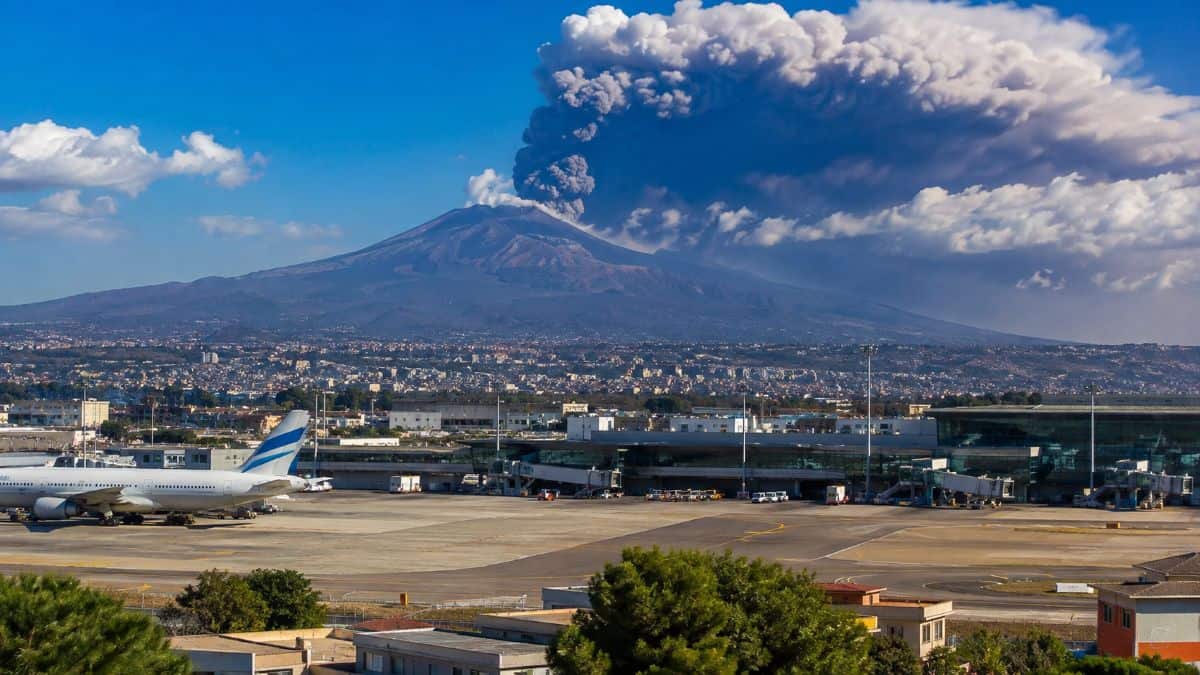
Image generated with Ai
Enormous disruptions are expected this summer in summer travel to Sicily due to the disruptions caused to the activities of Catania Fontanarossa Airport by Mount Etna. Travelers arriving to or departing from Eastern Sicily have had their travel plans disrupted by cancellations and diversions. Recent eruptions by Etna have caused public authorities to stop flights at the Airport and continue to extend these stop orders. One stop order extended flights to and from Catania to be grounded until 2:00 PM GMT on Thursday 13 August.
This disruption occurs during a very busy travel time on the European Travel Calendar. During this time, travelers passing through Catania en route to destinations such as Taormina, Syracuse, Mount Etna, and the Eastern Coastline of Sicily are significantly impacted. Approximately 700 flights have been canceled or disrupted as alternative airports have been forced to absorb the flights due to the stop order. As a result, Palermo has been significantly impacted.
Volcanic ash presents a particular challenge for commercial aviation because it can damage aircraft engines and reduce visibility around airports. As a result, aviation authorities cannot treat an eruption simply as a conventional weather disruption.
Mount Etna’s continuing activity has produced ash emissions capable of affecting airspace around Catania. Reuters reported that the aviation alert associated with the eruption had reached the highest level during an earlier phase of the current episode, while Italian authorities continued monitoring volcanic and atmospheric conditions.
Advertisement
The airport’s proximity to Etna makes Catania particularly sensitive to changes in wind direction and ash concentration. Even when eruptive activity decreases, accumulated ash and airborne particles can continue to affect runway and airspace safety.
This explains why airport reopening decisions can change quickly. A previously announced reopening time is not necessarily a guarantee that flights will operate normally.
| Travel factor | Current situation |
|---|---|
| Main airport affected | Catania Fontanarossa Airport |
| Primary cause | Volcanic ash associated with Mount Etna |
| Latest reported suspension | Operations extended until at least Thursday afternoon |
| Summer impact | Major disruption during Sicily’s peak holiday season |
| Flights affected | More than 700 cancellations or disruptions reported |
| Alternative airport pressure | Palermo and other Sicilian airports handling diverted traffic |
| Traveller priority | Confirm flight status directly with the airline before travelling |
The airport operator has repeatedly advised passengers to check their flight information before travelling to the terminal, reflecting the rapidly changing operational conditions.
The disruption at Catania is not confined to one airport. Diversions have transferred pressure to other parts of Sicily’s aviation and ground-transport network.
Palermo Airport has reportedly handled around 190 diverted flights during the disruption, while Comiso has also played a role in maintaining connectivity. The sudden movement of passengers towards alternative gateways has increased demand for buses, trains, taxis and accommodation.
For international visitors, an alternative airport can therefore solve only part of the problem. A passenger originally booked to Catania may still have to travel considerable distances by road or rail to reach an accommodation base in eastern Sicily.
The situation demonstrates the importance of viewing Sicily as a connected destination rather than treating each airport independently. When volcanic activity affects Catania, the availability of alternative transport becomes just as important as flight capacity.
August is traditionally an exceptionally busy month for Mediterranean tourism, with European travellers, international visitors and Italian holidaymakers moving through Sicily at high volumes.
The timing of the Etna disruption therefore magnifies its effects. Flights are operating with limited flexibility, while available seats on alternative services can disappear quickly. Travellers may also encounter higher demand for rental cars, trains, coaches and hotel rooms when itineraries suddenly change.
The eruption has also affected aviation beyond Sicily. Ash drifting southwards reached Malta, where 19 flights were cancelled and additional services experienced delays during the peak tourism period.
For tourism businesses, the consequences can extend beyond aviation. Hotels, restaurants, attractions, transfer companies and tour operators can all be affected when guests arrive late, miss connections or postpone journeys.
Travellers with flights to or from Catania should verify their individual flight status with their airline before leaving for the airport. Airport conditions can change after a flight has been scheduled, particularly when volcanic ash remains present in the surrounding airspace.
Passengers whose services are cancelled or diverted should first establish whether the airline has arranged alternative transportation or a new routing. Travelling independently to another airport without checking the airline’s instructions can create additional complications.
Where a journey is moved to Palermo or another Sicilian airport, travellers should also consider the onward distance to their destination. Ground transport availability may become constrained when hundreds of passengers are redirected simultaneously.
Official airport updates and airline communications should remain the primary sources for operational decisions. The Catania airport’s own news service has previously instructed passengers affected by Etna-related disruptions to check their airline before travelling.
The latest disruption highlights a long-standing reality of tourism around Mount Etna. The volcano is one of Sicily’s most recognisable attractions and contributes strongly to the island’s appeal, but its active geological character also creates an unavoidable operational risk for nearby infrastructure.
Italian scientific authorities, including the Istituto Nazionale di Geofisica e Vulcanologia, continuously monitor Etna’s volcanic behaviour and provide information relevant to aviation safety. Historical monitoring systems have also been developed specifically to track volcanic ash because of its potential impact on airports and surrounding communities.
For Sicily’s tourism industry, the priority is therefore balancing access with safety. Airport closures may cause substantial inconvenience, but restrictions are designed to prevent aircraft from operating in potentially hazardous ash conditions.
The immediate effect is a difficult travel situation during peak travel time for travelers whose itineraries depend on Catania Airport. That said, Sicily retains its overall travel appeal.
The island has a variety of road, rail, maritime, and airport travel routes with a range of travel options to accommodate travelers. However, this situation shows that the other travel alternatives can quickly become challenged if capacity in the aviation sector is removed.
Travelers need to be flexible. Visitors traveling to eastern Sicily should plan for longer transits to the airport and allow more time for unexpected travel delays. Travelers should also be responsive to travel advisories as they cannot expect that flights will resume on the previously announced reopening dates.
While travel advisories are issued for the changing volcanic activity of Mt. Etna, travel plans to Sicily need to be flexible with the changing situation for travel to Catania. It is better for travelers to plan with the latest travel information than to wait for a predicted arrival date.
1. Why is Catania Airport closed?
Catania Airport has been affected by volcanic ash from renewed activity at Mount Etna, creating aviation safety concerns and forcing flight suspensions.
2. Are flights to Catania operating normally?
Operations remain subject to changing volcanic and airspace conditions. Travellers should confirm their individual flight status directly with their airline.
3. How many flights have been affected?
More than 700 flights have reportedly been cancelled or disrupted during the latest period of Etna-related aviation problems.
4. Which airports are handling diverted flights?
Palermo has handled a substantial number of diverted flights, while Comiso has also supported alternative operations.
5. Is Palermo Airport a practical alternative to Catania?
It can be, but travellers should consider the additional road or rail journey required to reach eastern Sicily.
6. Can volcanic ash affect aircraft?
Yes. Volcanic ash can create serious aviation hazards, which is why flights may be suspended even when weather conditions otherwise appear suitable.
7. Is Mount Etna still active?
Authorities continue monitoring volcanic activity and ash emissions, meaning conditions can change quickly.
8. Should travellers still visit Sicily this summer?
Sicily remains a major holiday destination, but visitors travelling during the disruption should build flexibility into their itineraries and monitor transport conditions.
9. Can a Catania flight be diverted to another airport?
Yes. Airlines may divert or reroute services when Catania cannot safely handle aircraft, depending on operational circumstances and available capacity.
10. What should passengers do before travelling to Catania Airport?
They should check the latest flight information with their airline and confirm that their service is operating before travelling to the airport.
Advertisement
Advertisement
Advertisement













Friday, September 4, 2026

Friday, September 4, 2026

Friday, September 4, 2026

Thursday, September 3, 2026

Wednesday, September 2, 2026

Friday, September 4, 2026

Friday, September 4, 2026