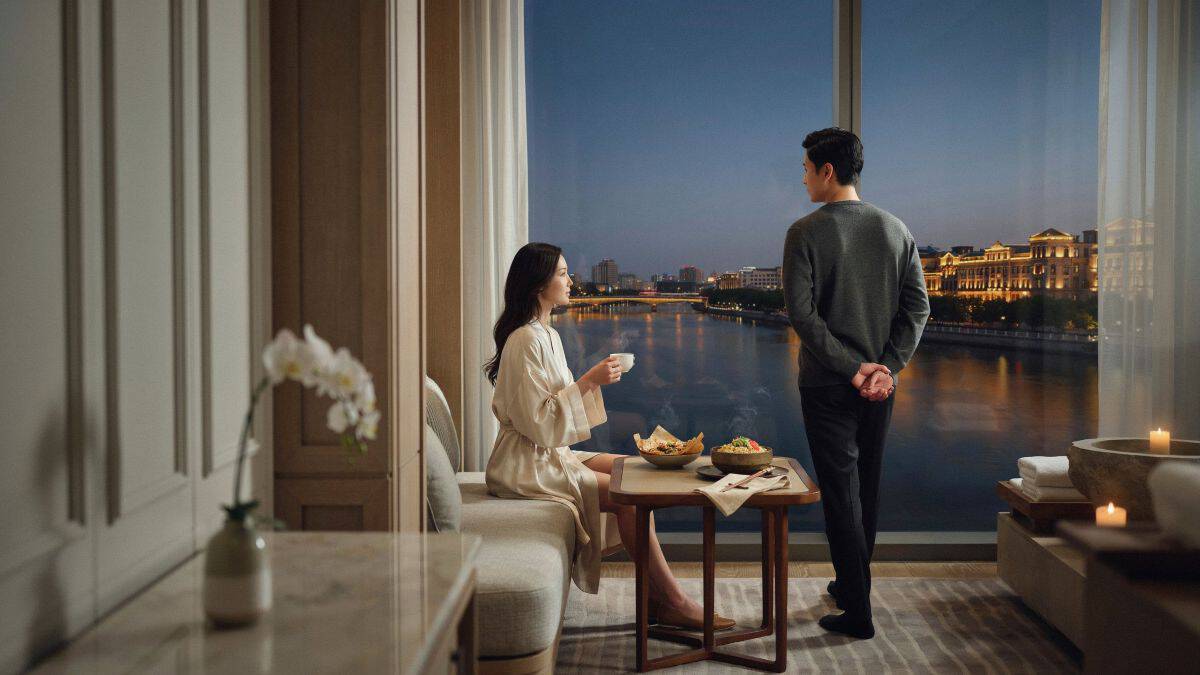
Image generated with Ai
Four Seasons Hotel Tianjin is promoting a different kind of travel where guests can experience heritage, food, river views, and wellness. Even though Tianjin is only 30 minutes away from Beijing by high-speed train, it still offers its visitors a different pace. Guests can walk along the Haihe River and cycle through the old neighborhoods where they can also experience a Tianjin breakfast. Of course, guests can always take spa treatments or have some quiet dining and river views back at the hotel. This new campaign is about turning an ordinary hotel stay into a wider cultural journey. Also, as an easily accessible secondary destination, Tianjin is now a great destination for visitors traveling to northern China.
The campaign does not announce a new hotel, renovation or package. It presents Four Seasons Hotel Tianjin as a base for travellers who want to experience the city without following a packed sightseeing schedule.
Advertisement
The hotel opened in January 2017. It stands at 138 Chifeng Road in Heping District, close to Nanjing Road, Binjiang Avenue and several historic neighbourhoods.
According to information supplied by Four Seasons, the property has:
Advertisement
The hotel says its rooms use wooden furnishings and light-coloured fabrics to create a calm setting. The accommodation occupies upper floors, allowing guests to look across Tianjin’s central business district.
Its position also reduces the need for long transfers between the hotel and several central attractions. Travellers can build a flexible route around architecture, food and the river rather than moving quickly between distant landmarks.
The former residence of Zhang Xueliang sits close to the hotel on Chifeng Road. The historic property is associated with a major military and political figure in modern Chinese history.
The building gives visitors a view of the social and architectural changes that shaped Tianjin during the early twentieth century. Preserved furniture and period details add context to the residence.
The nearby Porcelain House offers a sharp visual contrast. Ceramic fragments, porcelain pieces, stone carvings and decorative objects cover much of the building.
This unusual attraction combines a European-style property with Chinese decorative materials. Its colourful exterior has made it one of central Tianjin’s most recognisable visitor sites.
The Five Great Avenues, also called Wudadao, forms one of the most important parts of the suggested slow travel route. Travellers can explore the district on foot, by bicycle or through locally available carriage tours.
China’s government-backed tourism portal states that the district covers more than 600,000 square metres. It contains more than 2,000 houses displaying architectural influences from Britain, France, Italy, Germany and Spain.
More than 300 properties have connections with former politicians, business figures and other prominent residents. The district’s five principal roads take their names from the Chinese cities of Changde, Chongqing, Dali, Munan and Machang.
The area includes Minyuan Plaza, tree-lined roads, historic villas and several former residences. Its scale rewards travellers who slow down and notice individual doors, roofs, gardens and stone details.
Government tourism information describes Wudadao as Tianjin’s most completely preserved Western-style residential area. It was also among the first group of historic and cultural blocks recognised jointly by China’s Ministry of Housing and Urban-Rural Development and the national cultural heritage authorities.
Visitors can read more through the official government tourism profile of the Five Great Avenues.
The Haihe River runs through Tianjin and connects historic districts with modern commercial areas. Government tourism information describes it as the city’s mother river.
A walk along the waterfront lets visitors see public squares, bridges, residential neighbourhoods and towers without following a fixed tour. The central stretch links attractions such as Jinwan Square and the Tianjin Eye.
Evening boat services provide another view. Illuminated bridges and riverside buildings create a strong contrast between Tianjin’s trading history and its modern skyline.
Cruise times may change with the weather and season. Travellers should therefore confirm operating schedules and boarding locations before visiting.
The wider government tourism guide to Tianjin lists the Haihe River, Huangyaguan Great Wall and Ancient Culture Street among the municipality’s principal attractions.
Food forms a central part of the hotel’s five-senses campaign. At Cielo, the hotel promotes two dishes closely associated with everyday life in Tianjin.
Jianbing guozi combines a thin mung-bean crêpe with egg, sauce and a crisp fried cracker. Vendors prepare it quickly, but its mix of soft, crisp and savoury elements gives the dish a strong local identity.
Guoba cai uses sliced crêpe pieces served in a warm savoury sauce. Sesame paste and fermented tofu commonly add richness and depth.
Later in the day, Jin House serves Cantonese, Tianjin and regional dishes. The restaurant uses seasonal ingredients and offers dim sum, roasted meats, seafood and soups.
This dining strategy matters because it keeps local flavour inside the hotel experience. Visitors do not have to choose between an international luxury property and a meaningful introduction to Tianjin’s food culture.
The hotel’s L’Océan Spa has 11 treatment rooms, including spaces designed for couples. Its facilities also include relaxation areas, saunas, steam rooms and changing rooms.
The promoted Balinese massage uses warmed aromatherapy oils, long strokes and stretching movements. The hotel offers 60-minute and 90-minute versions, although prices and availability should be confirmed before booking.
Guests can also use the 25-metre indoor pool. Large windows and natural light connect the leisure area with the surrounding city.
These facilities support the wider slow travel theme. Rest becomes part of the itinerary instead of something left until every attraction has been visited.
High-speed trains connect Beijing and Tianjin, with some journeys taking about 30 minutes. Actual travel times depend on the service, departure station and arrival station.
Visitors should use the official China Railway 12306 website to check schedules, fares, identity-document requirements and ticket availability. Advance booking may be useful during weekends and public holidays.
The short rail journey gives Tianjin an important tourism advantage. International visitors can add the city to a Beijing holiday without taking another flight or making a long overland transfer.
Tianjin forms part of China’s expanded 240-hour visa-free transit programme. Eligible travellers can remain within approved areas for up to ten days when travelling from one country or region to a third destination.
China expanded the programme to citizens of 57 countries in August 2026. Travellers must still meet conditions involving nationality, entry points, travel documents and confirmed onward journeys.
The policy does not provide unrestricted visa-free entry for every visitor. Passengers should check the latest requirements before travelling and should not rely solely on airline or booking-site summaries.
The State Council of China’s visa-policy update provides authoritative information about recent changes.
The campaign gives Tianjin a clear role beside Beijing. It presents the city as a cultural extension of a northern China holiday rather than a competing stop filled with rushed sightseeing.
This approach also responds to rising demand for food, neighbourhood walks, wellness and experiences connected with everyday life. These elements can encourage longer stays and spread visitor spending across restaurants, attractions, transport providers and local businesses.
Chinese authorities are developing Tianjin as one of five international consumption centre cities, alongside Beijing, Shanghai, Guangzhou and Chongqing. Government reporting shows that foreign arrivals across these cities doubled in 2024 compared with the previous year.
More information about this development appears in the Chinese government report on inbound tourism and visitor spending.
Four Seasons Hotel Tianjin integrates local culture to allow guests to experience luxury travel activities that Beijing and Shanghai cannot. Guests can visit historic homes, go on bike rides through the Five Great Avenues, watch the lights of Tianjin sparkle along the Haihe River, and enjoy local breakfasts. After a restful night’s sleep, guests can enjoy a spa treatment followed by relaxation in a peaceful, quiet room. The train from Beijing is ideal for those looking for a quick getaway or an extension to their northern China trip. The New Transit Policy may also allow some international visitors who previously unqualified to participate in the campaign. The campaign is based off a strong premise that Tianjin offers travelers something unique and rewards those who stop to experience its streets, flavor, and river.
Advertisement
Advertisement
Advertisement












Wednesday, September 2, 2026

Tuesday, September 1, 2026

Wednesday, September 2, 2026

Wednesday, September 2, 2026

Tuesday, September 1, 2026

Tuesday, September 1, 2026

Tuesday, September 1, 2026

Tuesday, September 1, 2026



