
How Will Supersonic Travel Transform Aviation? Boom Supersonic’s Groundbreaking Flight Set to Redefine Journeys from New York to London and Beyond

Published
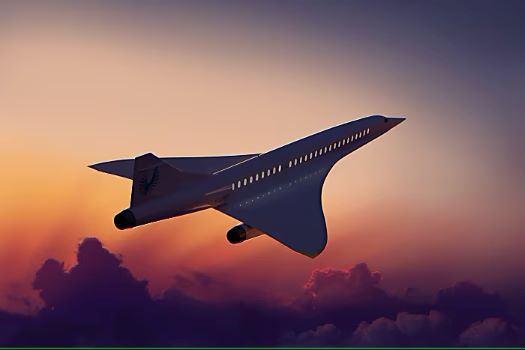 Image generated with Ai
Boom Supersonic has made a groundbreaking achievement in the field of aviation with the successful first supersonic flight of its XB-1 demonstrator aircraft at the Mojave Air & Space Port in California. This momentous flight marked a significant milestone in the development of the world’s fastest airliner, Overture. Historically, supersonic flight had been limited to military projects or large government-backed programs. However, Boom has changed that narrative by developing the first independently created civil supersonic jet, XB-1, which achieved speeds of Mach 1.122, surpassing the speed of sound for the first time in its history.
The Flight and the Aircraft’s Achievements
The XB-1 test flight was led by Chief Test Pilot Tristan “Geppetto” Brandenburg. The aircraft ascended to an altitude of 35,290 feet and achieved supersonic speeds, reaching an incredible 750 mph. This flight was notable not only for its speed but also for the innovative technology used in the aircraft’s design. The XB-1 is a direct precursor to Overture, the supersonic airliner currently under development by Boom Supersonic. Both aircraft share key technologies such as carbon fiber composites, digital stability augmentation, and an advanced augmented reality vision system for landing visibility.
Boom’s XB-1 flight took place in Mojave, CA, the same location where Chuck Yeager broke the sound barrier in 1947, cementing the historic nature of this achievement. With its success, XB-1 has demonstrated that the technology needed to enable commercial supersonic travel is already here. It validates the path forward for Overture, which is designed to carry passengers at speeds up to Mach 1.7—about twice the speed of current commercial airliners.
Advertisement
Advertisement
Technology Paving the Way for Future Air Travel
One of the most significant outcomes of the XB-1 flight is its validation of several technologies that will be incorporated into Overture. These technologies are vital for the development of a commercially viable supersonic airliner. Key innovations include:
Advertisement
Advertisement
- Augmented Reality Vision System: This system helps pilots navigate during takeoff and landing, even with a high angle of attack and a long nose that can obstruct runway visibility. This technology ensures that pilots have clear sightlines, improving safety and efficiency.
- Digitally Optimized Aerodynamics: Computational fluid dynamics (CFD) simulations have been used extensively to refine the aircraft’s design, enabling a combination of safety and efficiency during both supersonic flight and landing.
- Carbon Fiber Composites: Both XB-1 and Overture are primarily made from carbon fiber composites, offering a lightweight yet strong structure to enhance aerodynamics and durability.
- Supersonic Intakes: These specialized intakes convert the aircraft’s kinetic energy into pressure energy, allowing the engines to maintain efficient operation while flying at supersonic speeds.
The successful flight of XB-1 demonstrates that these technologies are ready for the next stage of development and sets the stage for the highly anticipated Overture supersonic airliner.
The Future of Supersonic Travel
Boom Supersonic’s ultimate goal is to make supersonic travel accessible to passengers on a global scale. Overture, the airliner derived from the XB-1 prototype, will carry 64 to 80 passengers and fly at speeds of Mach 1.7, significantly reducing flight times. For example, a flight from New York to London, which typically takes around 7 hours, could be completed in just 3.5 hours on Overture.
The demand for faster travel, particularly for business and leisure passengers, is expected to grow. The success of XB-1’s supersonic flight has already generated considerable interest from major airlines. For instance, American Airlines, United Airlines, and Japan Airlines have already placed orders for the Overture aircraft, with 130 orders and pre-orders already secured.
Impact on the Global Travel Industry
The introduction of commercial supersonic flight is poised to revolutionize air travel on a global scale. Once operational, Overture will have a significant impact on both the aviation industry and travel as a whole. This new generation of aircraft will not only cut down travel time but also create a new wave of demand for luxury, time-efficient air travel.
Advertisement
Advertisement
The ability to fly faster and more efficiently will have a ripple effect on the entire travel ecosystem. More passengers will be attracted to the time-saving aspect of supersonic travel, especially for long-haul flights, opening up new market opportunities for airlines. Moreover, the push towards sustainable aviation fuel (SAF) for supersonic aircraft will encourage the industry to further invest in cleaner and more eco-friendly technologies.
The Road Ahead for Boom Supersonic
Boom Supersonic has already made significant strides in the development of Overture, with a dedicated focus on optimizing speed, safety, and sustainability. The Overture program has garnered attention from a range of stakeholders, including key airline partners and government organizations, eager to explore the future of high-speed travel.
Boom’s commitment to sustainability is evident in its development of the Symphony engine, which is designed to run on up to 100% SAF, significantly reducing carbon emissions and aligning with the aviation industry’s sustainability goals. The company also recently completed construction of the Overture Superfactory in Greensboro, North Carolina, which will have the capacity to produce 66 Overture aircraft annually.
The successful first supersonic flight of XB-1 is just the beginning of a new era in air travel. With Overture, Boom Supersonic is poised to bring the benefits of supersonic travel to passengers worldwide. As the demand for faster, more efficient travel grows, Overture represents a major step forward in the evolution of aviation. The global travel industry will undoubtedly feel the impact of this innovation, as it promises to change the way people think about flying—making it faster, more efficient, and more accessible than ever before.
Advertisement
