
Australia Travel Watch as Cape Kimberley Planned Burn Puts Daintree Trips from Cairns and Port Douglas in Focus

Published
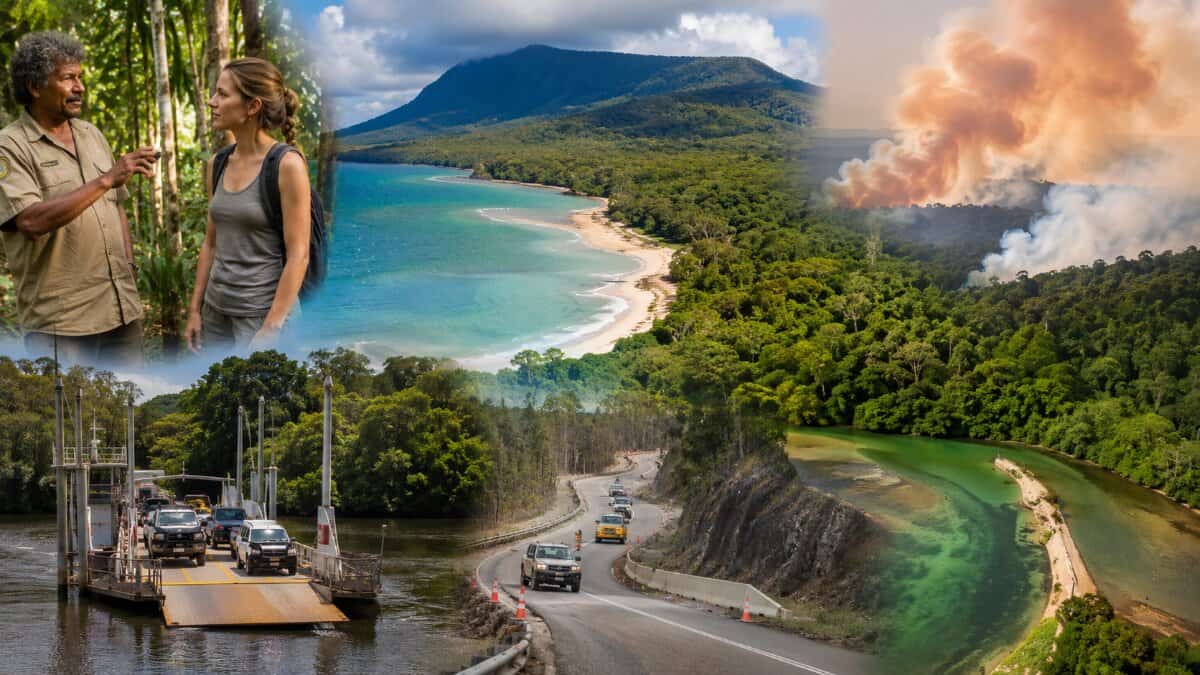
Queensland authorities have scheduled a planned burn at Cape Kimberley in Daintree National Park for 12 August, subject to weather, while the wider park alert applies from 12 to 14 August. Crucially, the official notice does not identify a blanket three-day Daintree closure. The bigger travel-industry story is the emerging need for dynamic itinerary management: fire operations now intersect with Indigenous joint management, the Daintree River ferry, continuing access infrastructure works and a road network still being strengthened after severe cyclone damage.
Cape Kimberley Burn Reveals a New Risk Calendar for Daintree Tourism
The most important development for travel businesses is not simply that a planned burn is taking place. It is that the Daintree tourism calendar increasingly needs to incorporate land-management operations as live operational variables, alongside weather, road conditions, ferry availability and rainforest access.
Advertisement
Advertisement
According to the Queensland Parks and Wildlife Service, planned burning operations apply to the Cape Kimberley area of Daintree National Park, Cape York Peninsula Aboriginal Land, from 12 to 14 August 2026. Queensland Fire Department separately lists the operational burn for 12 August, weather permitting, with Queensland Parks and Wildlife Service identified as the responsible agency.
The distinction matters. As of 11 August, the official Queensland park-alert register categorises Cape Kimberley as a planned burning operation, rather than using the temporary road closure or temporary track closure terminology attached to some other Queensland burn alerts. That means travel sellers should not describe the entire Daintree National Park as closed unless authorities subsequently impose an access restriction.
Advertisement
Advertisement
The specific Cape Kimberley notice also indicates that most fire activity is expected to diminish during the evening, while residual activity could remain and smoke may be visible for two to three days. That aligns the tourism-relevant disruption horizon more closely with visibility, air quality and local access conditions than with the active ignition period alone.
What Travellers Actually Need to Know
| Operational factor | Verified position as of 11 August 2026 | Travel-industry implication |
|---|---|---|
| Cape Kimberley burn | Scheduled for 12 August, weather permitting | Timing may move if conditions become unsuitable |
| Park alert period | 12–14 August | Operators should monitor conditions beyond ignition day |
| Responsible agency | Queensland Parks and Wildlife Service | Official Parks alerts remain the principal access reference |
| Smoke | May remain visible for two to three days | Scenic touring, photography and road visibility may be affected |
| Blanket Daintree closure | Not stated in the current alert listing | Avoid automatically cancelling wider Daintree itineraries |
| Daintree River ferry | Normal park guidance identifies operating hours of 5am to midnight | Tour timings remain dependent on the river crossing |
| Road environment | Narrow, winding roads and changing conditions apply within Cape Tribulation section | Additional contingency time remains prudent |
| Mobile reception | Limited across much of the Cape Tribulation section | Operators should not rely solely on mobile alerts once guests enter remote areas |
Queensland Parks advises that Daintree National Park lies roughly 80km to 150km north of Cairns, with its two principal sections at Mossman Gorge and Cape Tribulation. Access towards Cape Tribulation normally involves the Daintree River ferry, while mobile reception becomes limited in parts of the northern section.
Advertisement
Advertisement
Why This Is an Indigenous Tourism Governance Story, Not Merely a Fire Notice
Cape Kimberley sits inside a protected landscape where tourism management cannot be separated from Traditional Owner governance.
The Eastern Kuku Yalanji people are the Traditional Owners of Daintree National Park CYPAL. According to Queensland Parks, the park is jointly managed by the Jabalbina Yalanji Aboriginal Corporation and Queensland Parks and Wildlife Service through an Indigenous Management Agreement and related land-management arrangements.
Queensland’s broader CYPAL framework makes the implications particularly important for tourism. Traditional Owners and the State jointly develop resource and visitor-management arrangements, while day-to-day responsibilities can extend across fire management, permits, visitor presentation, facilities, pest management and protected-area operations.
Fire therefore sits within the same governance architecture that determines how visitors encounter Country.
Queensland Parks’ current First Nations fire-management guidance goes further. In formally jointly managed areas, decisions concerning when, where and how planned burns are conducted are made with Traditional Owner involvement to address environmental, cultural and community objectives. More than 2.5 million hectares of Queensland protected land are under formal joint-management arrangements.
There is, however, an important accuracy requirement for travel publishers.
Advertisement
Advertisement
This Specific Operation Should Not Automatically Be Called a Cultural Burn
The Cape Kimberley notice identifies the activity as planned burning operations. It does not classify the 12 August operation as a cultural burn.
That distinction should be preserved.
Queensland Parks treats cultural burning as one form of planned burning, but planned burns can also address ecological objectives, fuel management and other protected-area purposes. Labelling every burn occurring on jointly managed Country as a cultural burn risks simplifying both Indigenous fire knowledge and statutory park management.
For the travel industry, that precision is increasingly important because international demand for authentic Indigenous experiences is growing. Tourism Australia reports that close to 1.25 million international trips included an Indigenous experience in the year ending March 2026, up 6.7 per cent year on year.
The stronger tourism story is therefore not that visitors are witnessing Indigenous burning. It is that they are travelling through a landscape where Traditional Owner governance actively influences how environmental protection, visitor access and long-term destination resilience are managed.
Daintree Fire Management Protects an Exceptionally Ancient Tourism Asset
The conservation stakes are unusually high.
Advertisement
Advertisement
The Wet Tropics Management Authority identifies the Wet Tropics as containing some of the oldest continuously surviving tropical rainforests on Earth. Daintree National Park forms part of the roughly 900,000-hectare Wet Tropics World Heritage Area, which extends approximately 450 kilometres between Cooktown and Townsville.
Fire management in this environment is not simply about increasing or decreasing burning.
The Wet Tropics Management Authority identifies altered fire regimes as a conservation threat. Rainforest edges damaged repeatedly by fire can require active restoration, while Rainforest Aboriginal people have managed parts of this landscape using fire knowledge over thousands of years.
This creates a sophisticated management problem. Appropriate fire can help manage particular vegetation communities and reduce damaging fire behaviour, while inappropriate or repeated fire penetration can threaten sensitive rainforest ecosystems.
For tourism businesses selling Daintree as an ancient, nature-led destination, prescribed access management should therefore be understood as part of the product’s long-term protection rather than automatically framed as lost visitor capacity.
Ferry Construction Makes the August Burn More Relevant to Tour Operators
The timing becomes more interesting when Cape Kimberley is viewed against the Daintree’s wider infrastructure programme.
Advertisement
Advertisement
Douglas Shire Council confirms that the Daintree Ferry Replacement and Landside Infrastructure Projects are progressing during 2026, alongside continued road and recovery activity following severe damage caused by Tropical Cyclone Jasper in December 2023.
An August 2026 council update states that excavation around the ferry project is approaching completion, rock placement is under way on the northern side, culvert replacement continues and temporary single-lane traffic management remains possible where required.
That creates an important operational overlap.
Cape Kimberley lies immediately within the northern Daintree travel corridor. Earlier council recovery programmes also included Cape Kimberley Road and Milky Pine Road among unsealed roads targeted for repair north of the Daintree River, within a Douglas Shire repair package exceeding A$7 million.
Travel operators therefore need to think in layers. A planned burn may not close the whole destination, but a smoke event combined with ferry works, traffic control, weather or another road incident can reduce schedule resilience significantly.
Daintree Access Resilience Is Becoming Part of the Tourism Product
| Current structural issue | Official evidence | Strategic consequence |
|---|---|---|
| Planned burns | Cape Kimberley operation scheduled for 12 August | Land-management calendars need integration into itineraries |
| Ferry dependence | Main Cape Tribulation access crosses Daintree River | One transport node influences a large tourism corridor |
| Ferry redevelopment | Active landside works during August 2026 | Operators need additional timing flexibility |
| Post-cyclone recovery | Jasper damaged Cape Tribulation and Bloomfield access routes | Infrastructure resilience remains a tourism competitiveness issue |
| Indigenous joint management | Eastern Kuku Yalanji involvement covers visitor and fire management | Destination stewardship extends beyond conventional park administration |
| Limited connectivity | Mobile coverage is restricted in northern areas | Pre-departure operational checks become more important |
| Seasonal conditions | Daintree experiences very high rainfall and rapidly changing roads | Dynamic itinerary management remains necessary year-round |
This is the larger information gain from the Cape Kimberley alert: Daintree tourism is moving towards a dynamic-access operating model rather than a fixed-access attraction model.
Advertisement
Advertisement
Cairns and Port Douglas Gateways Have More at Stake as Queensland Tourism Grows
That operational reliability matters because the broader Queensland visitor economy is expanding.
Tourism Research Australia’s latest State and Regional Tourism Satellite Accounts, released on 28 July 2026, place Queensland tourism consumption at A$49 billion in 2024–25, up 3.9 per cent. Tourism consumption across Queensland’s regional areas increased by 4.8 per cent, faster than the combined Brisbane and Gold Coast result of 3.3 per cent.
Queensland generated A$19.2 billion in direct tourism gross state product, while direct tourism filled jobs reached approximately 161,000, up 4.6 per cent.
More recent Tourism and Events Queensland data show A$37.3 billion in domestic visitor expenditure during the year ending March 2026. Queensland received 26.1 million domestic overnight visitors, although overnight expenditure fell 3.9 per cent to A$27.4 billion.
| Queensland tourism indicator | Latest official result | Change |
|---|---|---|
| Tourism consumption 2024–25 | A$49.0bn | +3.9% |
| Regional tourism consumption growth | — | +4.8% |
| Direct tourism GSP | A$19.2bn | +3.5% |
| Direct tourism filled jobs | 161,000 | +4.6% |
| Domestic visitor expenditure, YE March 2026 | A$37.3bn | +7.3% |
| Domestic overnight visitors | 26.1m | +2.4% |
| Overnight visitor expenditure | A$27.4bn | -3.9% |
| Holiday overnight expenditure | A$15.3bn | 26% of Australian total |
These are statewide rather than Daintree-specific figures, but they demonstrate why small operational disruptions matter commercially. Visitor numbers can remain healthy even while spend per overnight traveller tightens. In such conditions, avoidable cancellations, missed excursions or inefficient transfers can carry greater consequences for regional operators.
Cairns remains the principal aviation gateway for much of Tropical North Queensland, while Port Douglas functions as a major accommodation and touring base for trips towards Mossman, the Daintree River and Cape Tribulation. Queensland Parks itself lists supplies in Cairns, Port Douglas, Mossman and Cape Tribulation when providing Daintree travel guidance.
Advertisement
Advertisement
Gateway investment is also continuing. Cairns Airport’s first A$60 million phase of its Eastern Aviation Precinct is scheduled to deliver four new aeronautical stands in 2027, increasing capacity for aircraft operations and future passenger growth.
That growth strengthens the case for equally resilient visitor dispersal beyond the airport.
What Travel Agents and Tour Operators Should Do Now
- Check the Cape Kimberley park alert immediately before departure on 12–14 August. Do not assume the burn will proceed exactly as scheduled because the operation remains weather dependent.
- Do not market the current alert as a three-day Daintree closure. Official material presently identifies planned burning operations rather than a blanket shutdown.
- Build additional transfer time into Daintree excursions. Ferry infrastructure works and temporary single-lane traffic management can interact with normal visitor movements.
- Warn self-drive customers about possible smoke and reduced visibility. Queensland Fire Department advises motorists to drive according to conditions when smoke affects roads.
- Download access information before entering the northern Daintree. Mobile reception is limited across parts of the Cape Tribulation section.
- Use precise Indigenous tourism terminology. Daintree is Eastern Kuku Yalanji Country and jointly managed, but the current Cape Kimberley announcement does not identify the operation specifically as a cultural burn.
- Maintain substitution plans rather than cancelling an entire regional itinerary. Cairns, Port Douglas, Mossman Gorge and other experiences can remain viable when a localised operational alert affects one part of the wider destination.
Cape Kimberley Signals the Future of Rainforest Tourism Management
Cape Kimberley’s August operation is a relatively small land-management event, but it reveals a much larger direction for nature tourism. The future of high-value protected-area tourism will increasingly depend on operators understanding that conservation, Indigenous governance, infrastructure resilience and visitor access are not separate systems. In Daintree National Park they increasingly function together.
For travellers, that may occasionally mean altered routes, smoke, delayed access or short-notice itinerary changes. For the industry, however, the alternative is more damaging: treating environmental management as an interruption rather than as infrastructure protecting the destination itself. The Daintree’s competitive advantage is precisely what makes its management complicated. It combines ancient rainforest, extraordinary biodiversity, Eastern Kuku Yalanji Country, World Heritage values and a geographically constrained visitor corridor north of Cairns and Port Douglas.
Cape Kimberley’s 12 August planned burn therefore deserves attention beyond a routine park alert. It offers a practical preview of regenerative tourism operations in which access becomes adaptive, Traditional Owner governance becomes increasingly visible, and destination resilience becomes part of the visitor product itself.
Advertisement
