
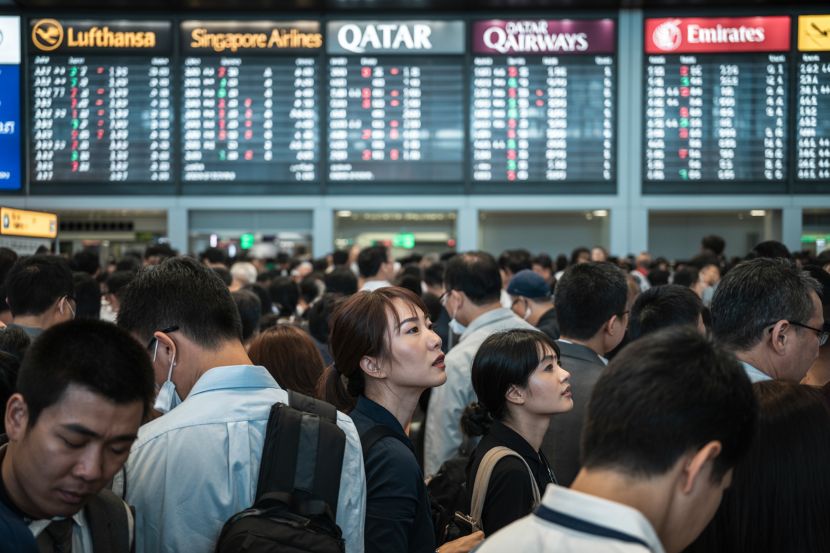
Image generated with Ai
In Beijing and across China, travellers struggled to keep to their plans this week as flight schedules buckled under pressure at major airports, with total delays exceeding 3,200 and 37 cancellations recorded between the country’s busiest civil aviation hubs. From Beijing Capital and Daxing International Airports to high‑traffic gateways in Shanghai, Xi’an, Urumqi and Haikou, passengers recounted long waits, sudden itinerary changes and mounting frustration at the lack of timely updates.
At Beijing Capital International — one of the busiest aerodromes nationwide — more than 240 flights were held up, forcing families and business travellers alike to navigate airport lounges for hours. Similar scenes unfolded in Shanghai’s Pudong and Hongqiao terminals, where combined delays surpassed 770 flights, despite meticulous scheduling efforts by airlines and airport authorities. This widespread travel disruption, confirmed by internal airline logs and tracking services, has sparked debate over the operational resilience of China’s civil aviation network in peak movement periods.
Advertisement
Detailed figures from air traffic operation feeds and airline reports show a pattern of stress across mainland hubs:
Middle‑tier but busy airports such as Nanjing Lukou (176 delays), Haikou Meilan (163), Xiamen Gaoqi (137) and Lanzhou Zhongchuan (128) collectively contributed to the national tally. Even airports not traditionally among the largest — Changchun Longjia and Nanchang Changbei — recorded persistent delays. While cancellations were numerically modest, their impact on itineraries at regional gateways was disproportionately disruptive.
Advertisement
Advertisement
This widespread effect on flight operations underscores the interconnected nature of China’s sky network: congestion or weather complications at one node can cascade through scheduling chains, amplifying delays far beyond isolated terminals.
The Civil Aviation Administration of China (CAAC), the regulatory body overseeing airlines, airports and airspace safety, stipulates robust delay and cancellation reporting protocols for carriers and airport operators. These rules require carriers to broadcast departure disruptions and reasons promptly to passengers, and for air traffic control and ground agents to provide coordinated updates.
Despite these frameworks, travellers on social media and travel forums have reported inconsistent information flows, leaving many uncertain about their flight status well into boarding windows. In response, industry spokespeople emphasised that enhanced communication lines between airlines, airports and passengers are being prioritised to prevent confusion and improve real‑time updates. They also acknowledged that peaking travel seasons and scheduling overlaps at multi‑airport metropolitan clusters, such as Beijing and Shanghai, complicate punctuality outcomes.
Analysts note that beyond scheduling density, environmental and systemic factors contribute to operational performance. Winter months in northern and western regions may bring fog or strong winds that reduce runway throughput, while peak holiday travel surges test ground handling and air traffic flow coordination. Historical aviation research within China has shown that flight delays have long been a source of passenger complaints, reflecting broader challenges of managing rapid demand growth across civil air transport networks.
Air traffic controllers and scheduling planners, for their part, seek to balance safety with flow — a complex task when meteorological variability, passenger volume peaks and aircraft rotations intersect. “Ensuring flight regularity is not just about departure times,” said an aviation operations expert. “It’s about synchronising runway capacity, crew availability and traffic control with real‑time conditions in a way that minimises ripple effects.”
For frequent flyer Ming Zhao, whose extended family planned an annual reunion in Xi’an, the extended delay at Xi’an Xianyang International Airport proved exasperating. “We arrived early with all our tickets ready,” he said, “but the delay pushed our dinner plans into the next day and left my elderly parents exhausted.” Similar accounts emerged from travellers diverted to nearby cities, forced to navigate public transport systems after missed connections.
Travel bloggers and video commentators also highlighted the unpredictability passengers faced, often waiting for hours with little information beyond generic “weather” or “air traffic” advisories. These stories have amplified public calls for better digital communication tools and more transparent operational dashboards that allow travellers to anticipate changes well before arrival at airports.
Industry insiders suggest that the current disruptions may prompt strategic reviews of slot allocations, runway utilisation and inter‑airport coordination, especially in mega urban clusters where capacity strains are perennial. “China’s aviation growth has been phenomenal, but with that comes the hard work of matching schedule ambition with everyday reliability,” said a civil aviation planner. Progress is expected in phased improvements to air traffic flow systems and scheduled buffer enhancements that reduce knock‑on delays.
Experts point to other global aviation networks where integrated scheduling models have reduced airport congestion and departure delays — lessons potentially applicable to China’s complex multi‑airport ecosystems. Improved collaboration between carriers and regulatory agencies will be paramount in smoothing future operations and restoring passenger confidence.
For all the technical figures and industry strategies, the story ultimately centres on people — families meeting after long separations, business travellers racing against time and young adventurers eager to explore China’s vast landscapes. These personal journeys, disrupted but not derailed, illustrate both the fragility and resilience of modern travel. As China’s aviation system evolves, many passengers express hope that skies will be less turbulent and journeys more predictable — not just in data points but in the lived experience of every traveller who passes through a bustling terminal.
Source: Flightaware
Advertisement
Tags: airline disruption, Beijing airport delays, CAAC flight stats, China Aviation, Civil Aviation Administration of China
Advertisement
Advertisement













Saturday, September 5, 2026

Saturday, September 5, 2026

Saturday, September 5, 2026
Saturday, September 5, 2026

Saturday, September 5, 2026

Saturday, September 5, 2026

Saturday, September 5, 2026

Saturday, September 5, 2026



